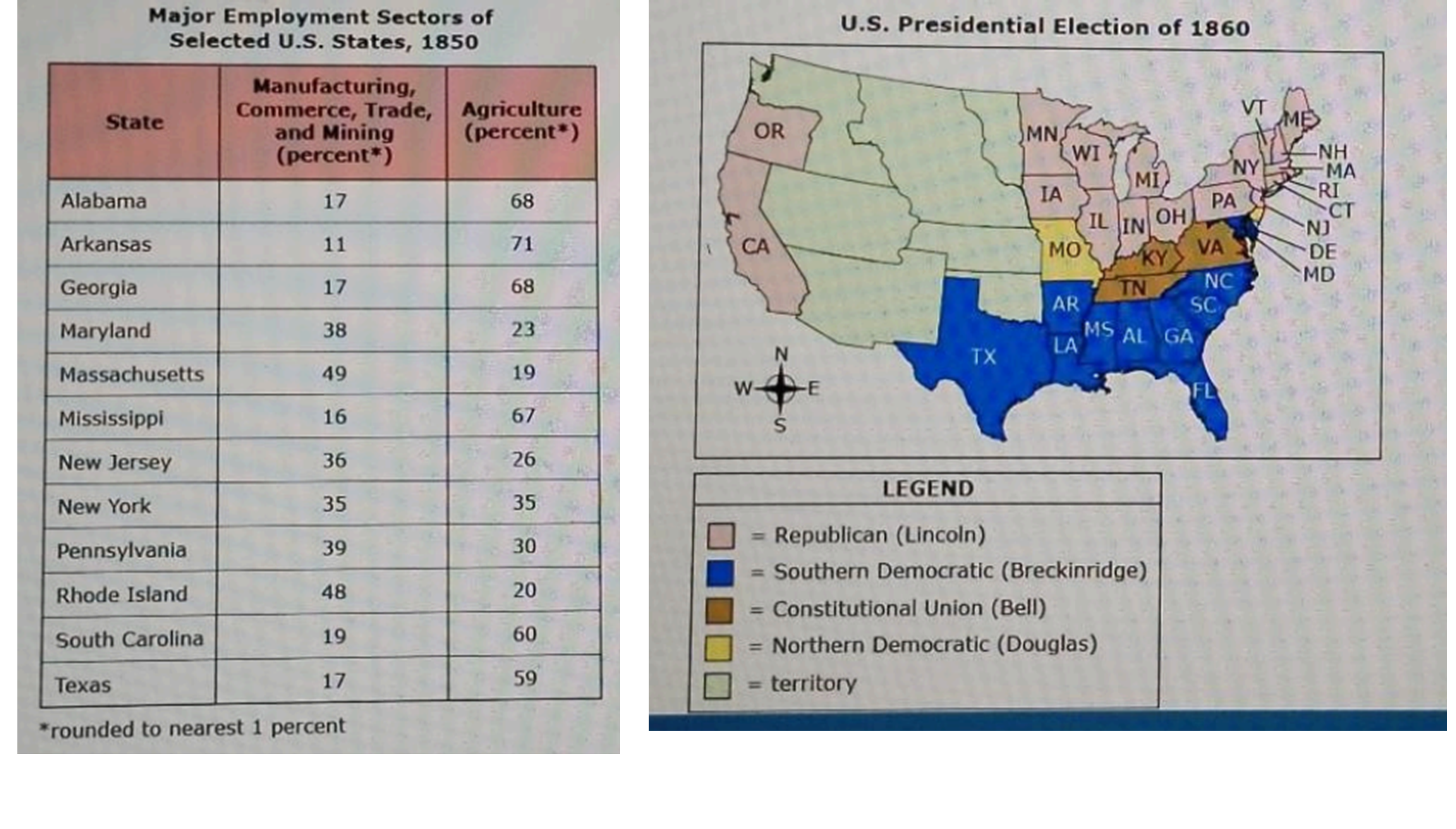
The information in the table is from the U.S. Census Bureau. The information in the map is from the Library of Congress.
Which statement is supported by both the table and the map?
- A. Differences in the total populations of the states led to political differences between the North and the South.
- B. Differences among the economies of the states contributed to political differences between the North and the South.
- C. Political differences between the North and the South reflected differences in education among the states.
- D. Political differences between the North and the South reflected differences in the standards of living in the states.
Correct Answer & Rationale
Correct Answer: B
Option B is supported by both the table and the map, as they illustrate how varying economic structures—such as agriculture in the South versus industrialization in the North—contributed to distinct political ideologies and policies. Option A incorrectly attributes political differences solely to population size, overlooking the economic factors at play. Option C suggests education differences as the main cause, which is not evident in the provided data. Option D implies that living standards were the primary influence, but the economic context is more directly linked to the political divide. Thus, B effectively encapsulates the relationship between economy and political differences.
Option B is supported by both the table and the map, as they illustrate how varying economic structures—such as agriculture in the South versus industrialization in the North—contributed to distinct political ideologies and policies. Option A incorrectly attributes political differences solely to population size, overlooking the economic factors at play. Option C suggests education differences as the main cause, which is not evident in the provided data. Option D implies that living standards were the primary influence, but the economic context is more directly linked to the political divide. Thus, B effectively encapsulates the relationship between economy and political differences.
Other Related Questions
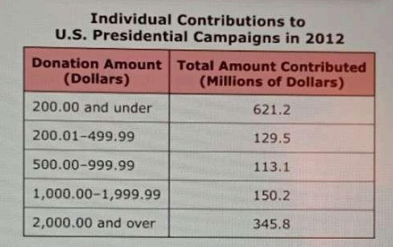
Which conclusion is best supported by information in the table and article?
- A. Individuals contributed a total amount of money equal to the total of all other sources of donations.
- B. Individuals contributing the smallest quantity of money insignificantly impact presidential campaigns.
- C. Individuals donated the greatest total amount although many contributions were relatively small.
- D. Individuals have more influence on the proposed policies of presidential candidates than groups do.
Correct Answer & Rationale
Correct Answer: C
Option C is supported by the data, indicating that while many individual contributions were small, they collectively formed the largest portion of total donations to presidential campaigns. This highlights the significant role individuals play despite the size of their contributions. Option A is incorrect as it suggests individuals’ contributions equaled all other sources, which is not supported by the data. Option B misrepresents the impact of smaller donations; even small contributions can collectively influence campaign funding significantly. Option D overstates individuals' influence on policy compared to groups, which often have more resources and organized lobbying power.
Option C is supported by the data, indicating that while many individual contributions were small, they collectively formed the largest portion of total donations to presidential campaigns. This highlights the significant role individuals play despite the size of their contributions. Option A is incorrect as it suggests individuals’ contributions equaled all other sources, which is not supported by the data. Option B misrepresents the impact of smaller donations; even small contributions can collectively influence campaign funding significantly. Option D overstates individuals' influence on policy compared to groups, which often have more resources and organized lobbying power.
Which statement from Common Sense provides evidence that the author Thomas Paine supported American independence?
- A. "Absolute governments have this advantage with them, that they are simple..."
- B. "I challenge the warmest advocate for reconciliation, to [show], a single advantage that this continent can reap, by being connected with Great Britain."
- C. "The prejudice of Englishmen, in [favor] of their own government arises as much or more from national pride than reason."
- D. "Society in every state is a blessing, but government even in its best state is but a necessary evil."
Correct Answer & Rationale
Correct Answer: B
Option B provides clear evidence of Thomas Paine's support for American independence by challenging the benefits of remaining connected to Great Britain. By asking advocates for reconciliation to demonstrate any advantages, Paine emphasizes the futility of such ties and advocates for autonomy. Option A discusses the simplicity of absolute governments, which does not directly address the question of American independence. Option C critiques English national pride but lacks a direct link to the argument for independence. Option D presents a philosophical view on government but does not specifically advocate for breaking away from British rule.
Option B provides clear evidence of Thomas Paine's support for American independence by challenging the benefits of remaining connected to Great Britain. By asking advocates for reconciliation to demonstrate any advantages, Paine emphasizes the futility of such ties and advocates for autonomy. Option A discusses the simplicity of absolute governments, which does not directly address the question of American independence. Option C critiques English national pride but lacks a direct link to the argument for independence. Option D presents a philosophical view on government but does not specifically advocate for breaking away from British rule.
Which statement from the passage is an opinion?
- A. "Even so, the success of Levittown depended not only on the efficiency of the Levitt brothers' process but also on the Federal Housing Administration" (paragraph 4)
- B. "Shortly after World War II, many changes led to the development of suburbs." (paragraph 1)
- C. "This, much of the baby-boom generation had well-constructed homes in which to grow up." (paragraph 4)
- D. "With this financing in place, more homes could be built and more veterans could afford to buy them." (paragraph 4)
Correct Answer & Rationale
Correct Answer: C
Option C expresses a subjective view about the quality of homes available to the baby-boom generation, indicating an opinion that these homes were "well-constructed." This characterization is not a factual statement and reflects a personal judgment. In contrast, Option A presents a factual statement about the factors contributing to Levittown's success, grounded in historical context. Option B provides a straightforward observation regarding the timeline of suburban development, without personal interpretation. Option D outlines a factual cause-and-effect relationship regarding financing and home construction, remaining objective. Thus, only Option C conveys a personal opinion.
Option C expresses a subjective view about the quality of homes available to the baby-boom generation, indicating an opinion that these homes were "well-constructed." This characterization is not a factual statement and reflects a personal judgment. In contrast, Option A presents a factual statement about the factors contributing to Levittown's success, grounded in historical context. Option B provides a straightforward observation regarding the timeline of suburban development, without personal interpretation. Option D outlines a factual cause-and-effect relationship regarding financing and home construction, remaining objective. Thus, only Option C conveys a personal opinion.
Which statement is based on the text?
- A. Individuals spend their income in factor markets.
- B. Entrepreneurs profit from participation in product markets.
- C. Individuals sell their labor in factor markets.
- D. Resources are traded in product markets.
Correct Answer & Rationale
Correct Answer: C
Option C accurately reflects the concept that individuals offer their labor in factor markets, where resources like labor are exchanged for wages. This aligns with economic principles regarding labor supply. Option A is incorrect since individuals do not spend income in factor markets; rather, they purchase goods and services in product markets. Option B misrepresents the role of entrepreneurs, who primarily earn profits through innovation and sales in product markets, not simply from participation. Option D is also misleading, as resources are exchanged in factor markets, while product markets focus on the sale of finished goods and services.
Option C accurately reflects the concept that individuals offer their labor in factor markets, where resources like labor are exchanged for wages. This aligns with economic principles regarding labor supply. Option A is incorrect since individuals do not spend income in factor markets; rather, they purchase goods and services in product markets. Option B misrepresents the role of entrepreneurs, who primarily earn profits through innovation and sales in product markets, not simply from participation. Option D is also misleading, as resources are exchanged in factor markets, while product markets focus on the sale of finished goods and services.