Which event counters the viewpoint expressed in the newspaper excerpt that African Americans refused to defend their civil rights?
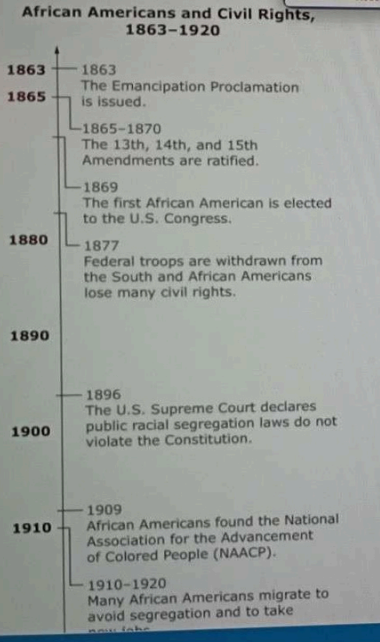
- A. the ratification of the 13th, 14th, and 15th Amendments
- B. the issuance of the Emancipation Proclamation
- C. the founding of the National Association for the Advancement of Colored People
- D. the start of the Great Migration
Correct Answer & Rationale
Correct Answer: C
The founding of the National Association for the Advancement of Colored People (NAACP) directly counters the viewpoint that African Americans refused to defend their civil rights. Established in 1909, the NAACP actively fought for civil rights through legal challenges, advocacy, and public education, demonstrating a strong commitment to defending their rights. Option A, the ratification of the 13th, 14th, and 15th Amendments, although significant, primarily established legal rights rather than showcasing active defense. Option B, the Emancipation Proclamation, ended slavery but did not directly address civil rights activism. Option D, the Great Migration, reflects a movement for better opportunities but does not specifically illustrate organized efforts to defend civil rights.
The founding of the National Association for the Advancement of Colored People (NAACP) directly counters the viewpoint that African Americans refused to defend their civil rights. Established in 1909, the NAACP actively fought for civil rights through legal challenges, advocacy, and public education, demonstrating a strong commitment to defending their rights. Option A, the ratification of the 13th, 14th, and 15th Amendments, although significant, primarily established legal rights rather than showcasing active defense. Option B, the Emancipation Proclamation, ended slavery but did not directly address civil rights activism. Option D, the Great Migration, reflects a movement for better opportunities but does not specifically illustrate organized efforts to defend civil rights.
Other Related Questions
Which statement is supported by both the table and the map?
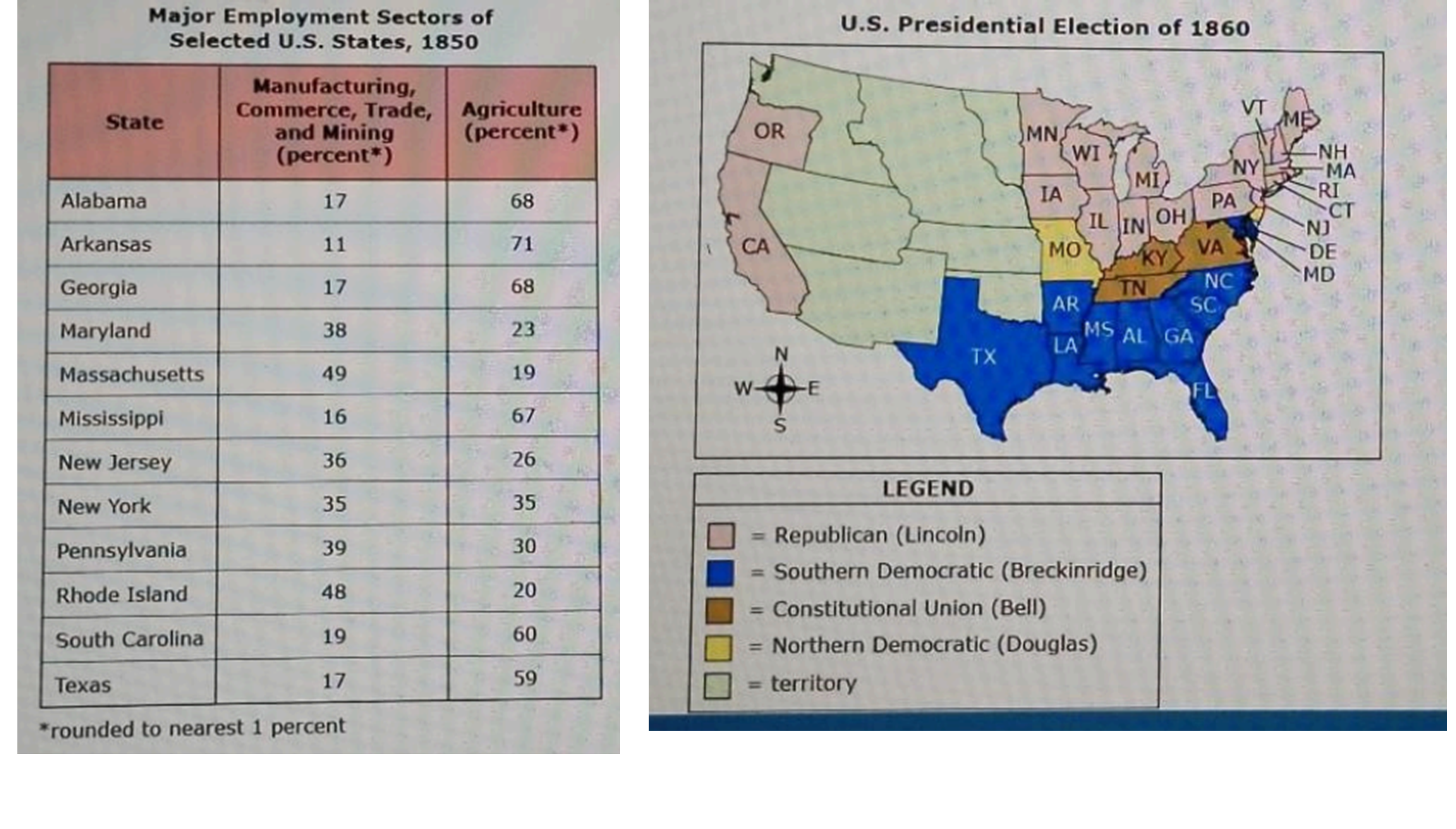
- A. Differences in the total populations of the states led to political differences between the North and the South.
- B. Differences among the economies of the states contributed to political differences between the North and the South.
- C. Political differences between the North and the South reflected differences in education among the states.
- D. Political differences between the North and the South reflected differences in the standards of living in the states.
Correct Answer & Rationale
Correct Answer: B
Option B is supported by both the table and the map, as they illustrate how varying economic structures—such as agriculture in the South versus industrialization in the North—contributed to distinct political ideologies and policies. Option A incorrectly attributes political differences solely to population size, overlooking the economic factors at play. Option C suggests education differences as the main cause, which is not evident in the provided data. Option D implies that living standards were the primary influence, but the economic context is more directly linked to the political divide. Thus, B effectively encapsulates the relationship between economy and political differences.
Option B is supported by both the table and the map, as they illustrate how varying economic structures—such as agriculture in the South versus industrialization in the North—contributed to distinct political ideologies and policies. Option A incorrectly attributes political differences solely to population size, overlooking the economic factors at play. Option C suggests education differences as the main cause, which is not evident in the provided data. Option D implies that living standards were the primary influence, but the economic context is more directly linked to the political divide. Thus, B effectively encapsulates the relationship between economy and political differences.
Based on the flowchart, how is a political party's presidential candidate selected?
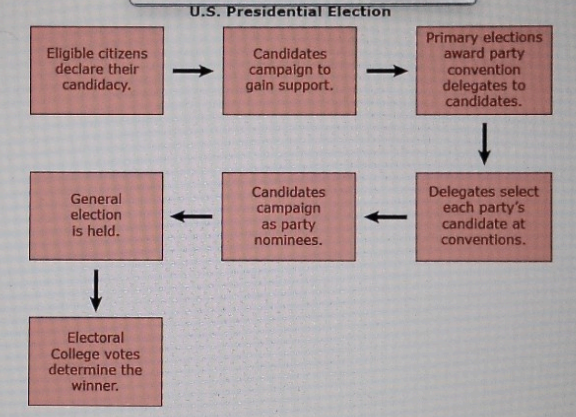
- A. by balloting after the general election
- B. by balloting at the party convention
- C. by votes cast in party primary elections
- D. by votes cast in the general election
Correct Answer & Rationale
Correct Answer: C
The selection of a political party's presidential candidate primarily occurs through votes cast in party primary elections. This process allows party members to express their preferences for candidates before the general election, ensuring that the nominee reflects the party's values and priorities. Option A is incorrect because the general election occurs after the candidate has already been chosen. Option B, while related to the convention, is misleading as the convention typically formalizes the candidate chosen in the primaries rather than selecting them. Option D is also incorrect, as the general election determines the overall winner, not the party's candidate.
The selection of a political party's presidential candidate primarily occurs through votes cast in party primary elections. This process allows party members to express their preferences for candidates before the general election, ensuring that the nominee reflects the party's values and priorities. Option A is incorrect because the general election occurs after the candidate has already been chosen. Option B, while related to the convention, is misleading as the convention typically formalizes the candidate chosen in the primaries rather than selecting them. Option D is also incorrect, as the general election determines the overall winner, not the party's candidate.
Which statement is based on the text?
- A. Individuals spend their income in factor markets.
- B. Entrepreneurs profit from participation in product markets.
- C. Individuals sell their labor in factor markets.
- D. Resources are traded in product markets.
Correct Answer & Rationale
Correct Answer: C
Option C accurately reflects the concept that individuals offer their labor in factor markets, where resources like labor are exchanged for wages. This aligns with economic principles regarding labor supply. Option A is incorrect since individuals do not spend income in factor markets; rather, they purchase goods and services in product markets. Option B misrepresents the role of entrepreneurs, who primarily earn profits through innovation and sales in product markets, not simply from participation. Option D is also misleading, as resources are exchanged in factor markets, while product markets focus on the sale of finished goods and services.
Option C accurately reflects the concept that individuals offer their labor in factor markets, where resources like labor are exchanged for wages. This aligns with economic principles regarding labor supply. Option A is incorrect since individuals do not spend income in factor markets; rather, they purchase goods and services in product markets. Option B misrepresents the role of entrepreneurs, who primarily earn profits through innovation and sales in product markets, not simply from participation. Option D is also misleading, as resources are exchanged in factor markets, while product markets focus on the sale of finished goods and services.
How did Chief Justice Marshall contribute to the U.S. government system of checks and balances?
- A. by establishing the Supreme Court's power to check Congress
- B. by creating the power to remove the president from office
- C. by expanding the president's power to check Congress
- D. by giving the Supreme Court the power to control itself
Correct Answer & Rationale
Correct Answer: A
Chief Justice Marshall played a pivotal role in defining the Supreme Court's authority, notably through the landmark case Marbury v. Madison, which established the principle of judicial review. This empowered the Court to invalidate laws passed by Congress that it deemed unconstitutional, effectively allowing it to check legislative power. Option B is incorrect as the power to remove a president lies with Congress through impeachment, not the Supreme Court. Option C misrepresents Marshall's contributions, as he did not expand presidential power but rather clarified judicial authority. Option D is also inaccurate; the Supreme Court does not have self-regulating powers but operates within the framework of checks and balances.
Chief Justice Marshall played a pivotal role in defining the Supreme Court's authority, notably through the landmark case Marbury v. Madison, which established the principle of judicial review. This empowered the Court to invalidate laws passed by Congress that it deemed unconstitutional, effectively allowing it to check legislative power. Option B is incorrect as the power to remove a president lies with Congress through impeachment, not the Supreme Court. Option C misrepresents Marshall's contributions, as he did not expand presidential power but rather clarified judicial authority. Option D is also inaccurate; the Supreme Court does not have self-regulating powers but operates within the framework of checks and balances.