Which statement is correct about the change in racial and ethnic populations between 2000 and 2010?
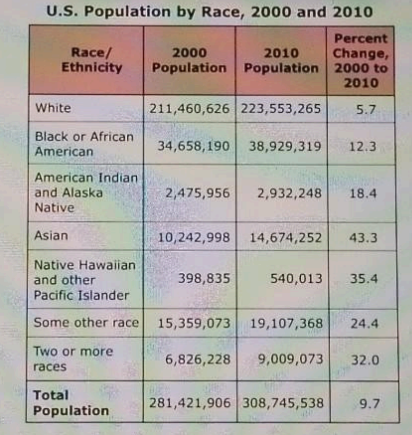
- A. The Black or African American population had the greatest percentage of growth.
- B. The Native Hawaiian and other Pacific Islander population grew by a greater proportion than the Asian population.
- C. The White population experienced the slowest growth of all groups.
- D. The American Indian and Alaska Native population experienced almost no change.
Correct Answer & Rationale
Correct Answer: B
Option B accurately reflects demographic trends, as the Native Hawaiian and other Pacific Islander population indeed saw a higher percentage increase compared to the Asian population during this period. Option A is incorrect; while the Black or African American population grew, it was not the greatest percentage increase among all racial groups. Option C misrepresents the data; although the White population's growth was slower compared to previous decades, it was not the slowest overall. Option D is misleading as well; the American Indian and Alaska Native population did experience some growth, albeit modest, rather than remaining unchanged.
Option B accurately reflects demographic trends, as the Native Hawaiian and other Pacific Islander population indeed saw a higher percentage increase compared to the Asian population during this period. Option A is incorrect; while the Black or African American population grew, it was not the greatest percentage increase among all racial groups. Option C misrepresents the data; although the White population's growth was slower compared to previous decades, it was not the slowest overall. Option D is misleading as well; the American Indian and Alaska Native population did experience some growth, albeit modest, rather than remaining unchanged.
Other Related Questions
Which statement from the excerpts is a fact?
- A. "When people blame the current crisis on the free market, they are making a grave intellectual error." (paragraph 3)
- B. "... we ultimately included a provision in the Affordable Care Act that people who can afford to buy health insurance should take the responsibility to do so." (paragraph 7)
- C. "Like other areas of the economy where the federal government wields its heavy hand, health care is overregulated and in need of serious market reforms." (paragraph 2)
- D. "... [T]oday's decision was a victory for people all over this country whose lives will be more secure because of this law and the Supreme Court's decision to uphold it." (paragraph 5)
Correct Answer & Rationale
Correct Answer: B
Option B presents a factual statement regarding the Affordable Care Act, specifically mentioning a provision that mandates individuals who can afford health insurance to take responsibility for purchasing it. This is a verifiable aspect of the legislation. In contrast, Option A expresses an opinion about blaming the free market, which is subjective and open to interpretation. Option C also conveys a viewpoint on government regulation and reform needs, lacking objective verification. Lastly, Option D describes a perceived outcome of a decision, reflecting an opinion on its impact rather than presenting a fact. Thus, only Option B stands as an objective statement grounded in legislation.
Option B presents a factual statement regarding the Affordable Care Act, specifically mentioning a provision that mandates individuals who can afford health insurance to take responsibility for purchasing it. This is a verifiable aspect of the legislation. In contrast, Option A expresses an opinion about blaming the free market, which is subjective and open to interpretation. Option C also conveys a viewpoint on government regulation and reform needs, lacking objective verification. Lastly, Option D describes a perceived outcome of a decision, reflecting an opinion on its impact rather than presenting a fact. Thus, only Option B stands as an objective statement grounded in legislation.
Which statement from the excerpts provides evidence for the Inference that minority rights were not protected by the U.S. government as originally founded?
- A. "To the contrary, the government they devised was defective from the start, requiring several amendments, a civil war, and momentous social transformation to attain the system of constitutional government, and its respect for the individual freedoms and human rights, we hold as fundamental today."
- B. "In a very real sense, it was then, in 1787, that the Revolution truly began."
- C. "I do not believe that the meaning of the Constitution was forever 'fixed' at the Philadelphia Convention."
- D. "For it was with the writing of our Constitution, setting down the architecture of democratic government, that the noble sentiments and brave rhetoric of 1776 took on substance......"
Correct Answer & Rationale
Correct Answer: A
Option A highlights the inherent flaws in the original government structure, indicating that it required significant amendments and a civil war to address fundamental issues, including the protection of minority rights. This suggests that, from its inception, the government did not adequately safeguard these rights. Options B, C, and D, while relevant to the historical context, do not specifically address the inadequacies of minority rights protection. B focuses on the ongoing nature of the Revolution, C discusses the evolving interpretation of the Constitution, and D emphasizes the establishment of democratic principles without mentioning the lack of protections for minority rights.
Option A highlights the inherent flaws in the original government structure, indicating that it required significant amendments and a civil war to address fundamental issues, including the protection of minority rights. This suggests that, from its inception, the government did not adequately safeguard these rights. Options B, C, and D, while relevant to the historical context, do not specifically address the inadequacies of minority rights protection. B focuses on the ongoing nature of the Revolution, C discusses the evolving interpretation of the Constitution, and D emphasizes the establishment of democratic principles without mentioning the lack of protections for minority rights.
Which statement best describes the action of the people in the photograph?
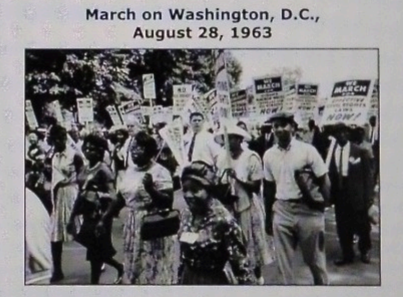
- A. They are utilizing an 8th Amendment right to secure the release of a colleague who was jailed unfairly.
- B. They are utilizing a 6th Amendment right to secure a fair trial for a jailed associate.
- C. They are utilizing a 1st Amendment right to secure equality under the law.
- D. They are utilizing a 14th Amendment right to secure the opportunity to vote in federal elections.
Correct Answer & Rationale
Correct Answer: C
The action depicted in the photograph aligns with the 1st Amendment, which guarantees freedoms concerning speech, assembly, and the right to petition the government. The individuals are likely advocating for equality under the law, a fundamental principle of democratic society. Option A incorrectly references the 8th Amendment, which focuses on protection against excessive bail and cruel punishment, not the right to protest for a colleague's release. Option B misapplies the 6th Amendment, which ensures the right to a fair trial, rather than addressing broader issues of equality. Option D inaccurately connects the situation to the 14th Amendment, which deals with citizenship rights and equal protection, not specifically voting rights.
The action depicted in the photograph aligns with the 1st Amendment, which guarantees freedoms concerning speech, assembly, and the right to petition the government. The individuals are likely advocating for equality under the law, a fundamental principle of democratic society. Option A incorrectly references the 8th Amendment, which focuses on protection against excessive bail and cruel punishment, not the right to protest for a colleague's release. Option B misapplies the 6th Amendment, which ensures the right to a fair trial, rather than addressing broader issues of equality. Option D inaccurately connects the situation to the 14th Amendment, which deals with citizenship rights and equal protection, not specifically voting rights.
Which one statement identifies the main idea of President Johnson's speech?
- A. The federal government has the responsibility to guarantee the rights of citizens.
- B. The expansion of educational opportunities should be the next goal of the civil rights movement.
- C. The expansion of voting rights can eliminate poverty.
- D. The federal government has power over state governments.
Correct Answer & Rationale
Correct Answer: A
Option A accurately captures the essence of President Johnson's speech, which emphasizes the government's duty to protect citizens' rights, particularly in the context of civil rights and social justice. Option B, while relevant to the civil rights movement, does not encapsulate the primary focus of the speech, which is broader than just education. Option C suggests a direct correlation between voting rights and poverty alleviation, which, though important, is not the main thrust of Johnson's address. Option D misrepresents the speech's intent, as it does not primarily discuss the federal government's authority over states but rather its role in ensuring citizen rights.
Option A accurately captures the essence of President Johnson's speech, which emphasizes the government's duty to protect citizens' rights, particularly in the context of civil rights and social justice. Option B, while relevant to the civil rights movement, does not encapsulate the primary focus of the speech, which is broader than just education. Option C suggests a direct correlation between voting rights and poverty alleviation, which, though important, is not the main thrust of Johnson's address. Option D misrepresents the speech's intent, as it does not primarily discuss the federal government's authority over states but rather its role in ensuring citizen rights.