The excerpt below is from the 1831 U.S. Supreme Court case Cherokee Nation v. Georgia.
The Indian territory is admitted to compose a part of the United States. They acknowledge themselves in their treaties to be under the protection of the United States; they admit that the United States shall have the sole and exclusive right of regulating the trade with them, and managing all their affairs as they think proper... Treaties were made with some tribes... by which they ceded all their lands... [and] they admit their dependence.
They look to our government for protection; rely upon its kindness and its power... and address the president as their great father.
... [T]he Cherokee nation. retains its usages and customs and self government, greatly improved by the civilization which it has been the policy of the United States to encourage and foster among them.
This excerpt is taken from the public domain.
What is the main point of view expressed in this excerpt?
- A. The Cherokee Nation is equal to the United States in terms of trade and government.
- B. The Cherokee Nation is dependent on the United States for basic necessities and survival.
- C. The Cherokee Nation is dependent on the United States for guidance and protection.
- D. The Cherokee Nation is a separate state that deals with the United States as a foreign country.
Correct Answer & Rationale
Correct Answer: C
The excerpt emphasizes the Cherokee Nation's reliance on the United States for guidance and protection, reflecting a relationship where the Cherokee seek support in navigating external challenges. Option A misrepresents the dynamics by suggesting equality in trade and government, which overlooks the power imbalance. Option B, while hinting at dependence, fails to capture the broader context of guidance and protection that the Cherokee sought. Option D incorrectly frames the relationship as one of complete separation, ignoring the interdependence that characterized their interactions with the United States.
The excerpt emphasizes the Cherokee Nation's reliance on the United States for guidance and protection, reflecting a relationship where the Cherokee seek support in navigating external challenges. Option A misrepresents the dynamics by suggesting equality in trade and government, which overlooks the power imbalance. Option B, while hinting at dependence, fails to capture the broader context of guidance and protection that the Cherokee sought. Option D incorrectly frames the relationship as one of complete separation, ignoring the interdependence that characterized their interactions with the United States.
Other Related Questions
Which prediction is supported by both graphs?
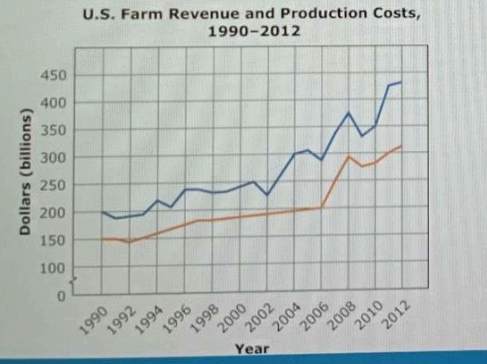
- A. The average wage for farm workers will decrease..
- B. The average cost for agricultural produce will decrease.
- C. The operating cost of running a farm will increase.
- D. The number of people required for producing food will increase.
Correct Answer & Rationale
Correct Answer: C
Option C is supported by both graphs, indicating an upward trend in operational costs due to factors like inflation and increased resource prices. This aligns with economic patterns observed in the agricultural sector. Option A is incorrect as both graphs do not show a decline in farm worker wages; rather, they suggest stability or growth. Option B is misleading; the graphs do not reflect a decrease in agricultural produce costs, which often correlate with rising operational expenses. Option D is also unsupported, as the data does not indicate an increase in labor requirements, but rather highlights efficiency improvements in farming practices.
Option C is supported by both graphs, indicating an upward trend in operational costs due to factors like inflation and increased resource prices. This aligns with economic patterns observed in the agricultural sector. Option A is incorrect as both graphs do not show a decline in farm worker wages; rather, they suggest stability or growth. Option B is misleading; the graphs do not reflect a decrease in agricultural produce costs, which often correlate with rising operational expenses. Option D is also unsupported, as the data does not indicate an increase in labor requirements, but rather highlights efficiency improvements in farming practices.
This flow chart traces development of democratic government in England. Which event completes this sequence?

- A. The English Bill of Rights gave the king power to appoint most members of Parliament.
- B. The Magna Carta forced the nobles to give up their feudal lands.
- C. The English Bill of Rights guaranteed suffrage to most male citizens.
- D. The Magna Carta forced the king to share his political power.
Correct Answer & Rationale
Correct Answer: D
The correct choice, D, highlights the Magna Carta's pivotal role in limiting the king's absolute power and initiating the concept of shared governance. This foundational document established that the monarch must consult nobles before making decisions, laying the groundwork for parliamentary democracy. Option A is incorrect as the English Bill of Rights actually limited the king's power over Parliament, not enhanced it. Option B misrepresents the Magna Carta's purpose; it did not force nobles to relinquish their lands, but rather addressed their grievances against the king. Option C is also inaccurate, as the English Bill of Rights did not guarantee suffrage but focused on limiting royal authority and protecting certain rights.
The correct choice, D, highlights the Magna Carta's pivotal role in limiting the king's absolute power and initiating the concept of shared governance. This foundational document established that the monarch must consult nobles before making decisions, laying the groundwork for parliamentary democracy. Option A is incorrect as the English Bill of Rights actually limited the king's power over Parliament, not enhanced it. Option B misrepresents the Magna Carta's purpose; it did not force nobles to relinquish their lands, but rather addressed their grievances against the king. Option C is also inaccurate, as the English Bill of Rights did not guarantee suffrage but focused on limiting royal authority and protecting certain rights.
How does the U.S. Supreme Court's ruling differ from Justice Murphy's dissent?
- A. Only Justice Murphy's dissent acknowledged the dangers to the United States of having citizens from foreign lands.
- B. Only the Court's ruling acknowledged that the actions of fearful U.S. authorities can endanger the civil rights of citizens.
- C. Only the Court's ruling contended that Korematsu was ordered held in an internment camp because he was disloyal to the United States during time of war.
- D. Only Justice Murphy's dissent contended that U.S. internment camps were a clear-cut example of racial prejudice.
Correct Answer & Rationale
Correct Answer: D
Justice Murphy's dissent emphasized that the internment camps represented blatant racial prejudice, highlighting the unjust targeting of Japanese Americans based solely on their ethnicity. This perspective contrasts sharply with the majority opinion, which focused on national security concerns without addressing the racial implications. Option A is incorrect as both perspectives recognize the potential dangers of foreign nationals, albeit in different contexts. Option B misrepresents the majority's stance, which did not explicitly acknowledge civil rights violations. Option C inaccurately simplifies the Court's ruling, which did not solely attribute internment to disloyalty.
Justice Murphy's dissent emphasized that the internment camps represented blatant racial prejudice, highlighting the unjust targeting of Japanese Americans based solely on their ethnicity. This perspective contrasts sharply with the majority opinion, which focused on national security concerns without addressing the racial implications. Option A is incorrect as both perspectives recognize the potential dangers of foreign nationals, albeit in different contexts. Option B misrepresents the majority's stance, which did not explicitly acknowledge civil rights violations. Option C inaccurately simplifies the Court's ruling, which did not solely attribute internment to disloyalty.
Which quotation from the excerpt reveals the author's bias about the relationship between the rule of the majority and the rights of the minority?
- A. "The wishes of the smaller group will override the wishes of the larger group and this will create resentment."
- B. "Requiring a unanimous vote or more than a majority vote is meant to provide a safeguard against oppression."
- C. "In these circumstances, expect constant scheming, trickery, and tiresome delays, resulting in disgraceful deals that violate the public good."
- D. "In times of national emergency, the goodness, badness, weakness, and strength of the government is supremely important."
Correct Answer & Rationale
Correct Answer: C
Option C highlights the author's bias by suggesting that the majority's decisions can lead to unethical behavior that undermines public welfare. This reveals a concern for minority rights, indicating that the author believes majority rule may result in negative consequences for those not in power. Option A misrepresents the author's view, as it suggests that the smaller group's wishes will always be overridden, which does not directly reflect bias against majority rule. Option B focuses on safeguards against oppression, which does not convey bias but rather a protective measure. Option D addresses the government's performance during emergencies but fails to connect to the relationship between majority rule and minority rights, missing the core issue of bias.
Option C highlights the author's bias by suggesting that the majority's decisions can lead to unethical behavior that undermines public welfare. This reveals a concern for minority rights, indicating that the author believes majority rule may result in negative consequences for those not in power. Option A misrepresents the author's view, as it suggests that the smaller group's wishes will always be overridden, which does not directly reflect bias against majority rule. Option B focuses on safeguards against oppression, which does not convey bias but rather a protective measure. Option D addresses the government's performance during emergencies but fails to connect to the relationship between majority rule and minority rights, missing the core issue of bias.