The Affordable Care Act was passed by the U.S. Congress in 2010, but faced numerous legal challenges after it took effect. In 2012, the U.S. Supreme Court ruled that the law was constitutional.
Excerpts from Senator Rand Paul's article against the Affordable Care Act, March 25, 2011
1 Excerpt 1: "For the first time in U.S. history, the federal government will force you to purchase health insurance."
2 Excerpt 2: "Like other areas of the economy where the federal government wields its heavy hand, health care is overregulated and in need of serious market reforms. But many see bigger government as the solution to this problem...."
3 Excerpt 3: "When people blame the current crisis on the free market, they are making a grave intellectual error. We have not even remotely tried a free market in health care. We put layer upon layer of rules and mandates on companies. We limit the choices available to consumers."
4 Excerpt 4: "The solutions we seek to our health care problems should therefore offer more freedom, not less."
Excerpts from President Obama's speech about the Supreme Court ruling on the Affordable Care Act, June 28, 2012
5 Excerpt 1: "... Earlier today, the Supreme Court upheld the constitutionality of the Affordable Care Act... [T]oday's decision was a victory for people all over this country whose lives will be more secure because of this law and the Supreme Court's decision to uphold it."
6 Excerpt 2: "Each state will take the lead in designing [its] own menu of [health care] options, and if states can come up with even better ways of covering more people at the same quality and cost, this law allows them to do that, too."
7 Excerpt 3: "That's why... we ultimately included a provision in the Affordable Care Act that people who can afford to buy health insurance should take the responsibility to do so."
How does the message presented by Senator Paul differ from the message presented by President Obama?
- A. Only Senator Paul promotes less government involvement in health care.
- B. Only Senator Paul wants to secure more health care for U.S. citizens.
- C. Only President Obama supports the Supreme Court's right to rule about health care.
- D. Only President Obama discusses problems in the health care industry.
Correct Answer & Rationale
Correct Answer: A
Senator Paul advocates for reduced government involvement in health care, emphasizing personal choice and market-driven solutions. This contrasts with President Obama's approach, which supports a more active role for the government in expanding access and regulating the industry. Option B is incorrect as both politicians aim to improve health care access, albeit through different methods. Option C misrepresents Obama's stance; he supports health care reforms that align with Supreme Court rulings but does not solely focus on this aspect. Option D is misleading; while Obama addresses health care issues, Senator Paul also discusses industry challenges, making this option inaccurate.
Senator Paul advocates for reduced government involvement in health care, emphasizing personal choice and market-driven solutions. This contrasts with President Obama's approach, which supports a more active role for the government in expanding access and regulating the industry. Option B is incorrect as both politicians aim to improve health care access, albeit through different methods. Option C misrepresents Obama's stance; he supports health care reforms that align with Supreme Court rulings but does not solely focus on this aspect. Option D is misleading; while Obama addresses health care issues, Senator Paul also discusses industry challenges, making this option inaccurate.
Other Related Questions
Which event counters the viewpoint expressed in the newspaper excerpt that African Americans refused to defend their civil rights?
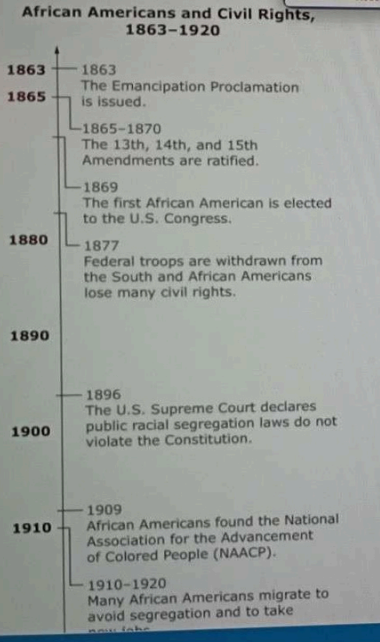
- A. the ratification of the 13th, 14th, and 15th Amendments
- B. the issuance of the Emancipation Proclamation
- C. the founding of the National Association for the Advancement of Colored People
- D. the start of the Great Migration
Correct Answer & Rationale
Correct Answer: C
The founding of the National Association for the Advancement of Colored People (NAACP) directly counters the viewpoint that African Americans refused to defend their civil rights. Established in 1909, the NAACP actively fought for civil rights through legal challenges, advocacy, and public education, demonstrating a strong commitment to defending their rights. Option A, the ratification of the 13th, 14th, and 15th Amendments, although significant, primarily established legal rights rather than showcasing active defense. Option B, the Emancipation Proclamation, ended slavery but did not directly address civil rights activism. Option D, the Great Migration, reflects a movement for better opportunities but does not specifically illustrate organized efforts to defend civil rights.
The founding of the National Association for the Advancement of Colored People (NAACP) directly counters the viewpoint that African Americans refused to defend their civil rights. Established in 1909, the NAACP actively fought for civil rights through legal challenges, advocacy, and public education, demonstrating a strong commitment to defending their rights. Option A, the ratification of the 13th, 14th, and 15th Amendments, although significant, primarily established legal rights rather than showcasing active defense. Option B, the Emancipation Proclamation, ended slavery but did not directly address civil rights activism. Option D, the Great Migration, reflects a movement for better opportunities but does not specifically illustrate organized efforts to defend civil rights.
Which feature of the U.S. system of government did de Tocqueville believe might cause conflict in society?
- A. The majority is able to achieve special rights.
- B. The minority is able to block popular legislation.
- C. Legislators must represent minority interests.
- D. Legislators sometimes act against majority rule.
Correct Answer & Rationale
Correct Answer: A
De Tocqueville observed that when the majority in a democracy can impose its will, it might lead to the oppression of minority groups, creating societal conflict. This reflects his concern about "tyranny of the majority," where the dominant group's interests overshadow the rights of others. Option B is incorrect because while minorities can influence legislation, de Tocqueville focused more on majority power. Option C misrepresents his views; he acknowledged the importance of minority representation but did not see it as a source of conflict. Option D is also inaccurate, as de Tocqueville emphasized the potential for the majority to dominate rather than legislators opposing the majority.
De Tocqueville observed that when the majority in a democracy can impose its will, it might lead to the oppression of minority groups, creating societal conflict. This reflects his concern about "tyranny of the majority," where the dominant group's interests overshadow the rights of others. Option B is incorrect because while minorities can influence legislation, de Tocqueville focused more on majority power. Option C misrepresents his views; he acknowledged the importance of minority representation but did not see it as a source of conflict. Option D is also inaccurate, as de Tocqueville emphasized the potential for the majority to dominate rather than legislators opposing the majority.
Which statement is supported by the diagrams?
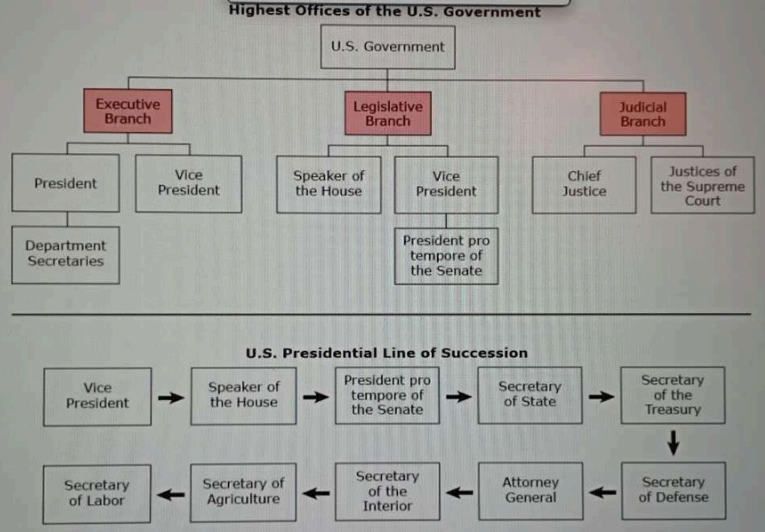
- A. Only the vice president and the president pro tempore of the Senate serve in two branches.
- B. Only officials from the executive and legislative branches are in the line of presidential succession.
- C. The order of presidential succession is determined by the members of the executive branch.
- D. The leaders of Congress are accountable to the members of the executive branch.
Correct Answer & Rationale
Correct Answer: B
Option B accurately reflects the structure of presidential succession, which includes officials from both the executive and legislative branches, specifically the vice president and the leaders of Congress. Option A is misleading; while the vice president and president pro tempore serve in both branches, other officials in the line of succession also include members from the cabinet, which is part of the executive branch. Option C is incorrect as the order of succession is established by law, not determined solely by the executive branch members. Option D misrepresents accountability; Congress leaders are accountable to their constituents, not the executive branch.
Option B accurately reflects the structure of presidential succession, which includes officials from both the executive and legislative branches, specifically the vice president and the leaders of Congress. Option A is misleading; while the vice president and president pro tempore serve in both branches, other officials in the line of succession also include members from the cabinet, which is part of the executive branch. Option C is incorrect as the order of succession is established by law, not determined solely by the executive branch members. Option D misrepresents accountability; Congress leaders are accountable to their constituents, not the executive branch.
Based on the information in this passage, which feature of ancient Roman government most influenced the Founders in framing the U.S. Constitution?
- A. A popularly elected representative vetoed legislation.
- B. Magistrates proposed laws.
- C. A system of checks and balances limited power.
- D. Senators elected the consuls.
Correct Answer & Rationale
Correct Answer: C
The feature that most influenced the Founders in framing the U.S. Constitution is the system of checks and balances, which limited the power of government branches to prevent tyranny. This principle is evident in the U.S. system, where each branch can check the others, ensuring a balance of power. Option A is incorrect because while representatives play a role in legislation, the emphasis on a veto by a popularly elected official is not a defining characteristic of Roman governance. Option B, proposing laws by magistrates, describes a function of government but does not reflect the broader concept of power limitation. Option D incorrectly focuses on the election of consuls, which is less relevant to the Founders' emphasis on checks and balances.
The feature that most influenced the Founders in framing the U.S. Constitution is the system of checks and balances, which limited the power of government branches to prevent tyranny. This principle is evident in the U.S. system, where each branch can check the others, ensuring a balance of power. Option A is incorrect because while representatives play a role in legislation, the emphasis on a veto by a popularly elected official is not a defining characteristic of Roman governance. Option B, proposing laws by magistrates, describes a function of government but does not reflect the broader concept of power limitation. Option D incorrectly focuses on the election of consuls, which is less relevant to the Founders' emphasis on checks and balances.