Based on the timeline and the map, what was one way African Americans dealt with Jim Crow laws?
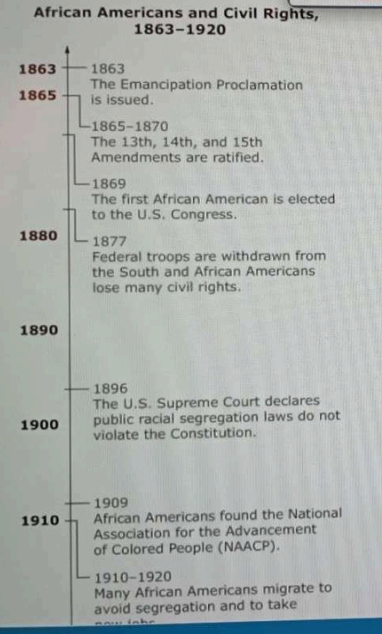
- A. by taking service jobs in southern cities
- B. by seeking factory jobs in urban areas of the North
- C. by becoming tenant farmers in other parts of the South
- D. by gaining technical skills in northern schools
Correct Answer & Rationale
Correct Answer: B
African Americans responded to Jim Crow laws by seeking factory jobs in urban areas of the North, as this migration offered better economic opportunities and a chance to escape oppressive conditions in the South. Option A, taking service jobs in southern cities, often perpetuated the same discriminatory practices found under Jim Crow. Option C, becoming tenant farmers in other parts of the South, did not provide significant relief from the systemic racism and economic hardship prevalent in that region. Option D, gaining technical skills in northern schools, while beneficial, was not a widespread or immediate solution compared to the mass migration to northern factories.
African Americans responded to Jim Crow laws by seeking factory jobs in urban areas of the North, as this migration offered better economic opportunities and a chance to escape oppressive conditions in the South. Option A, taking service jobs in southern cities, often perpetuated the same discriminatory practices found under Jim Crow. Option C, becoming tenant farmers in other parts of the South, did not provide significant relief from the systemic racism and economic hardship prevalent in that region. Option D, gaining technical skills in northern schools, while beneficial, was not a widespread or immediate solution compared to the mass migration to northern factories.
Other Related Questions
Which quotation from the excerpt reveals the author's bias about the relationship between the rule of the majority and the rights of the minority?
- A. "The wishes of the smaller group will override the wishes of the larger group and this will create resentment."
- B. "Requiring a unanimous vote or more than a majority vote is meant to provide a safeguard against oppression."
- C. "In these circumstances, expect constant scheming, trickery, and tiresome delays, resulting in disgraceful deals that violate the public good."
- D. "In times of national emergency, the goodness, badness, weakness, and strength of the government is supremely important."
Correct Answer & Rationale
Correct Answer: C
Option C highlights the author's bias by suggesting that the majority's decisions can lead to unethical behavior that undermines public welfare. This reveals a concern for minority rights, indicating that the author believes majority rule may result in negative consequences for those not in power. Option A misrepresents the author's view, as it suggests that the smaller group's wishes will always be overridden, which does not directly reflect bias against majority rule. Option B focuses on safeguards against oppression, which does not convey bias but rather a protective measure. Option D addresses the government's performance during emergencies but fails to connect to the relationship between majority rule and minority rights, missing the core issue of bias.
Option C highlights the author's bias by suggesting that the majority's decisions can lead to unethical behavior that undermines public welfare. This reveals a concern for minority rights, indicating that the author believes majority rule may result in negative consequences for those not in power. Option A misrepresents the author's view, as it suggests that the smaller group's wishes will always be overridden, which does not directly reflect bias against majority rule. Option B focuses on safeguards against oppression, which does not convey bias but rather a protective measure. Option D addresses the government's performance during emergencies but fails to connect to the relationship between majority rule and minority rights, missing the core issue of bias.
Which statement is based on the text?
- A. Individuals spend their income in factor markets.
- B. Entrepreneurs profit from participation in product markets.
- C. Individuals sell their labor in factor markets.
- D. Resources are traded in product markets.
Correct Answer & Rationale
Correct Answer: C
Option C accurately reflects the concept that individuals offer their labor in factor markets, where resources like labor are exchanged for wages. This aligns with economic principles regarding labor supply. Option A is incorrect since individuals do not spend income in factor markets; rather, they purchase goods and services in product markets. Option B misrepresents the role of entrepreneurs, who primarily earn profits through innovation and sales in product markets, not simply from participation. Option D is also misleading, as resources are exchanged in factor markets, while product markets focus on the sale of finished goods and services.
Option C accurately reflects the concept that individuals offer their labor in factor markets, where resources like labor are exchanged for wages. This aligns with economic principles regarding labor supply. Option A is incorrect since individuals do not spend income in factor markets; rather, they purchase goods and services in product markets. Option B misrepresents the role of entrepreneurs, who primarily earn profits through innovation and sales in product markets, not simply from participation. Option D is also misleading, as resources are exchanged in factor markets, while product markets focus on the sale of finished goods and services.
How does the message presented by Senator Paul differ from the message presented by President Obama?
- A. Only Senator Paul promotes less government involvement in health care.
- B. Only Senator Paul wants to secure more health care for U.S. citizens.
- C. Only President Obama supports the Supreme Court's right to rule about health care.
- D. Only President Obama discusses problems in the health care industry.
Correct Answer & Rationale
Correct Answer: A
Senator Paul advocates for reduced government involvement in health care, emphasizing personal choice and market-driven solutions. This contrasts with President Obama's approach, which supports a more active role for the government in expanding access and regulating the industry. Option B is incorrect as both politicians aim to improve health care access, albeit through different methods. Option C misrepresents Obama's stance; he supports health care reforms that align with Supreme Court rulings but does not solely focus on this aspect. Option D is misleading; while Obama addresses health care issues, Senator Paul also discusses industry challenges, making this option inaccurate.
Senator Paul advocates for reduced government involvement in health care, emphasizing personal choice and market-driven solutions. This contrasts with President Obama's approach, which supports a more active role for the government in expanding access and regulating the industry. Option B is incorrect as both politicians aim to improve health care access, albeit through different methods. Option C misrepresents Obama's stance; he supports health care reforms that align with Supreme Court rulings but does not solely focus on this aspect. Option D is misleading; while Obama addresses health care issues, Senator Paul also discusses industry challenges, making this option inaccurate.
Which historical event most likely shaped the author's point of view?
- A. the development of the concept of Manifest Destiny
- B. the United States' involvement in World War I
- C. the United States' internal conflicts during the Great Depression
- D. the calls for social reform during Prohibition
Correct Answer & Rationale
Correct Answer: B
The author's perspective is significantly influenced by the United States' involvement in World War I, as this event marked a pivotal shift in national identity and global engagement. The war prompted discussions about democracy, freedom, and the role of the U.S. on the world stage, shaping the author's views on these themes. Option A, Manifest Destiny, pertains to 19th-century expansionism, which is less relevant to the author's context. Option C, the Great Depression, focuses on economic struggles rather than the broader geopolitical implications of war. Option D, social reform during Prohibition, addresses domestic issues but does not encompass the global impact and ideological shifts brought about by World War I.
The author's perspective is significantly influenced by the United States' involvement in World War I, as this event marked a pivotal shift in national identity and global engagement. The war prompted discussions about democracy, freedom, and the role of the U.S. on the world stage, shaping the author's views on these themes. Option A, Manifest Destiny, pertains to 19th-century expansionism, which is less relevant to the author's context. Option C, the Great Depression, focuses on economic struggles rather than the broader geopolitical implications of war. Option D, social reform during Prohibition, addresses domestic issues but does not encompass the global impact and ideological shifts brought about by World War I.