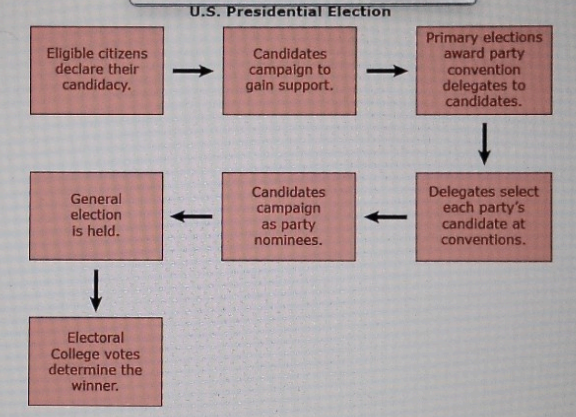
Based on the flowchart, how is a political party's presidential candidate selected?
- A. by balloting after the general election
- B. by balloting at the party convention
- C. by votes cast in party primary elections
- D. by votes cast in the general election
Correct Answer & Rationale
Correct Answer: C
The selection of a political party's presidential candidate primarily occurs through votes cast in party primary elections. This process allows party members to express their preferences for candidates before the general election, ensuring that the nominee reflects the party's values and priorities. Option A is incorrect because the general election occurs after the candidate has already been chosen. Option B, while related to the convention, is misleading as the convention typically formalizes the candidate chosen in the primaries rather than selecting them. Option D is also incorrect, as the general election determines the overall winner, not the party's candidate.
The selection of a political party's presidential candidate primarily occurs through votes cast in party primary elections. This process allows party members to express their preferences for candidates before the general election, ensuring that the nominee reflects the party's values and priorities. Option A is incorrect because the general election occurs after the candidate has already been chosen. Option B, while related to the convention, is misleading as the convention typically formalizes the candidate chosen in the primaries rather than selecting them. Option D is also incorrect, as the general election determines the overall winner, not the party's candidate.
Other Related Questions
What is the meaning of the word entrenched as used in this excerpt?
- A. in control
- B. strongly defended
- C. established and unlikely to change
- D. surrounded and unable to move
Correct Answer & Rationale
Correct Answer: C
The term "entrenched" conveys the idea of something that is firmly established and resistant to change, aligning with option C. This suggests a deep-rooted nature, often implying that it has become a significant part of a system or belief. Option A, "in control," does not capture the essence of being deeply embedded or resistant to alteration. Option B, "strongly defended," implies a protective stance rather than a state of being firmly established. Option D, "surrounded and unable to move," suggests physical confinement rather than the figurative sense of being firmly set in place.
The term "entrenched" conveys the idea of something that is firmly established and resistant to change, aligning with option C. This suggests a deep-rooted nature, often implying that it has become a significant part of a system or belief. Option A, "in control," does not capture the essence of being deeply embedded or resistant to alteration. Option B, "strongly defended," implies a protective stance rather than a state of being firmly established. Option D, "surrounded and unable to move," suggests physical confinement rather than the figurative sense of being firmly set in place.
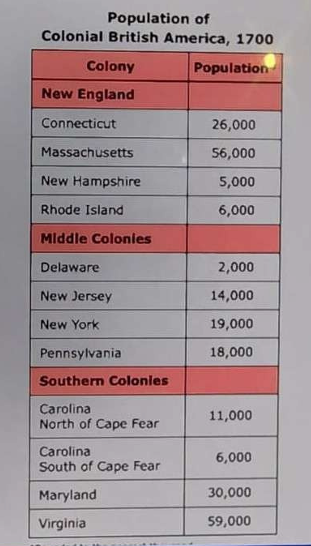
What was the mean population across the British American colonies in 1700?
- A. 56,000
- B. 21,000
- C. 6,000
- D. 16,000
Correct Answer & Rationale
Correct Answer: D
In 1700, the mean population across the British American colonies was approximately 16,000. This figure reflects the early colonial growth and settlement patterns during that period. Option A (56,000) overestimates the population, as it does not account for the smaller settlements and rural areas that characterized the colonies at that time. Option B (21,000) is also too high, misrepresenting the demographic data available for the early 18th century. Option C (6,000) significantly underestimates the population, ignoring the established colonies with growing communities. Thus, D accurately represents the mean population based on historical records.
In 1700, the mean population across the British American colonies was approximately 16,000. This figure reflects the early colonial growth and settlement patterns during that period. Option A (56,000) overestimates the population, as it does not account for the smaller settlements and rural areas that characterized the colonies at that time. Option B (21,000) is also too high, misrepresenting the demographic data available for the early 18th century. Option C (6,000) significantly underestimates the population, ignoring the established colonies with growing communities. Thus, D accurately represents the mean population based on historical records.
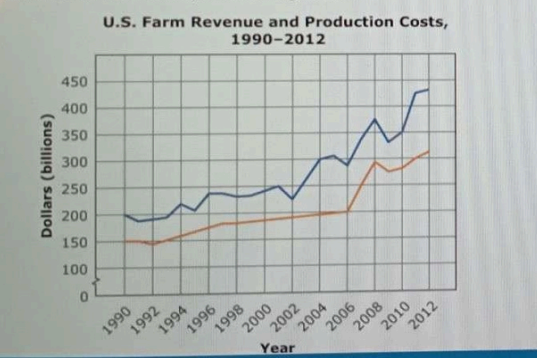
What impact do the varying insurance rates of the Revenue Protection Plan have on farming?
- A. They maintain stable prices for certain crops.
- B. They give farmers an incentive to promote crop diversity.
- C. They ensure the steady increase of crop production levels.
- D. They give farmers an incentive to grow crops that have higher subsidies.
Correct Answer & Rationale
Correct Answer: D
The varying insurance rates of the Revenue Protection Plan incentivize farmers to cultivate crops that receive higher subsidies, as these crops can mitigate financial risks associated with farming. This option aligns with economic behavior, where farmers are likely to prioritize profitability. Option A is incorrect because insurance rates do not directly stabilize prices; they primarily provide financial protection. Option B misrepresents the incentive structure; while crop diversity is beneficial, the plan does not specifically encourage it through varying rates. Option C is misleading, as the plan does not guarantee increased production levels; it merely provides a safety net against revenue loss.
The varying insurance rates of the Revenue Protection Plan incentivize farmers to cultivate crops that receive higher subsidies, as these crops can mitigate financial risks associated with farming. This option aligns with economic behavior, where farmers are likely to prioritize profitability. Option A is incorrect because insurance rates do not directly stabilize prices; they primarily provide financial protection. Option B misrepresents the incentive structure; while crop diversity is beneficial, the plan does not specifically encourage it through varying rates. Option C is misleading, as the plan does not guarantee increased production levels; it merely provides a safety net against revenue loss.
Which statement best explains the situation described in the paragraphs?
- A. Crude oil prices in 2014 encouraged U.S. families to buy less gasoline in 2015.
- B. Crude oil production levels have caused U.S. gasoline prices to fall.
- C. Greater crude oil reserves have caused the U.S. government to reduce gasoline prices.
- D. Lower crude oil production will cause U.S. gasoline prices to return to 2014 levels by 2016.
Correct Answer & Rationale
Correct Answer: B
Option B accurately reflects the relationship between crude oil production levels and gasoline prices. Increased production typically leads to lower prices, as supply outstrips demand. Option A incorrectly suggests a direct correlation between crude oil prices in 2014 and gasoline purchases in 2015, neglecting the influence of production levels. Option C misrepresents the role of reserves; while greater reserves can impact prices, it is production levels that directly affect market prices. Option D speculates on future price increases due to lower production, which is uncertain and not directly supported by the information provided.
Option B accurately reflects the relationship between crude oil production levels and gasoline prices. Increased production typically leads to lower prices, as supply outstrips demand. Option A incorrectly suggests a direct correlation between crude oil prices in 2014 and gasoline purchases in 2015, neglecting the influence of production levels. Option C misrepresents the role of reserves; while greater reserves can impact prices, it is production levels that directly affect market prices. Option D speculates on future price increases due to lower production, which is uncertain and not directly supported by the information provided.