The Affordable Care Act was passed by the U.S. Congress in 2010, but faced numerous legal challenges after it took effect. In 2012, the U.S. Supreme Court ruled that the law was constitutional.
Excerpts from Senator Rand Paul's article against the Affordable Care Act, March 25, 2011
1 Excerpt 1: "For the first time in U.S. history, the federal government will force you to purchase health insurance."
2 Excerpt 2: "Like other areas of the economy where the federal government wields its heavy hand, health care is overregulated and in need of serious market reforms. But many see bigger government as the solution to this problem...."
3 Excerpt 3: "When people blame the current crisis on the free market, they are making a grave intellectual error. We have not even remotely tried a free market in health care. We put layer upon layer of rules and mandates on companies. We limit the choices available to consumers."
4 Excerpt 4: "The solutions we seek to our health care problems should therefore offer more freedom, not less."
Excerpts from President Obama's speech about the Supreme Court ruling on the Affordable Care Act, June 28, 2012
5 Excerpt 1: "... Earlier today, the Supreme Court upheld the constitutionality of the Affordable Care Act... [T]oday's decision was a victory for people all over this country whose lives will be more secure because of this law and the Supreme Court's decision to uphold it."
6 Excerpt 2: "Each state will take the lead in designing [its] own menu of [health care] options, and if states can come up with even better ways of covering more people at the same quality and cost, this law allows them to do that, too."
7 Excerpt 3: "That's why... we ultimately included a provision in the Affordable Care Act that people who can afford to buy health insurance should take the responsibility to do so."
Which statement from the excerpts is a fact?
- A. "When people blame the current crisis on the free market, they are making a grave intellectual error." (paragraph 3)
- B. "... we ultimately included a provision in the Affordable Care Act that people who can afford to buy health insurance should take the responsibility to do so." (paragraph 7)
- C. "Like other areas of the economy where the federal government wields its heavy hand, health care is overregulated and in need of serious market reforms." (paragraph 2)
- D. "... [T]oday's decision was a victory for people all over this country whose lives will be more secure because of this law and the Supreme Court's decision to uphold it." (paragraph 5)
Correct Answer & Rationale
Correct Answer: B
Option B presents a factual statement regarding the Affordable Care Act, specifically mentioning a provision that mandates individuals who can afford health insurance to take responsibility for purchasing it. This is a verifiable aspect of the legislation. In contrast, Option A expresses an opinion about blaming the free market, which is subjective and open to interpretation. Option C also conveys a viewpoint on government regulation and reform needs, lacking objective verification. Lastly, Option D describes a perceived outcome of a decision, reflecting an opinion on its impact rather than presenting a fact. Thus, only Option B stands as an objective statement grounded in legislation.
Option B presents a factual statement regarding the Affordable Care Act, specifically mentioning a provision that mandates individuals who can afford health insurance to take responsibility for purchasing it. This is a verifiable aspect of the legislation. In contrast, Option A expresses an opinion about blaming the free market, which is subjective and open to interpretation. Option C also conveys a viewpoint on government regulation and reform needs, lacking objective verification. Lastly, Option D describes a perceived outcome of a decision, reflecting an opinion on its impact rather than presenting a fact. Thus, only Option B stands as an objective statement grounded in legislation.
Other Related Questions
According to this graph, in which year did the U.S. government first achieve a budget surplus?
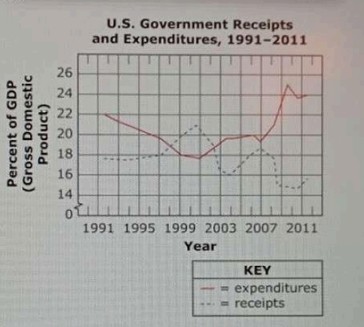
- A. 1996
- B. 1994
- C. 1998
- D. 2002
Correct Answer & Rationale
Correct Answer: C
The graph indicates that the U.S. government first achieved a budget surplus in 1998, as evidenced by the line crossing above the zero mark in that year. Option A (1996) shows a deficit, as the line remains below zero. Option B (1994) also reflects a deficit, indicating that the government had not yet balanced its budget. Option D (2002) is incorrect as it depicts a return to deficit after a surplus, confirming that the surplus was achieved earlier in 1998. Thus, 1998 is the first year when the budget surplus was realized.
The graph indicates that the U.S. government first achieved a budget surplus in 1998, as evidenced by the line crossing above the zero mark in that year. Option A (1996) shows a deficit, as the line remains below zero. Option B (1994) also reflects a deficit, indicating that the government had not yet balanced its budget. Option D (2002) is incorrect as it depicts a return to deficit after a surplus, confirming that the surplus was achieved earlier in 1998. Thus, 1998 is the first year when the budget surplus was realized.
According to Justice Marshall, what historical factor has contradicted the ideas expressed in the U.S. Constitution?
- A. slavery
- B. free enterprise
- C. religion
- D. class war
Correct Answer & Rationale
Correct Answer: A
Justice Marshall highlighted slavery as a significant historical contradiction to the principles of freedom and equality enshrined in the U.S. Constitution. Slavery directly undermined the Constitution's assertion that all men are created equal, creating a profound moral and ethical conflict. In contrast, free enterprise (B) aligns with the Constitution's emphasis on individual rights and economic freedom. Religion (C) is protected under the First Amendment, promoting freedom rather than contradiction. Class war (D) is a socio-economic conflict that, while relevant, does not directly challenge the foundational ideals of the Constitution in the same way slavery does.
Justice Marshall highlighted slavery as a significant historical contradiction to the principles of freedom and equality enshrined in the U.S. Constitution. Slavery directly undermined the Constitution's assertion that all men are created equal, creating a profound moral and ethical conflict. In contrast, free enterprise (B) aligns with the Constitution's emphasis on individual rights and economic freedom. Religion (C) is protected under the First Amendment, promoting freedom rather than contradiction. Class war (D) is a socio-economic conflict that, while relevant, does not directly challenge the foundational ideals of the Constitution in the same way slavery does.
Which prediction is supported by both graphs?
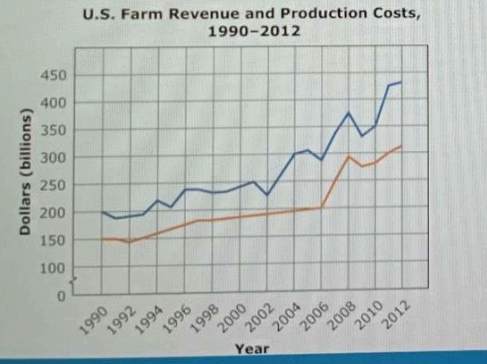
- A. The average wage for farm workers will decrease..
- B. The average cost for agricultural produce will decrease.
- C. The operating cost of running a farm will increase.
- D. The number of people required for producing food will increase.
Correct Answer & Rationale
Correct Answer: C
Option C is supported by both graphs, indicating an upward trend in operational costs due to factors like inflation and increased resource prices. This aligns with economic patterns observed in the agricultural sector. Option A is incorrect as both graphs do not show a decline in farm worker wages; rather, they suggest stability or growth. Option B is misleading; the graphs do not reflect a decrease in agricultural produce costs, which often correlate with rising operational expenses. Option D is also unsupported, as the data does not indicate an increase in labor requirements, but rather highlights efficiency improvements in farming practices.
Option C is supported by both graphs, indicating an upward trend in operational costs due to factors like inflation and increased resource prices. This aligns with economic patterns observed in the agricultural sector. Option A is incorrect as both graphs do not show a decline in farm worker wages; rather, they suggest stability or growth. Option B is misleading; the graphs do not reflect a decrease in agricultural produce costs, which often correlate with rising operational expenses. Option D is also unsupported, as the data does not indicate an increase in labor requirements, but rather highlights efficiency improvements in farming practices.
The United States fought in World War II from 1941 to 1945. Which statement explains the peak annual inflation rate during the 1940s?
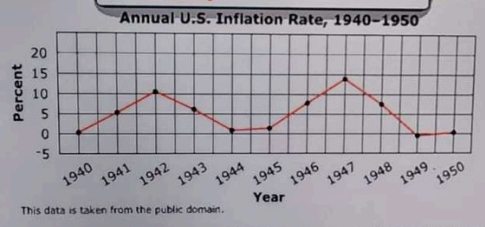
- A. Consumer demand increased due to the end of rationing.
- B. Manufacturing decreased because of less demand for weapons.
- C. Government spending increased due to national defense.
- D. Wages decreased because of competition for scarce jobs.
Correct Answer & Rationale
Correct Answer: C
The peak annual inflation rate during the 1940s can be attributed to increased government spending due to national defense efforts. This surge in spending stimulated the economy and raised prices as the demand for goods and services outpaced supply. Option A is incorrect; while consumer demand did rise post-rationing, it was not the primary driver of inflation during the war years. Option B is also wrong, as manufacturing actually increased during the war to meet military needs. Option D misrepresents the labor market; wages generally rose due to high demand for workers, not decreased. Thus, government spending for defense was the key factor in driving inflation during this period.
The peak annual inflation rate during the 1940s can be attributed to increased government spending due to national defense efforts. This surge in spending stimulated the economy and raised prices as the demand for goods and services outpaced supply. Option A is incorrect; while consumer demand did rise post-rationing, it was not the primary driver of inflation during the war years. Option B is also wrong, as manufacturing actually increased during the war to meet military needs. Option D misrepresents the labor market; wages generally rose due to high demand for workers, not decreased. Thus, government spending for defense was the key factor in driving inflation during this period.