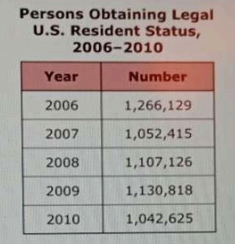
This table contains information from the U.S. Department of Homeland Security.
What is the mean number of people who became legal residents of the United States during this five-year period?
- A. 1,119,823
- B. 223,504
- C. 5,599,113
- D. 1,107,126
Correct Answer & Rationale
Correct Answer: A
To determine the mean number of legal residents over the five-year period, one must sum the total number of residents and divide by five. The correct calculation yields a mean of 1,119,823, reflecting the average annual influx. Option B (223,504) represents a miscalculation, likely reflecting a single year's data rather than an average. Option C (5,599,113) incorrectly totals the residents without division, suggesting a cumulative number rather than an average. Option D (1,107,126) is close but does not accurately reflect the mean, indicating a minor arithmetic error.
To determine the mean number of legal residents over the five-year period, one must sum the total number of residents and divide by five. The correct calculation yields a mean of 1,119,823, reflecting the average annual influx. Option B (223,504) represents a miscalculation, likely reflecting a single year's data rather than an average. Option C (5,599,113) incorrectly totals the residents without division, suggesting a cumulative number rather than an average. Option D (1,107,126) is close but does not accurately reflect the mean, indicating a minor arithmetic error.
Other Related Questions
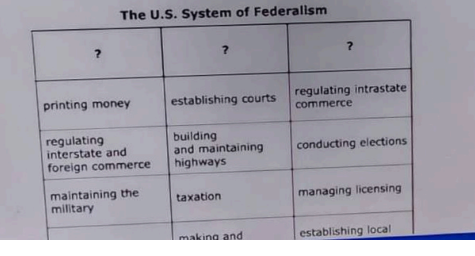
Complete the U.S. System of Federalism chart based on information from the passage. Click on the title below you want to select and drag it into the top of each column in the chart.
Correct Answer & Rationale
Correct Answer:
**Correct answer:** Federal Government **Rationale:** The Federal Government is responsible for national issues such as defense, immigration, and foreign policy, which distinguishes it from state governments. State Governments handle local matters like education and transportation, focusing on regional needs. The option "Local Government" refers to municipal or county levels, which operate under the authority of the state and do not encompass federal responsibilities. Therefore, the Federal Government is accurately placed at the top of the federalism chart, while the other options misrepresent the hierarchy and scope of governance in the U.S. system.
**Correct answer:** Federal Government **Rationale:** The Federal Government is responsible for national issues such as defense, immigration, and foreign policy, which distinguishes it from state governments. State Governments handle local matters like education and transportation, focusing on regional needs. The option "Local Government" refers to municipal or county levels, which operate under the authority of the state and do not encompass federal responsibilities. Therefore, the Federal Government is accurately placed at the top of the federalism chart, while the other options misrepresent the hierarchy and scope of governance in the U.S. system.
Which statement identifies the purpose of President Nixon's message?
- A. to convince Congress that technological advancement and population growth must be slowed to protect the environment
- B. to convince Congress that industrial polluters of the air and water should not pay for cleaning the environment
- C. to convince Congress that it must take part in action to address human damage to the environment
- D. to convince Congress that there should be no benefits for businesses that pollute the environment
Correct Answer & Rationale
Correct Answer: C
President Nixon's message aimed to mobilize Congress to actively engage in addressing environmental degradation caused by human activities. This focus on collective action underscores the urgency of legislative involvement in environmental protection. Option A misinterprets the goal, as Nixon did not advocate for slowing technological advancement but rather for responsible management. Option B inaccurately suggests that he supported industrial polluters avoiding responsibility, which contradicts his environmental stance. Option D implies a complete lack of support for businesses, neglecting the balanced approach Nixon promoted towards regulatory measures and economic growth.
President Nixon's message aimed to mobilize Congress to actively engage in addressing environmental degradation caused by human activities. This focus on collective action underscores the urgency of legislative involvement in environmental protection. Option A misinterprets the goal, as Nixon did not advocate for slowing technological advancement but rather for responsible management. Option B inaccurately suggests that he supported industrial polluters avoiding responsibility, which contradicts his environmental stance. Option D implies a complete lack of support for businesses, neglecting the balanced approach Nixon promoted towards regulatory measures and economic growth.
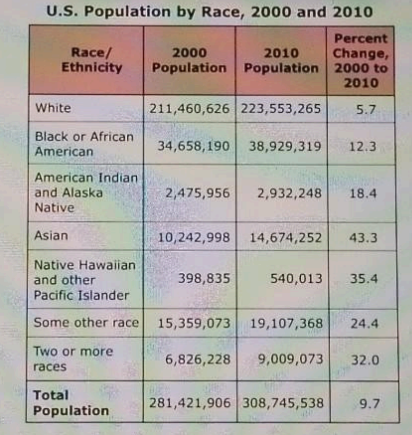
Which statement is correct about the change in racial and ethnic populations between 2000 and 2010?
- A. The Black or African American population had the greatest percentage of growth.
- B. The Native Hawaiian and other Pacific Islander population grew by a greater proportion than the Asian population.
- C. The White population experienced the slowest growth of all groups.
- D. The American Indian and Alaska Native population experienced almost no change.
Correct Answer & Rationale
Correct Answer: B
Option B accurately reflects demographic trends, as the Native Hawaiian and other Pacific Islander population indeed saw a higher percentage increase compared to the Asian population during this period. Option A is incorrect; while the Black or African American population grew, it was not the greatest percentage increase among all racial groups. Option C misrepresents the data; although the White population's growth was slower compared to previous decades, it was not the slowest overall. Option D is misleading as well; the American Indian and Alaska Native population did experience some growth, albeit modest, rather than remaining unchanged.
Option B accurately reflects demographic trends, as the Native Hawaiian and other Pacific Islander population indeed saw a higher percentage increase compared to the Asian population during this period. Option A is incorrect; while the Black or African American population grew, it was not the greatest percentage increase among all racial groups. Option C misrepresents the data; although the White population's growth was slower compared to previous decades, it was not the slowest overall. Option D is misleading as well; the American Indian and Alaska Native population did experience some growth, albeit modest, rather than remaining unchanged.
Based on the excerpt, which conclusion can be drawn about the U.S. Constitution and the Bill of Rights?
- A. Ratification of the Bill of Rights was completed before the Constitution was drafted.
- B. Ratification of the Constitution was dependent on the passage of the Bill of Rights.
- C. Most leaders were worried that the Bill of Rights would weaken the ruling class protected by the Constitution.
- D. Many leaders were concerned that the Bill of Rights would upset the balance of powers outlined in the Constitution.
Correct Answer & Rationale
Correct Answer: B
The conclusion that ratification of the Constitution was dependent on the passage of the Bill of Rights is supported by historical context, as many states required assurance of individual rights to approve the Constitution. Option A is incorrect because the Bill of Rights was introduced after the Constitution was drafted. Option C misrepresents the intent of the Bill of Rights; leaders were primarily concerned with protecting individual liberties rather than preserving the ruling class. Option D is also inaccurate, as the Bill of Rights aimed to safeguard citizens' rights without disrupting the balance of powers established by the Constitution.
The conclusion that ratification of the Constitution was dependent on the passage of the Bill of Rights is supported by historical context, as many states required assurance of individual rights to approve the Constitution. Option A is incorrect because the Bill of Rights was introduced after the Constitution was drafted. Option C misrepresents the intent of the Bill of Rights; leaders were primarily concerned with protecting individual liberties rather than preserving the ruling class. Option D is also inaccurate, as the Bill of Rights aimed to safeguard citizens' rights without disrupting the balance of powers established by the Constitution.