This passage contains information about the concept of sustainability.
What does the word "sustainability" mean? "Sustainability" means using natural resources responsibly so that they are available to future generations. Sustainability seeks to balance economic, environmental, and societal challenges and opportunities. For example, to achieve sustainability a business will not view profit only in terms of dollars. Energy companies will ask what impact their operation has on humans, wildlife, land, and water. The ill-advised rush to extract new discoveries of shale oil and natural gas is a case in point. These resources will earn millions of dollars and create many jobs. However, if the result is polluted water and ghost towns, it is not a sustainable model.
Which statement from the passage is an opinion?
- A. "The ill-advised rush to extract new discoveries of shale oil and natural gas is a case in point."
- B. "...if the result is polluted water and ghost towns, it is not a sustainable model."
- C. “‘Sustainability' means using natural resources responsibly so that they are available to future generations."
- D. "... to achieve sustainability a business will not view profit only in terms of dollars."
Correct Answer & Rationale
Correct Answer: A
Option A expresses a subjective viewpoint about the extraction of shale oil and natural gas, labeling it as "ill-advised." This indicates a personal judgment rather than an objective fact. In contrast, Option B presents a consequence of unsustainable practices, framing it as a logical outcome rather than an opinion. Option C defines "sustainability" in a factual manner, outlining its meaning without personal bias. Lastly, Option D describes a business approach towards sustainability, focusing on a principle rather than expressing a personal belief. Thus, A stands out as the only statement rooted in opinion.
Option A expresses a subjective viewpoint about the extraction of shale oil and natural gas, labeling it as "ill-advised." This indicates a personal judgment rather than an objective fact. In contrast, Option B presents a consequence of unsustainable practices, framing it as a logical outcome rather than an opinion. Option C defines "sustainability" in a factual manner, outlining its meaning without personal bias. Lastly, Option D describes a business approach towards sustainability, focusing on a principle rather than expressing a personal belief. Thus, A stands out as the only statement rooted in opinion.
Other Related Questions
Which statement from the excerpts provides evidence for the Inference that minority rights were not protected by the U.S. government as originally founded?
- A. "To the contrary, the government they devised was defective from the start, requiring several amendments, a civil war, and momentous social transformation to attain the system of constitutional government, and its respect for the individual freedoms and human rights, we hold as fundamental today."
- B. "In a very real sense, it was then, in 1787, that the Revolution truly began."
- C. "I do not believe that the meaning of the Constitution was forever 'fixed' at the Philadelphia Convention."
- D. "For it was with the writing of our Constitution, setting down the architecture of democratic government, that the noble sentiments and brave rhetoric of 1776 took on substance......"
Correct Answer & Rationale
Correct Answer: A
Option A highlights the inherent flaws in the original government structure, indicating that it required significant amendments and a civil war to address fundamental issues, including the protection of minority rights. This suggests that, from its inception, the government did not adequately safeguard these rights. Options B, C, and D, while relevant to the historical context, do not specifically address the inadequacies of minority rights protection. B focuses on the ongoing nature of the Revolution, C discusses the evolving interpretation of the Constitution, and D emphasizes the establishment of democratic principles without mentioning the lack of protections for minority rights.
Option A highlights the inherent flaws in the original government structure, indicating that it required significant amendments and a civil war to address fundamental issues, including the protection of minority rights. This suggests that, from its inception, the government did not adequately safeguard these rights. Options B, C, and D, while relevant to the historical context, do not specifically address the inadequacies of minority rights protection. B focuses on the ongoing nature of the Revolution, C discusses the evolving interpretation of the Constitution, and D emphasizes the establishment of democratic principles without mentioning the lack of protections for minority rights.
According to the information in the first graph, which statement correctly describes the period from 2006 to 2008?
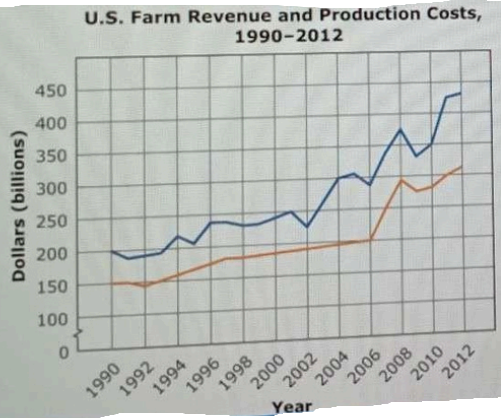
- A. Gross farm income continued the decline that had characterized previous years.
- B. Gross farm income increased despite increases in production costs.
- C. Increases in production costs caused gross farm income to decline.
- D. Decreases in production costs continued throughout this period.
Correct Answer & Rationale
Correct Answer: B
During the period from 2006 to 2008, gross farm income saw an increase, even as production costs rose. This indicates that farmers managed to offset higher expenses with increased revenue. Option A is incorrect as it suggests a continuation of decline, which contradicts the data showing growth in income. Option C misinterprets the relationship between rising costs and income, as income actually increased despite those costs. Option D is inaccurate because it implies a consistent decrease in production costs, which is not supported by the graph indicating rising expenses during this timeframe.
During the period from 2006 to 2008, gross farm income saw an increase, even as production costs rose. This indicates that farmers managed to offset higher expenses with increased revenue. Option A is incorrect as it suggests a continuation of decline, which contradicts the data showing growth in income. Option C misinterprets the relationship between rising costs and income, as income actually increased despite those costs. Option D is inaccurate because it implies a consistent decrease in production costs, which is not supported by the graph indicating rising expenses during this timeframe.
According to Justice Marshall, what historical factor has contradicted the ideas expressed in the U.S. Constitution?
- A. slavery
- B. free enterprise
- C. religion
- D. class war
Correct Answer & Rationale
Correct Answer: A
Justice Marshall highlighted slavery as a significant historical contradiction to the principles of freedom and equality enshrined in the U.S. Constitution. Slavery directly undermined the Constitution's assertion that all men are created equal, creating a profound moral and ethical conflict. In contrast, free enterprise (B) aligns with the Constitution's emphasis on individual rights and economic freedom. Religion (C) is protected under the First Amendment, promoting freedom rather than contradiction. Class war (D) is a socio-economic conflict that, while relevant, does not directly challenge the foundational ideals of the Constitution in the same way slavery does.
Justice Marshall highlighted slavery as a significant historical contradiction to the principles of freedom and equality enshrined in the U.S. Constitution. Slavery directly undermined the Constitution's assertion that all men are created equal, creating a profound moral and ethical conflict. In contrast, free enterprise (B) aligns with the Constitution's emphasis on individual rights and economic freedom. Religion (C) is protected under the First Amendment, promoting freedom rather than contradiction. Class war (D) is a socio-economic conflict that, while relevant, does not directly challenge the foundational ideals of the Constitution in the same way slavery does.
How does the message presented by Senator Paul differ from the message presented by President Obama?
- A. Only Senator Paul promotes less government involvement in health care.
- B. Only Senator Paul wants to secure more health care for U.S. citizens.
- C. Only President Obama supports the Supreme Court's right to rule about health care.
- D. Only President Obama discusses problems in the health care industry.
Correct Answer & Rationale
Correct Answer: A
Senator Paul advocates for reduced government involvement in health care, emphasizing personal choice and market-driven solutions. This contrasts with President Obama's approach, which supports a more active role for the government in expanding access and regulating the industry. Option B is incorrect as both politicians aim to improve health care access, albeit through different methods. Option C misrepresents Obama's stance; he supports health care reforms that align with Supreme Court rulings but does not solely focus on this aspect. Option D is misleading; while Obama addresses health care issues, Senator Paul also discusses industry challenges, making this option inaccurate.
Senator Paul advocates for reduced government involvement in health care, emphasizing personal choice and market-driven solutions. This contrasts with President Obama's approach, which supports a more active role for the government in expanding access and regulating the industry. Option B is incorrect as both politicians aim to improve health care access, albeit through different methods. Option C misrepresents Obama's stance; he supports health care reforms that align with Supreme Court rulings but does not solely focus on this aspect. Option D is misleading; while Obama addresses health care issues, Senator Paul also discusses industry challenges, making this option inaccurate.