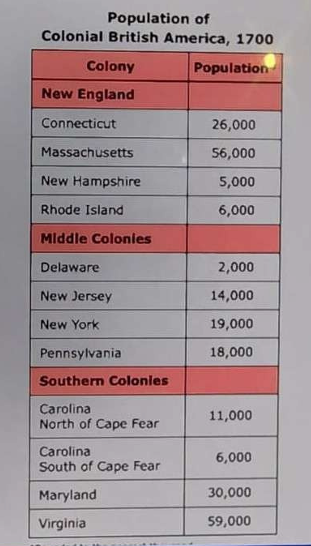
This table contains data from the U.S. Census Bureau.
What was the mean population across the British American colonies in 1700?
- A. 56,000
- B. 21,000
- C. 6,000
- D. 16,000
Correct Answer & Rationale
Correct Answer: D
In 1700, the mean population across the British American colonies was approximately 16,000. This figure reflects the early colonial growth and settlement patterns during that period. Option A (56,000) overestimates the population, as it does not account for the smaller settlements and rural areas that characterized the colonies at that time. Option B (21,000) is also too high, misrepresenting the demographic data available for the early 18th century. Option C (6,000) significantly underestimates the population, ignoring the established colonies with growing communities. Thus, D accurately represents the mean population based on historical records.
In 1700, the mean population across the British American colonies was approximately 16,000. This figure reflects the early colonial growth and settlement patterns during that period. Option A (56,000) overestimates the population, as it does not account for the smaller settlements and rural areas that characterized the colonies at that time. Option B (21,000) is also too high, misrepresenting the demographic data available for the early 18th century. Option C (6,000) significantly underestimates the population, ignoring the established colonies with growing communities. Thus, D accurately represents the mean population based on historical records.
Other Related Questions
Which statement identifies the purpose of President Nixon's message?
- A. to convince Congress that technological advancement and population growth must be slowed to protect the environment
- B. to convince Congress that industrial polluters of the air and water should not pay for cleaning the environment
- C. to convince Congress that it must take part in action to address human damage to the environment
- D. to convince Congress that there should be no benefits for businesses that pollute the environment
Correct Answer & Rationale
Correct Answer: C
President Nixon's message aimed to mobilize Congress to actively engage in addressing environmental degradation caused by human activities. This focus on collective action underscores the urgency of legislative involvement in environmental protection. Option A misinterprets the goal, as Nixon did not advocate for slowing technological advancement but rather for responsible management. Option B inaccurately suggests that he supported industrial polluters avoiding responsibility, which contradicts his environmental stance. Option D implies a complete lack of support for businesses, neglecting the balanced approach Nixon promoted towards regulatory measures and economic growth.
President Nixon's message aimed to mobilize Congress to actively engage in addressing environmental degradation caused by human activities. This focus on collective action underscores the urgency of legislative involvement in environmental protection. Option A misinterprets the goal, as Nixon did not advocate for slowing technological advancement but rather for responsible management. Option B inaccurately suggests that he supported industrial polluters avoiding responsibility, which contradicts his environmental stance. Option D implies a complete lack of support for businesses, neglecting the balanced approach Nixon promoted towards regulatory measures and economic growth.
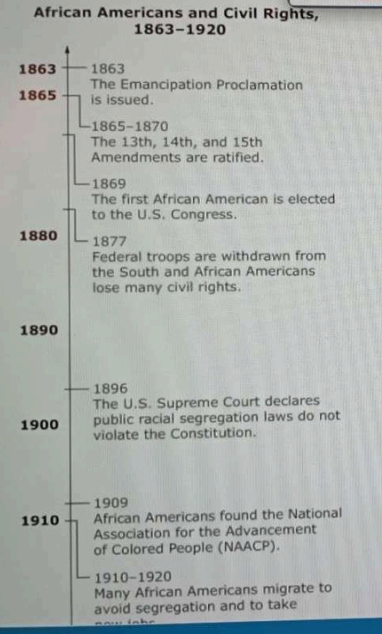
Based on the timeline and the map, what was one way African Americans dealt with Jim Crow laws?
- A. by taking service jobs in southern cities
- B. by seeking factory jobs in urban areas of the North
- C. by becoming tenant farmers in other parts of the South
- D. by gaining technical skills in northern schools
Correct Answer & Rationale
Correct Answer: B
African Americans responded to Jim Crow laws by seeking factory jobs in urban areas of the North, as this migration offered better economic opportunities and a chance to escape oppressive conditions in the South. Option A, taking service jobs in southern cities, often perpetuated the same discriminatory practices found under Jim Crow. Option C, becoming tenant farmers in other parts of the South, did not provide significant relief from the systemic racism and economic hardship prevalent in that region. Option D, gaining technical skills in northern schools, while beneficial, was not a widespread or immediate solution compared to the mass migration to northern factories.
African Americans responded to Jim Crow laws by seeking factory jobs in urban areas of the North, as this migration offered better economic opportunities and a chance to escape oppressive conditions in the South. Option A, taking service jobs in southern cities, often perpetuated the same discriminatory practices found under Jim Crow. Option C, becoming tenant farmers in other parts of the South, did not provide significant relief from the systemic racism and economic hardship prevalent in that region. Option D, gaining technical skills in northern schools, while beneficial, was not a widespread or immediate solution compared to the mass migration to northern factories.
Which statement from the passage is an opinion?
- A. "Even so, the success of Levittown depended not only on the efficiency of the Levitt brothers' process but also on the Federal Housing Administration" (paragraph 4)
- B. "Shortly after World War II, many changes led to the development of suburbs." (paragraph 1)
- C. "This, much of the baby-boom generation had well-constructed homes in which to grow up." (paragraph 4)
- D. "With this financing in place, more homes could be built and more veterans could afford to buy them." (paragraph 4)
Correct Answer & Rationale
Correct Answer: C
Option C expresses a subjective view about the quality of homes available to the baby-boom generation, indicating an opinion that these homes were "well-constructed." This characterization is not a factual statement and reflects a personal judgment. In contrast, Option A presents a factual statement about the factors contributing to Levittown's success, grounded in historical context. Option B provides a straightforward observation regarding the timeline of suburban development, without personal interpretation. Option D outlines a factual cause-and-effect relationship regarding financing and home construction, remaining objective. Thus, only Option C conveys a personal opinion.
Option C expresses a subjective view about the quality of homes available to the baby-boom generation, indicating an opinion that these homes were "well-constructed." This characterization is not a factual statement and reflects a personal judgment. In contrast, Option A presents a factual statement about the factors contributing to Levittown's success, grounded in historical context. Option B provides a straightforward observation regarding the timeline of suburban development, without personal interpretation. Option D outlines a factual cause-and-effect relationship regarding financing and home construction, remaining objective. Thus, only Option C conveys a personal opinion.
Which historical event shaped President Wilson's point of view?
- A. the enactment of the Neutrality Acts
- B. the building of the Panama Canal
- C. the outcome of the Spanish-American War
- D. the fighting in World War I
Correct Answer & Rationale
Correct Answer: D
President Wilson's perspective was profoundly shaped by the fighting in World War I, as it highlighted the need for a new approach to international relations and the promotion of democracy. His commitment to a peaceful resolution and the establishment of the League of Nations stemmed from the devastation of the war. Option A, the Neutrality Acts, reflects a desire to avoid conflict, but they were enacted after Wilson's initial views were formed. Option B, the Panama Canal, was significant for U.S. expansion but did not directly influence Wilson's foreign policy. Option C, the Spanish-American War, marked an earlier phase of U.S. imperialism, contrasting with Wilson's focus on self-determination and peace.
President Wilson's perspective was profoundly shaped by the fighting in World War I, as it highlighted the need for a new approach to international relations and the promotion of democracy. His commitment to a peaceful resolution and the establishment of the League of Nations stemmed from the devastation of the war. Option A, the Neutrality Acts, reflects a desire to avoid conflict, but they were enacted after Wilson's initial views were formed. Option B, the Panama Canal, was significant for U.S. expansion but did not directly influence Wilson's foreign policy. Option C, the Spanish-American War, marked an earlier phase of U.S. imperialism, contrasting with Wilson's focus on self-determination and peace.