The U.S. System of Federalism
1. Federalism is a system of government in which power is divided between a central authority and smaller political units, such as states or provinces. This basic principle is presented in the 10th Amendment to the U.S. Constitution.
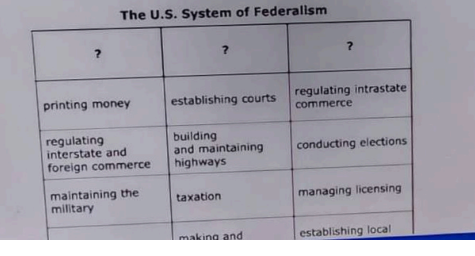
2. Under U.S. federalism, the national government is given power over issues of countrywide concern. These powers inciude providing national defense and declaring war, entering into treaties with foreign governments, printing money, regulating interstate and international commerce, and making laws that enforce the U.S. Constitution.
3. Power over domestic issues usually falls under the powers of the states. These powers include establishing local governments and issuing licenses. States also have the power to regulate intrastate commerce, provide for public health and safety, and exercise other powers that are not given to the federal government nor prohibited to the state governments. Finally, states exercise political powers, which include conducting elections and ratifying amendments to the U.S.Constitution.
4. The national and state governments share the powers of establishing and collecting taxes, building and maintaining highways, borrowing and spending
Complete the U.S. System of Federalism chart based on information from the passage. Click on the title below you want to select and drag it into the top of each column in the chart.
Correct Answer & Rationale
Correct Answer:
**Correct answer:** Federal Government **Rationale:** The Federal Government is responsible for national issues such as defense, immigration, and foreign policy, which distinguishes it from state governments. State Governments handle local matters like education and transportation, focusing on regional needs. The option "Local Government" refers to municipal or county levels, which operate under the authority of the state and do not encompass federal responsibilities. Therefore, the Federal Government is accurately placed at the top of the federalism chart, while the other options misrepresent the hierarchy and scope of governance in the U.S. system.
**Correct answer:** Federal Government **Rationale:** The Federal Government is responsible for national issues such as defense, immigration, and foreign policy, which distinguishes it from state governments. State Governments handle local matters like education and transportation, focusing on regional needs. The option "Local Government" refers to municipal or county levels, which operate under the authority of the state and do not encompass federal responsibilities. Therefore, the Federal Government is accurately placed at the top of the federalism chart, while the other options misrepresent the hierarchy and scope of governance in the U.S. system.
Other Related Questions
What is the meaning of the word entrenched as used in this excerpt?
- A. in control
- B. strongly defended
- C. established and unlikely to change
- D. surrounded and unable to move
Correct Answer & Rationale
Correct Answer: C
The term "entrenched" conveys the idea of something that is firmly established and resistant to change, aligning with option C. This suggests a deep-rooted nature, often implying that it has become a significant part of a system or belief. Option A, "in control," does not capture the essence of being deeply embedded or resistant to alteration. Option B, "strongly defended," implies a protective stance rather than a state of being firmly established. Option D, "surrounded and unable to move," suggests physical confinement rather than the figurative sense of being firmly set in place.
The term "entrenched" conveys the idea of something that is firmly established and resistant to change, aligning with option C. This suggests a deep-rooted nature, often implying that it has become a significant part of a system or belief. Option A, "in control," does not capture the essence of being deeply embedded or resistant to alteration. Option B, "strongly defended," implies a protective stance rather than a state of being firmly established. Option D, "surrounded and unable to move," suggests physical confinement rather than the figurative sense of being firmly set in place.
Which statement from the excerpts is a fact?
- A. "When people blame the current crisis on the free market, they are making a grave intellectual error." (paragraph 3)
- B. "... we ultimately included a provision in the Affordable Care Act that people who can afford to buy health insurance should take the responsibility to do so." (paragraph 7)
- C. "Like other areas of the economy where the federal government wields its heavy hand, health care is overregulated and in need of serious market reforms." (paragraph 2)
- D. "... [T]oday's decision was a victory for people all over this country whose lives will be more secure because of this law and the Supreme Court's decision to uphold it." (paragraph 5)
Correct Answer & Rationale
Correct Answer: B
Option B presents a factual statement regarding the Affordable Care Act, specifically mentioning a provision that mandates individuals who can afford health insurance to take responsibility for purchasing it. This is a verifiable aspect of the legislation. In contrast, Option A expresses an opinion about blaming the free market, which is subjective and open to interpretation. Option C also conveys a viewpoint on government regulation and reform needs, lacking objective verification. Lastly, Option D describes a perceived outcome of a decision, reflecting an opinion on its impact rather than presenting a fact. Thus, only Option B stands as an objective statement grounded in legislation.
Option B presents a factual statement regarding the Affordable Care Act, specifically mentioning a provision that mandates individuals who can afford health insurance to take responsibility for purchasing it. This is a verifiable aspect of the legislation. In contrast, Option A expresses an opinion about blaming the free market, which is subjective and open to interpretation. Option C also conveys a viewpoint on government regulation and reform needs, lacking objective verification. Lastly, Option D describes a perceived outcome of a decision, reflecting an opinion on its impact rather than presenting a fact. Thus, only Option B stands as an objective statement grounded in legislation.
Which statement is supported by both the table and the map?
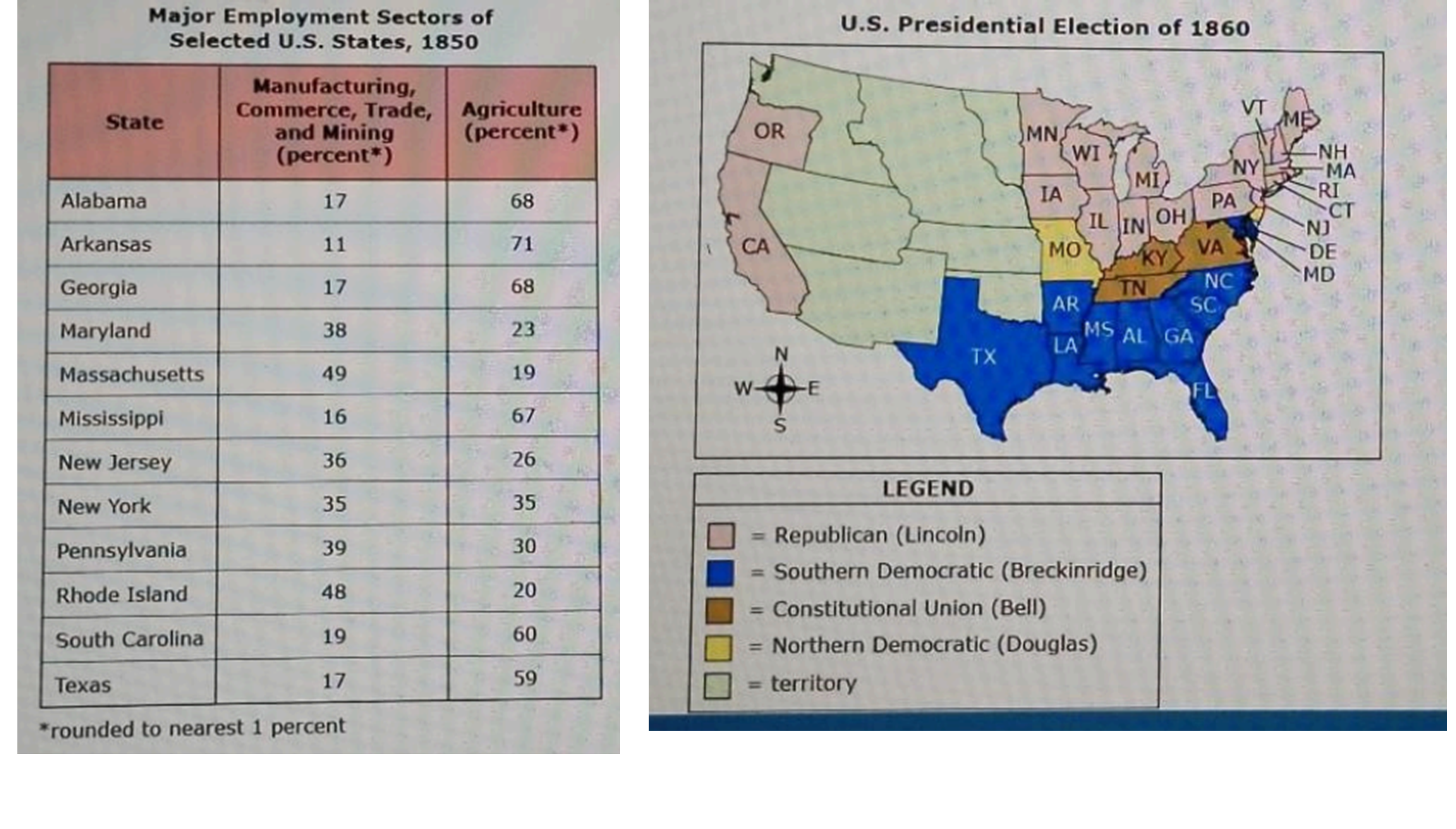
- A. Differences in the total populations of the states led to political differences between the North and the South.
- B. Differences among the economies of the states contributed to political differences between the North and the South.
- C. Political differences between the North and the South reflected differences in education among the states.
- D. Political differences between the North and the South reflected differences in the standards of living in the states.
Correct Answer & Rationale
Correct Answer: B
Option B is supported by both the table and the map, as they illustrate how varying economic structures—such as agriculture in the South versus industrialization in the North—contributed to distinct political ideologies and policies. Option A incorrectly attributes political differences solely to population size, overlooking the economic factors at play. Option C suggests education differences as the main cause, which is not evident in the provided data. Option D implies that living standards were the primary influence, but the economic context is more directly linked to the political divide. Thus, B effectively encapsulates the relationship between economy and political differences.
Option B is supported by both the table and the map, as they illustrate how varying economic structures—such as agriculture in the South versus industrialization in the North—contributed to distinct political ideologies and policies. Option A incorrectly attributes political differences solely to population size, overlooking the economic factors at play. Option C suggests education differences as the main cause, which is not evident in the provided data. Option D implies that living standards were the primary influence, but the economic context is more directly linked to the political divide. Thus, B effectively encapsulates the relationship between economy and political differences.
Which event counters the viewpoint expressed in the newspaper excerpt that African Americans refused to defend their civil rights?
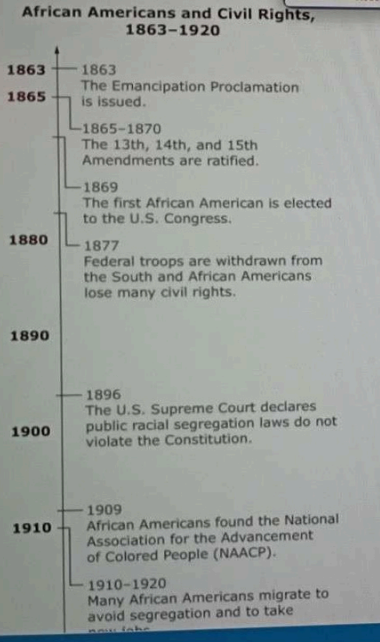
- A. the ratification of the 13th, 14th, and 15th Amendments
- B. the issuance of the Emancipation Proclamation
- C. the founding of the National Association for the Advancement of Colored People
- D. the start of the Great Migration
Correct Answer & Rationale
Correct Answer: C
The founding of the National Association for the Advancement of Colored People (NAACP) directly counters the viewpoint that African Americans refused to defend their civil rights. Established in 1909, the NAACP actively fought for civil rights through legal challenges, advocacy, and public education, demonstrating a strong commitment to defending their rights. Option A, the ratification of the 13th, 14th, and 15th Amendments, although significant, primarily established legal rights rather than showcasing active defense. Option B, the Emancipation Proclamation, ended slavery but did not directly address civil rights activism. Option D, the Great Migration, reflects a movement for better opportunities but does not specifically illustrate organized efforts to defend civil rights.
The founding of the National Association for the Advancement of Colored People (NAACP) directly counters the viewpoint that African Americans refused to defend their civil rights. Established in 1909, the NAACP actively fought for civil rights through legal challenges, advocacy, and public education, demonstrating a strong commitment to defending their rights. Option A, the ratification of the 13th, 14th, and 15th Amendments, although significant, primarily established legal rights rather than showcasing active defense. Option B, the Emancipation Proclamation, ended slavery but did not directly address civil rights activism. Option D, the Great Migration, reflects a movement for better opportunities but does not specifically illustrate organized efforts to defend civil rights.