These excerpts are from the first volume of Alexis de Tocquevilles osoit Delhicciacy in America, published in 1835.
Excerpt 1
A majority... may be regarded as a being whose opinions, and most frequently whose interests, are opposed to those of another being, which is styled a minority. If it be admitted that a man, possessing absolute power, may misuse that power by wronging his adversaries, why should a majority not be liable to the same reproach?
Excerpt 2
If there existed in America a class of citizens whom the... majority sought to deprive of exclusive privileges which they had possessed for ages... it is probable that the minority would be less ready to comply with its laws.
These excerpts are taken from the public domain.
Which feature of the U.S. system of government did de Tocqueville believe might cause conflict in society?
- A. The majority is able to achieve special rights.
- B. The minority is able to block popular legislation.
- C. Legislators must represent minority interests.
- D. Legislators sometimes act against majority rule.
Correct Answer & Rationale
Correct Answer: A
De Tocqueville observed that when the majority in a democracy can impose its will, it might lead to the oppression of minority groups, creating societal conflict. This reflects his concern about "tyranny of the majority," where the dominant group's interests overshadow the rights of others. Option B is incorrect because while minorities can influence legislation, de Tocqueville focused more on majority power. Option C misrepresents his views; he acknowledged the importance of minority representation but did not see it as a source of conflict. Option D is also inaccurate, as de Tocqueville emphasized the potential for the majority to dominate rather than legislators opposing the majority.
De Tocqueville observed that when the majority in a democracy can impose its will, it might lead to the oppression of minority groups, creating societal conflict. This reflects his concern about "tyranny of the majority," where the dominant group's interests overshadow the rights of others. Option B is incorrect because while minorities can influence legislation, de Tocqueville focused more on majority power. Option C misrepresents his views; he acknowledged the importance of minority representation but did not see it as a source of conflict. Option D is also inaccurate, as de Tocqueville emphasized the potential for the majority to dominate rather than legislators opposing the majority.
Other Related Questions
Which statement about the ratification of the 19th Amendment is based on the passage?
- A. Ratification was the result of the Seneca Falls Convention.
- B. Ratification occurred in return for the military service of women during World War I.
- C. Ratification occurred prior to the granting of voting rights to freed slaves.
- D. Ratification was the result of the accumulated efforts of women for decades.
Correct Answer & Rationale
Correct Answer: D
The ratification of the 19th Amendment was the culmination of decades of advocacy and activism by women who fought tirelessly for their voting rights, making option D the most accurate statement. Option A incorrectly attributes the ratification solely to the Seneca Falls Convention, which was just one of many events in the long struggle for women's suffrage. Option B suggests a direct exchange of military service for voting rights, which oversimplifies the complex social and political factors involved. Option C misrepresents the timeline, as the 19th Amendment was ratified after the Civil War, but the fight for voting rights for freed slaves and women evolved concurrently, not sequentially.
The ratification of the 19th Amendment was the culmination of decades of advocacy and activism by women who fought tirelessly for their voting rights, making option D the most accurate statement. Option A incorrectly attributes the ratification solely to the Seneca Falls Convention, which was just one of many events in the long struggle for women's suffrage. Option B suggests a direct exchange of military service for voting rights, which oversimplifies the complex social and political factors involved. Option C misrepresents the timeline, as the 19th Amendment was ratified after the Civil War, but the fight for voting rights for freed slaves and women evolved concurrently, not sequentially.
Which historical event most likely shaped the author's point of view?
- A. the development of the concept of Manifest Destiny
- B. the United States' involvement in World War I
- C. the United States' internal conflicts during the Great Depression
- D. the calls for social reform during Prohibition
Correct Answer & Rationale
Correct Answer: B
The author's perspective is significantly influenced by the United States' involvement in World War I, as this event marked a pivotal shift in national identity and global engagement. The war prompted discussions about democracy, freedom, and the role of the U.S. on the world stage, shaping the author's views on these themes. Option A, Manifest Destiny, pertains to 19th-century expansionism, which is less relevant to the author's context. Option C, the Great Depression, focuses on economic struggles rather than the broader geopolitical implications of war. Option D, social reform during Prohibition, addresses domestic issues but does not encompass the global impact and ideological shifts brought about by World War I.
The author's perspective is significantly influenced by the United States' involvement in World War I, as this event marked a pivotal shift in national identity and global engagement. The war prompted discussions about democracy, freedom, and the role of the U.S. on the world stage, shaping the author's views on these themes. Option A, Manifest Destiny, pertains to 19th-century expansionism, which is less relevant to the author's context. Option C, the Great Depression, focuses on economic struggles rather than the broader geopolitical implications of war. Option D, social reform during Prohibition, addresses domestic issues but does not encompass the global impact and ideological shifts brought about by World War I.
Which prediction is supported by both graphs?
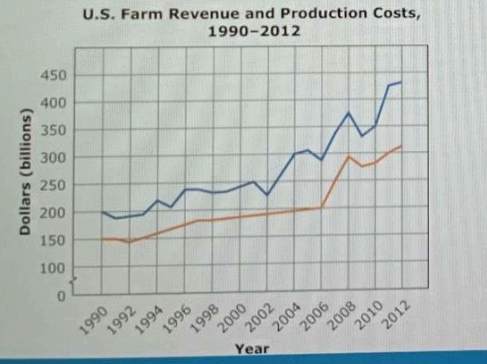
- A. The average wage for farm workers will decrease..
- B. The average cost for agricultural produce will decrease.
- C. The operating cost of running a farm will increase.
- D. The number of people required for producing food will increase.
Correct Answer & Rationale
Correct Answer: C
Option C is supported by both graphs, indicating an upward trend in operational costs due to factors like inflation and increased resource prices. This aligns with economic patterns observed in the agricultural sector. Option A is incorrect as both graphs do not show a decline in farm worker wages; rather, they suggest stability or growth. Option B is misleading; the graphs do not reflect a decrease in agricultural produce costs, which often correlate with rising operational expenses. Option D is also unsupported, as the data does not indicate an increase in labor requirements, but rather highlights efficiency improvements in farming practices.
Option C is supported by both graphs, indicating an upward trend in operational costs due to factors like inflation and increased resource prices. This aligns with economic patterns observed in the agricultural sector. Option A is incorrect as both graphs do not show a decline in farm worker wages; rather, they suggest stability or growth. Option B is misleading; the graphs do not reflect a decrease in agricultural produce costs, which often correlate with rising operational expenses. Option D is also unsupported, as the data does not indicate an increase in labor requirements, but rather highlights efficiency improvements in farming practices.
Assuming that the majority of senators and representatives voted along party lines, which conclusion about the U.S. government in 2011 does the table support?
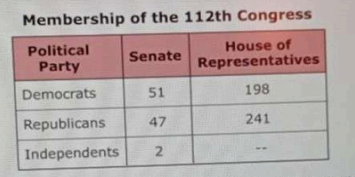
- A. The party that passed more legislation could be anticipated.
- B. The party that would win the next presidential election could be predicted.
- C. Party divisions were a challenge to the legislative process.
- D. Party affiliations are a requirement for congressional membership.
Correct Answer & Rationale
Correct Answer: C
The data suggests that party divisions significantly impacted the legislative process in 2011, indicating that partisan alignment often hindered bipartisan cooperation. Option A incorrectly implies that the quantity of legislation passed directly correlates with party strength, which is not supported by the information. Option B assumes a direct link between legislative success and electoral outcomes, which cannot be inferred from party voting patterns alone. Option D misrepresents the nature of congressional membership, as party affiliation is not a formal requirement but rather a common practice among members.
The data suggests that party divisions significantly impacted the legislative process in 2011, indicating that partisan alignment often hindered bipartisan cooperation. Option A incorrectly implies that the quantity of legislation passed directly correlates with party strength, which is not supported by the information. Option B assumes a direct link between legislative success and electoral outcomes, which cannot be inferred from party voting patterns alone. Option D misrepresents the nature of congressional membership, as party affiliation is not a formal requirement but rather a common practice among members.