These statements are from Essentials of Americanization, a book by soclology professor Emory S. Bogardus.
The Americanization movement had its primary, or immediate, origin in 1914 when... a renaissance of nationalism occurred throughout the civilized world.
Americanization begins with an examination of American traits and ends with... an assimilation movement... We may consider the Mayflower Compact as the initial statement of Americanism... and Theodore Roosevelt's and Woodrow Wilson's recent addresses as modern revisions....
Our national purpose must be clearly stated, taught to our people, and accepted throughout the land.... It will be necessary continually to shun... autocracy, imperialism, ambition for world domination, [and] Injustice in dealing with weak nations, classes, or persons.
[The United States] must transform her imperfect democracy, not into another strong nation-state... but into a perfected democracy dedicated to the task of pushing forward the principles of democracy throughout the world.
Which historical event most likely shaped the author's point of view?
- A. the development of the concept of Manifest Destiny
- B. the United States' involvement in World War I
- C. the United States' internal conflicts during the Great Depression
- D. the calls for social reform during Prohibition
Correct Answer & Rationale
Correct Answer: B
The author's perspective is significantly influenced by the United States' involvement in World War I, as this event marked a pivotal shift in national identity and global engagement. The war prompted discussions about democracy, freedom, and the role of the U.S. on the world stage, shaping the author's views on these themes. Option A, Manifest Destiny, pertains to 19th-century expansionism, which is less relevant to the author's context. Option C, the Great Depression, focuses on economic struggles rather than the broader geopolitical implications of war. Option D, social reform during Prohibition, addresses domestic issues but does not encompass the global impact and ideological shifts brought about by World War I.
The author's perspective is significantly influenced by the United States' involvement in World War I, as this event marked a pivotal shift in national identity and global engagement. The war prompted discussions about democracy, freedom, and the role of the U.S. on the world stage, shaping the author's views on these themes. Option A, Manifest Destiny, pertains to 19th-century expansionism, which is less relevant to the author's context. Option C, the Great Depression, focuses on economic struggles rather than the broader geopolitical implications of war. Option D, social reform during Prohibition, addresses domestic issues but does not encompass the global impact and ideological shifts brought about by World War I.
Other Related Questions
Which basic assumption is only behind the speech?
- A. Freedom of speech must be protected in schools.
- B. Citizens can express their views through symbols.
- C. Citizens should be able to express their views on issues.
- D. Freedom of speech has some restrictions
Correct Answer & Rationale
Correct Answer: D
The assumption that freedom of speech has some restrictions is solely focused on the speech itself, acknowledging that while individuals have the right to express themselves, this right is not absolute. Option A discusses the protection of speech specifically in schools, which implies a context rather than the nature of speech itself. Option B refers to expression through symbols, indicating non-verbal communication, thus not limited to speech. Option C emphasizes the ability to express views on issues broadly, again not confined to speech alone. Each of these options extends beyond the core principle of speech restrictions.
The assumption that freedom of speech has some restrictions is solely focused on the speech itself, acknowledging that while individuals have the right to express themselves, this right is not absolute. Option A discusses the protection of speech specifically in schools, which implies a context rather than the nature of speech itself. Option B refers to expression through symbols, indicating non-verbal communication, thus not limited to speech. Option C emphasizes the ability to express views on issues broadly, again not confined to speech alone. Each of these options extends beyond the core principle of speech restrictions.
Based on the flowchart, how is a political party's presidential candidate selected?
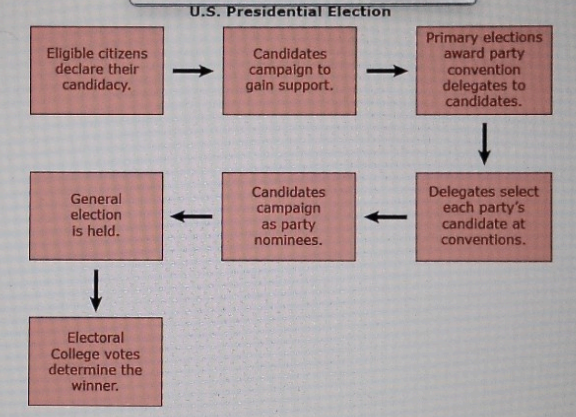
- A. by balloting after the general election
- B. by balloting at the party convention
- C. by votes cast in party primary elections
- D. by votes cast in the general election
Correct Answer & Rationale
Correct Answer: C
The selection of a political party's presidential candidate primarily occurs through votes cast in party primary elections. This process allows party members to express their preferences for candidates before the general election, ensuring that the nominee reflects the party's values and priorities. Option A is incorrect because the general election occurs after the candidate has already been chosen. Option B, while related to the convention, is misleading as the convention typically formalizes the candidate chosen in the primaries rather than selecting them. Option D is also incorrect, as the general election determines the overall winner, not the party's candidate.
The selection of a political party's presidential candidate primarily occurs through votes cast in party primary elections. This process allows party members to express their preferences for candidates before the general election, ensuring that the nominee reflects the party's values and priorities. Option A is incorrect because the general election occurs after the candidate has already been chosen. Option B, while related to the convention, is misleading as the convention typically formalizes the candidate chosen in the primaries rather than selecting them. Option D is also incorrect, as the general election determines the overall winner, not the party's candidate.
How does the U.S. Supreme Court's ruling differ from Justice Murphy's dissent?
- A. Only Justice Murphy's dissent acknowledged the dangers to the United States of having citizens from foreign lands.
- B. Only the Court's ruling acknowledged that the actions of fearful U.S. authorities can endanger the civil rights of citizens.
- C. Only the Court's ruling contended that Korematsu was ordered held in an internment camp because he was disloyal to the United States during time of war.
- D. Only Justice Murphy's dissent contended that U.S. internment camps were a clear-cut example of racial prejudice.
Correct Answer & Rationale
Correct Answer: D
Justice Murphy's dissent emphasized that the internment camps represented blatant racial prejudice, highlighting the unjust targeting of Japanese Americans based solely on their ethnicity. This perspective contrasts sharply with the majority opinion, which focused on national security concerns without addressing the racial implications. Option A is incorrect as both perspectives recognize the potential dangers of foreign nationals, albeit in different contexts. Option B misrepresents the majority's stance, which did not explicitly acknowledge civil rights violations. Option C inaccurately simplifies the Court's ruling, which did not solely attribute internment to disloyalty.
Justice Murphy's dissent emphasized that the internment camps represented blatant racial prejudice, highlighting the unjust targeting of Japanese Americans based solely on their ethnicity. This perspective contrasts sharply with the majority opinion, which focused on national security concerns without addressing the racial implications. Option A is incorrect as both perspectives recognize the potential dangers of foreign nationals, albeit in different contexts. Option B misrepresents the majority's stance, which did not explicitly acknowledge civil rights violations. Option C inaccurately simplifies the Court's ruling, which did not solely attribute internment to disloyalty.
Which statement best describes the action of the people in the photograph?
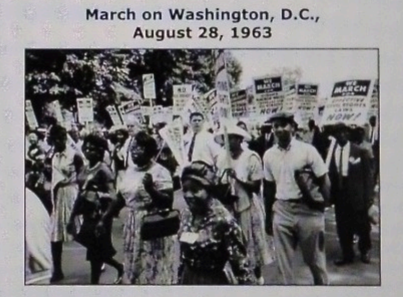
- A. They are utilizing an 8th Amendment right to secure the release of a colleague who was jailed unfairly.
- B. They are utilizing a 6th Amendment right to secure a fair trial for a jailed associate.
- C. They are utilizing a 1st Amendment right to secure equality under the law.
- D. They are utilizing a 14th Amendment right to secure the opportunity to vote in federal elections.
Correct Answer & Rationale
Correct Answer: C
The action depicted in the photograph aligns with the 1st Amendment, which guarantees freedoms concerning speech, assembly, and the right to petition the government. The individuals are likely advocating for equality under the law, a fundamental principle of democratic society. Option A incorrectly references the 8th Amendment, which focuses on protection against excessive bail and cruel punishment, not the right to protest for a colleague's release. Option B misapplies the 6th Amendment, which ensures the right to a fair trial, rather than addressing broader issues of equality. Option D inaccurately connects the situation to the 14th Amendment, which deals with citizenship rights and equal protection, not specifically voting rights.
The action depicted in the photograph aligns with the 1st Amendment, which guarantees freedoms concerning speech, assembly, and the right to petition the government. The individuals are likely advocating for equality under the law, a fundamental principle of democratic society. Option A incorrectly references the 8th Amendment, which focuses on protection against excessive bail and cruel punishment, not the right to protest for a colleague's release. Option B misapplies the 6th Amendment, which ensures the right to a fair trial, rather than addressing broader issues of equality. Option D inaccurately connects the situation to the 14th Amendment, which deals with citizenship rights and equal protection, not specifically voting rights.