This is an excerpt from a 2001 speech by U.S. Representative Ron Paul, introducing the Education Improvement Tax Cut Act.
I need not remind my colleagues that education is one of, if not the, top priority of the American people.... Many proposals that claim to increase local control over education actually extend federal power by holding schools "accountable" to federal bureaucrats and politicians. Of course, schools should be held accountable for their results, but under the United States Constitution, they should be held accountable to parents and school boards not to federal officials.
This excerpt is taken from the public domain.
This is an excerpt from a 2009 speech by President George W. Bush, discussing the No Child Left Behind Act.
We believe that it is important to have a high quality education if one is going to succeed in the 21st century.... The philosophy behind the law is pretty straightforward... In exchange for federal dollars... we expect results. We're spending money on schools, and shouldn't we determine whether or not the money we're spending is yielding the results society expects?
This excerpt is taken from the public domain.
Based on the excerpts, which speaker would agree with each statement below? Drag each statement into the box labeled with that speaker's name. If neither would agree with a statement, drag it to the box labeled "Neither."
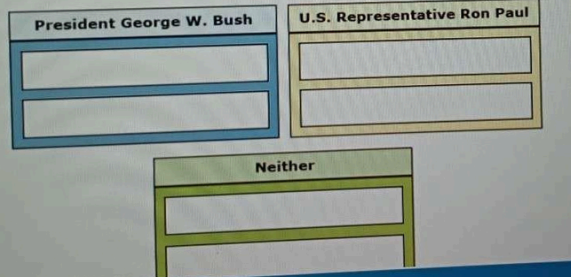
- A. Congress should spend money public education.
- B. Schools should meet federal education guidelines.
- C. Parents should hold public schools accountable.
- D. Local districts should set school guidelines.
Correct Answer & Rationale
Correct Answer:
Speaker A likely supports the idea that Congress should spend money on public education, as this aligns with a belief in federal investment in education for equitable access. Speaker B would agree that schools should meet federal education guidelines, as this emphasizes the importance of uniform standards for educational quality and accountability. Speaker C advocates for parental accountability in public schools, reflecting the belief that parents play a vital role in monitoring and improving educational outcomes. Speaker D likely supports the idea that local districts should set school guidelines, as this allows for tailored approaches that reflect community needs and values. If neither speaker aligns with a statement, it belongs in the "Neither" category.
Speaker A likely supports the idea that Congress should spend money on public education, as this aligns with a belief in federal investment in education for equitable access. Speaker B would agree that schools should meet federal education guidelines, as this emphasizes the importance of uniform standards for educational quality and accountability. Speaker C advocates for parental accountability in public schools, reflecting the belief that parents play a vital role in monitoring and improving educational outcomes. Speaker D likely supports the idea that local districts should set school guidelines, as this allows for tailored approaches that reflect community needs and values. If neither speaker aligns with a statement, it belongs in the "Neither" category.
Other Related Questions
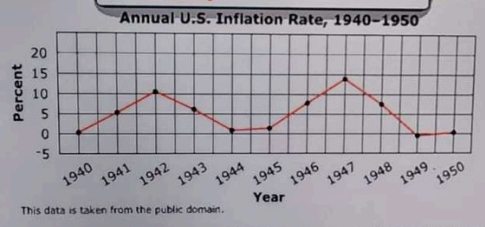
The United States fought in World War II from 1941 to 1945. Which statement explains the peak annual inflation rate during the 1940s?
- A. Consumer demand increased due to the end of rationing.
- B. Manufacturing decreased because of less demand for weapons.
- C. Government spending increased due to national defense.
- D. Wages decreased because of competition for scarce jobs.
Correct Answer & Rationale
Correct Answer: C
The peak annual inflation rate during the 1940s can be attributed to increased government spending due to national defense efforts. This surge in spending stimulated the economy and raised prices as the demand for goods and services outpaced supply. Option A is incorrect; while consumer demand did rise post-rationing, it was not the primary driver of inflation during the war years. Option B is also wrong, as manufacturing actually increased during the war to meet military needs. Option D misrepresents the labor market; wages generally rose due to high demand for workers, not decreased. Thus, government spending for defense was the key factor in driving inflation during this period.
The peak annual inflation rate during the 1940s can be attributed to increased government spending due to national defense efforts. This surge in spending stimulated the economy and raised prices as the demand for goods and services outpaced supply. Option A is incorrect; while consumer demand did rise post-rationing, it was not the primary driver of inflation during the war years. Option B is also wrong, as manufacturing actually increased during the war to meet military needs. Option D misrepresents the labor market; wages generally rose due to high demand for workers, not decreased. Thus, government spending for defense was the key factor in driving inflation during this period.
Which statement from Common Sense provides evidence that the author Thomas Paine supported American independence?
- A. "Absolute governments have this advantage with them, that they are simple..."
- B. "I challenge the warmest advocate for reconciliation, to [show], a single advantage that this continent can reap, by being connected with Great Britain."
- C. "The prejudice of Englishmen, in [favor] of their own government arises as much or more from national pride than reason."
- D. "Society in every state is a blessing, but government even in its best state is but a necessary evil."
Correct Answer & Rationale
Correct Answer: B
Option B provides clear evidence of Thomas Paine's support for American independence by challenging the benefits of remaining connected to Great Britain. By asking advocates for reconciliation to demonstrate any advantages, Paine emphasizes the futility of such ties and advocates for autonomy. Option A discusses the simplicity of absolute governments, which does not directly address the question of American independence. Option C critiques English national pride but lacks a direct link to the argument for independence. Option D presents a philosophical view on government but does not specifically advocate for breaking away from British rule.
Option B provides clear evidence of Thomas Paine's support for American independence by challenging the benefits of remaining connected to Great Britain. By asking advocates for reconciliation to demonstrate any advantages, Paine emphasizes the futility of such ties and advocates for autonomy. Option A discusses the simplicity of absolute governments, which does not directly address the question of American independence. Option C critiques English national pride but lacks a direct link to the argument for independence. Option D presents a philosophical view on government but does not specifically advocate for breaking away from British rule.
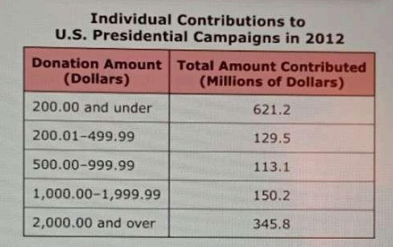
Which conclusion is best supported by information in the table and article?
- A. Individuals contributed a total amount of money equal to the total of all other sources of donations.
- B. Individuals contributing the smallest quantity of money insignificantly impact presidential campaigns.
- C. Individuals donated the greatest total amount although many contributions were relatively small.
- D. Individuals have more influence on the proposed policies of presidential candidates than groups do.
Correct Answer & Rationale
Correct Answer: C
Option C is supported by the data, indicating that while many individual contributions were small, they collectively formed the largest portion of total donations to presidential campaigns. This highlights the significant role individuals play despite the size of their contributions. Option A is incorrect as it suggests individuals’ contributions equaled all other sources, which is not supported by the data. Option B misrepresents the impact of smaller donations; even small contributions can collectively influence campaign funding significantly. Option D overstates individuals' influence on policy compared to groups, which often have more resources and organized lobbying power.
Option C is supported by the data, indicating that while many individual contributions were small, they collectively formed the largest portion of total donations to presidential campaigns. This highlights the significant role individuals play despite the size of their contributions. Option A is incorrect as it suggests individuals’ contributions equaled all other sources, which is not supported by the data. Option B misrepresents the impact of smaller donations; even small contributions can collectively influence campaign funding significantly. Option D overstates individuals' influence on policy compared to groups, which often have more resources and organized lobbying power.
What is the meaning of confederation in this passage?
- A. a government in which the whole population of a country votes to make laws for the people
- B. a political union in which power is divided between a strong central authority and the various other political units
- C. a political union in which the component units retain significant independence from the central government
- D. a government in which people vote to elect representatives who make laws for the people
Correct Answer & Rationale
Correct Answer: C
Confederation refers to a political union where individual components maintain considerable autonomy while cooperating for mutual benefit. Option C accurately captures this definition, emphasizing the independence of component units from the central authority. Option A describes a direct democracy, which is not aligned with the concept of confederation. Option B suggests a balance of power that leans towards a strong central authority, contradicting the essence of a confederation. Option D outlines a representative democracy, which does not inherently involve the independence of component units, thus misrepresenting the nature of a confederation.
Confederation refers to a political union where individual components maintain considerable autonomy while cooperating for mutual benefit. Option C accurately captures this definition, emphasizing the independence of component units from the central authority. Option A describes a direct democracy, which is not aligned with the concept of confederation. Option B suggests a balance of power that leans towards a strong central authority, contradicting the essence of a confederation. Option D outlines a representative democracy, which does not inherently involve the independence of component units, thus misrepresenting the nature of a confederation.