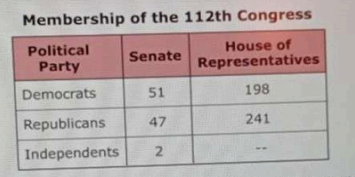
This table shows the numbers of Democrats, Republicans, and Independents in the 112th session of the U.S. Congress in 2011.
Assuming that the majority of senators and representatives voted along party lines, which conclusion about the U.S. government in 2011 does the table support?
- A. The party that passed more legislation could be anticipated.
- B. The party that would win the next presidential election could be predicted.
- C. Party divisions were a challenge to the legislative process.
- D. Party affiliations are a requirement for congressional membership.
Correct Answer & Rationale
Correct Answer: C
The data suggests that party divisions significantly impacted the legislative process in 2011, indicating that partisan alignment often hindered bipartisan cooperation. Option A incorrectly implies that the quantity of legislation passed directly correlates with party strength, which is not supported by the information. Option B assumes a direct link between legislative success and electoral outcomes, which cannot be inferred from party voting patterns alone. Option D misrepresents the nature of congressional membership, as party affiliation is not a formal requirement but rather a common practice among members.
The data suggests that party divisions significantly impacted the legislative process in 2011, indicating that partisan alignment often hindered bipartisan cooperation. Option A incorrectly implies that the quantity of legislation passed directly correlates with party strength, which is not supported by the information. Option B assumes a direct link between legislative success and electoral outcomes, which cannot be inferred from party voting patterns alone. Option D misrepresents the nature of congressional membership, as party affiliation is not a formal requirement but rather a common practice among members.
Other Related Questions
Which feature of the U.S. system of government did de Tocqueville believe might cause conflict in society?
- A. The majority is able to achieve special rights.
- B. The minority is able to block popular legislation.
- C. Legislators must represent minority interests.
- D. Legislators sometimes act against majority rule.
Correct Answer & Rationale
Correct Answer: A
De Tocqueville observed that when the majority in a democracy can impose its will, it might lead to the oppression of minority groups, creating societal conflict. This reflects his concern about "tyranny of the majority," where the dominant group's interests overshadow the rights of others. Option B is incorrect because while minorities can influence legislation, de Tocqueville focused more on majority power. Option C misrepresents his views; he acknowledged the importance of minority representation but did not see it as a source of conflict. Option D is also inaccurate, as de Tocqueville emphasized the potential for the majority to dominate rather than legislators opposing the majority.
De Tocqueville observed that when the majority in a democracy can impose its will, it might lead to the oppression of minority groups, creating societal conflict. This reflects his concern about "tyranny of the majority," where the dominant group's interests overshadow the rights of others. Option B is incorrect because while minorities can influence legislation, de Tocqueville focused more on majority power. Option C misrepresents his views; he acknowledged the importance of minority representation but did not see it as a source of conflict. Option D is also inaccurate, as de Tocqueville emphasized the potential for the majority to dominate rather than legislators opposing the majority.
Which statement is based on the text?
- A. Individuals spend their income in factor markets.
- B. Entrepreneurs profit from participation in product markets.
- C. Individuals sell their labor in factor markets.
- D. Resources are traded in product markets.
Correct Answer & Rationale
Correct Answer: C
Option C accurately reflects the concept that individuals offer their labor in factor markets, where resources like labor are exchanged for wages. This aligns with economic principles regarding labor supply. Option A is incorrect since individuals do not spend income in factor markets; rather, they purchase goods and services in product markets. Option B misrepresents the role of entrepreneurs, who primarily earn profits through innovation and sales in product markets, not simply from participation. Option D is also misleading, as resources are exchanged in factor markets, while product markets focus on the sale of finished goods and services.
Option C accurately reflects the concept that individuals offer their labor in factor markets, where resources like labor are exchanged for wages. This aligns with economic principles regarding labor supply. Option A is incorrect since individuals do not spend income in factor markets; rather, they purchase goods and services in product markets. Option B misrepresents the role of entrepreneurs, who primarily earn profits through innovation and sales in product markets, not simply from participation. Option D is also misleading, as resources are exchanged in factor markets, while product markets focus on the sale of finished goods and services.
What basic assumption behind Marshall's remarks is not behind Reagan's remarks?
- A. The framers of the U.S. Constitution have received more credit than they deserve for the governmental protections Americans enjoy.
- B. The framers of the U.S. Constitution have been credited with creating a document that protects all free people around the world.
- C. The U.S. Constitution created a government whose promises are yet to be realized by many around the world.
- D. The U.S. Constitution created a government based on the principles expressed in the Declaration of Independence.
Correct Answer & Rationale
Correct Answer: A
Marshall's remarks imply a critical view of the framers' contributions, suggesting they may not deserve as much credit for governmental protections as commonly believed. This contrasts with Reagan's perspective, which typically emphasizes the positive legacy of the framers. Option B incorrectly assumes that both figures share the belief in the global impact of the Constitution, which Reagan often highlighted. Option C suggests an acknowledgment of unrealized promises, aligning with both perspectives, while option D reinforces a foundational agreement on principles that both figures would likely support. Thus, A stands out as the unique assumption absent in Reagan's remarks.
Marshall's remarks imply a critical view of the framers' contributions, suggesting they may not deserve as much credit for governmental protections as commonly believed. This contrasts with Reagan's perspective, which typically emphasizes the positive legacy of the framers. Option B incorrectly assumes that both figures share the belief in the global impact of the Constitution, which Reagan often highlighted. Option C suggests an acknowledgment of unrealized promises, aligning with both perspectives, while option D reinforces a foundational agreement on principles that both figures would likely support. Thus, A stands out as the unique assumption absent in Reagan's remarks.
Which statement is supported by the diagrams?
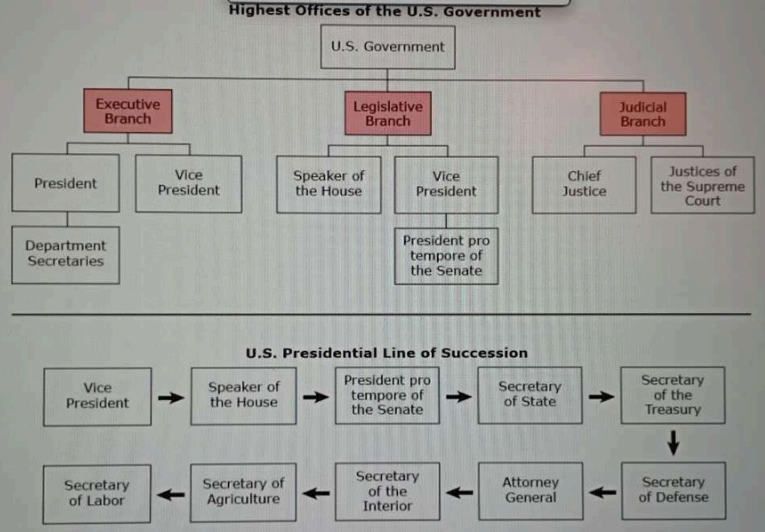
- A. Only the vice president and the president pro tempore of the Senate serve in two branches.
- B. Only officials from the executive and legislative branches are in the line of presidential succession.
- C. The order of presidential succession is determined by the members of the executive branch.
- D. The leaders of Congress are accountable to the members of the executive branch.
Correct Answer & Rationale
Correct Answer: B
Option B accurately reflects the structure of presidential succession, which includes officials from both the executive and legislative branches, specifically the vice president and the leaders of Congress. Option A is misleading; while the vice president and president pro tempore serve in both branches, other officials in the line of succession also include members from the cabinet, which is part of the executive branch. Option C is incorrect as the order of succession is established by law, not determined solely by the executive branch members. Option D misrepresents accountability; Congress leaders are accountable to their constituents, not the executive branch.
Option B accurately reflects the structure of presidential succession, which includes officials from both the executive and legislative branches, specifically the vice president and the leaders of Congress. Option A is misleading; while the vice president and president pro tempore serve in both branches, other officials in the line of succession also include members from the cabinet, which is part of the executive branch. Option C is incorrect as the order of succession is established by law, not determined solely by the executive branch members. Option D misrepresents accountability; Congress leaders are accountable to their constituents, not the executive branch.