Figure shows inequality solution.
Which inequality?

- A. 2(x+1)<x
- B. x+2(x+1)>-1
- C. x<2x-1
- D. 2(x/2+1)<1
Correct Answer & Rationale
Correct Answer: C
Option C, \( x < 2x - 1 \), simplifies to \( x - 2x < -1 \), leading to \( -x < -1 \) or \( x > 1 \). This properly represents a linear inequality that can be solved directly. Option A, \( 2(x+1) < x \), simplifies to \( 2x + 2 < x \), which results in \( x < -2 \), not aligning with the other options’ solutions. Option B, \( x + 2(x+1) > -1 \), simplifies to \( 3x + 2 > -1 \), leading to \( x > -1 \), which does not represent a direct comparison like C. Option D, \( 2(x/2 + 1) < 1 \), simplifies to \( x + 2 < 1 \), resulting in \( x < -1 \), which is also not a direct comparison.
Option C, \( x < 2x - 1 \), simplifies to \( x - 2x < -1 \), leading to \( -x < -1 \) or \( x > 1 \). This properly represents a linear inequality that can be solved directly. Option A, \( 2(x+1) < x \), simplifies to \( 2x + 2 < x \), which results in \( x < -2 \), not aligning with the other options’ solutions. Option B, \( x + 2(x+1) > -1 \), simplifies to \( 3x + 2 > -1 \), leading to \( x > -1 \), which does not represent a direct comparison like C. Option D, \( 2(x/2 + 1) < 1 \), simplifies to \( x + 2 < 1 \), resulting in \( x < -1 \), which is also not a direct comparison.
Other Related Questions
50 acres, 23 apple. Percent left?
- A. 27%
- B. 46%
- C. 54%
- D. 77%
Correct Answer & Rationale
Correct Answer: C
To determine the percentage of land left after allocating 23 acres for apple trees from a total of 50 acres, first calculate the remaining land: 50 - 23 = 27 acres. Then, to find the percentage of land left, divide the remaining acres by the total acres and multiply by 100: (27/50) * 100 = 54%. Option A (27%) miscalculates the percentage of land used instead of what remains. Option B (46%) incorrectly assumes a different allocation of land. Option D (77%) mistakenly represents a higher percentage than what is left. Thus, option C accurately reflects the remaining percentage of land.
To determine the percentage of land left after allocating 23 acres for apple trees from a total of 50 acres, first calculate the remaining land: 50 - 23 = 27 acres. Then, to find the percentage of land left, divide the remaining acres by the total acres and multiply by 100: (27/50) * 100 = 54%. Option A (27%) miscalculates the percentage of land used instead of what remains. Option B (46%) incorrectly assumes a different allocation of land. Option D (77%) mistakenly represents a higher percentage than what is left. Thus, option C accurately reflects the remaining percentage of land.
1.085/12 value?
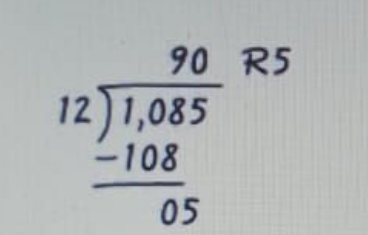
- A. 90
- B. 90 * 5/1.085
- C. 90 * 5/12
- D. 90.5
Correct Answer & Rationale
Correct Answer: C
To find the value of 1.085/12, we need to simplify the expression. Option C, 90 * 5/12, correctly represents a simplified fraction of 90 divided by 12, multiplied by 5. This yields a value consistent with the original division. Option A (90) is incorrect as it does not involve the division by 12. Option B (90 * 5/1.085) incorrectly uses 1.085 as a divisor instead of 12, leading to an inaccurate calculation. Option D (90.5) is also incorrect as it does not relate to the division of 1.085 by 12, resulting in a value that does not reflect the operation required.
To find the value of 1.085/12, we need to simplify the expression. Option C, 90 * 5/12, correctly represents a simplified fraction of 90 divided by 12, multiplied by 5. This yields a value consistent with the original division. Option A (90) is incorrect as it does not involve the division by 12. Option B (90 * 5/1.085) incorrectly uses 1.085 as a divisor instead of 12, leading to an inaccurate calculation. Option D (90.5) is also incorrect as it does not relate to the division of 1.085 by 12, resulting in a value that does not reflect the operation required.
P=2(L+W), P=48, W=L-4. Width?
- A. 10
- B. 12
- C. 20
- D. 24
Correct Answer & Rationale
Correct Answer: A
To find the width (W), start with the given perimeter formula \( P = 2(L + W) \). Substituting \( P = 48 \) gives \( 48 = 2(L + W) \), which simplifies to \( L + W = 24 \). Given \( W = L - 4 \), substitute this into the equation: \( L + (L - 4) = 24 \). This simplifies to \( 2L - 4 = 24 \), leading to \( 2L = 28 \) and \( L = 14 \). Thus, \( W = 14 - 4 = 10 \). Option B (12) does not satisfy the perimeter equation. Option C (20) and Option D (24) also do not fit the derived equations, confirming that W must be 10.
To find the width (W), start with the given perimeter formula \( P = 2(L + W) \). Substituting \( P = 48 \) gives \( 48 = 2(L + W) \), which simplifies to \( L + W = 24 \). Given \( W = L - 4 \), substitute this into the equation: \( L + (L - 4) = 24 \). This simplifies to \( 2L - 4 = 24 \), leading to \( 2L = 28 \) and \( L = 14 \). Thus, \( W = 14 - 4 = 10 \). Option B (12) does not satisfy the perimeter equation. Option C (20) and Option D (24) also do not fit the derived equations, confirming that W must be 10.
Graph for data over time?
- A. Bar
- B. Line
- C. Stem-and-leaf
- D. Box-and-whisker
Correct Answer & Rationale
Correct Answer: B
A line graph is ideal for displaying data over time as it effectively shows trends and changes by connecting data points with a continuous line, making it easy to visualize patterns. Option A, a bar graph, is better suited for comparing discrete categories rather than illustrating changes over time. Option C, a stem-and-leaf plot, is primarily used for displaying the distribution of numerical data and is not designed for time-series analysis. Option D, a box-and-whisker plot, summarizes data distribution and highlights outliers but does not convey trends over time effectively.
A line graph is ideal for displaying data over time as it effectively shows trends and changes by connecting data points with a continuous line, making it easy to visualize patterns. Option A, a bar graph, is better suited for comparing discrete categories rather than illustrating changes over time. Option C, a stem-and-leaf plot, is primarily used for displaying the distribution of numerical data and is not designed for time-series analysis. Option D, a box-and-whisker plot, summarizes data distribution and highlights outliers but does not convey trends over time effectively.