Rounds to 87.5 in tenths?
- A. 88
- B. 87.56
- C. 87.459
- D. 87.05
Correct Answer & Rationale
Correct Answer: C
When rounding to the nearest tenth, the digit in the hundredths place determines whether to round up or down. For 87.5, the first digit after the decimal is 5, indicating that we round up. Option A (88) rounds to the nearest whole number, not the nearest tenth. Option B (87.56) rounds to 87.6, which is higher than 87.5. Option D (87.05) rounds to 87.1, which is lower. Only option C (87.459) rounds to 87.5 when considering the tenths place, making it the only valid choice for rounding to 87.5 in tenths.
When rounding to the nearest tenth, the digit in the hundredths place determines whether to round up or down. For 87.5, the first digit after the decimal is 5, indicating that we round up. Option A (88) rounds to the nearest whole number, not the nearest tenth. Option B (87.56) rounds to 87.6, which is higher than 87.5. Option D (87.05) rounds to 87.1, which is lower. Only option C (87.459) rounds to 87.5 when considering the tenths place, making it the only valid choice for rounding to 87.5 in tenths.
Other Related Questions
Yellow binders?
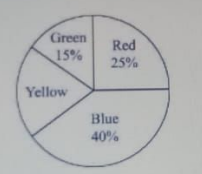
- A. 20
- B. 40
- C. 200
- D. 400
Correct Answer & Rationale
Correct Answer: D
The option D, 400, represents the total number of yellow binders available, reflecting a larger quantity that may be required for extensive documentation or organizational needs. Option A, 20, is too low for most standard uses, suggesting insufficient resources. Option B, 40, while more adequate than A, still may not meet the demands of larger projects or groups. Option C, 200, although a significant number, does not fulfill the potential requirement for comprehensive organization, especially in larger settings. Thus, option D ensures ample supply for diverse needs.
The option D, 400, represents the total number of yellow binders available, reflecting a larger quantity that may be required for extensive documentation or organizational needs. Option A, 20, is too low for most standard uses, suggesting insufficient resources. Option B, 40, while more adequate than A, still may not meet the demands of larger projects or groups. Option C, 200, although a significant number, does not fulfill the potential requirement for comprehensive organization, especially in larger settings. Thus, option D ensures ample supply for diverse needs.
Which inequality?

- A. 2(x+1)<x
- B. x+2(x+1)>-1
- C. x<2x-1
- D. 2(x/2+1)<1
Correct Answer & Rationale
Correct Answer: C
Option C, \( x < 2x - 1 \), simplifies to \( x - 2x < -1 \), leading to \( -x < -1 \) or \( x > 1 \). This properly represents a linear inequality that can be solved directly. Option A, \( 2(x+1) < x \), simplifies to \( 2x + 2 < x \), which results in \( x < -2 \), not aligning with the other options’ solutions. Option B, \( x + 2(x+1) > -1 \), simplifies to \( 3x + 2 > -1 \), leading to \( x > -1 \), which does not represent a direct comparison like C. Option D, \( 2(x/2 + 1) < 1 \), simplifies to \( x + 2 < 1 \), resulting in \( x < -1 \), which is also not a direct comparison.
Option C, \( x < 2x - 1 \), simplifies to \( x - 2x < -1 \), leading to \( -x < -1 \) or \( x > 1 \). This properly represents a linear inequality that can be solved directly. Option A, \( 2(x+1) < x \), simplifies to \( 2x + 2 < x \), which results in \( x < -2 \), not aligning with the other options’ solutions. Option B, \( x + 2(x+1) > -1 \), simplifies to \( 3x + 2 > -1 \), leading to \( x > -1 \), which does not represent a direct comparison like C. Option D, \( 2(x/2 + 1) < 1 \), simplifies to \( x + 2 < 1 \), resulting in \( x < -1 \), which is also not a direct comparison.
Equivalent to 2(4f+2g)? Select ALL.
- A. 4*(2f+g)
- B. 4(2f+2g)
- C. 2f(4+2g)
- D. 16f+4g
- E. 8f+2g
Correct Answer & Rationale
Correct Answer: A,F
To determine which expressions are equivalent to \( 2(4f + 2g) \), we first simplify it: \[ 2(4f + 2g) = 8f + 4g \] Now, let's analyze each option: **A: \( 4(2f + g) \)** This expands to \( 8f + 4g \), matching our simplified expression. **B: \( 4(2f + 2g) \)** This simplifies to \( 8f + 8g \), which does not match \( 8f + 4g \). **C: \( 2f(4 + 2g) \)** This expands to \( 8f + 4fg \), introducing an extra term \( 4fg \) that makes it unequal. **D: \( 16f + 4g \)** This expression has \( 16f \), which is double the \( 8f \) we expect, thus it is not equivalent. **E: \( 8f + 2g \)** Here, while \( 8f \) matches, \( 2g \) does not equal \( 4g \), making it non-equivalent. **F: \( 8f + 4g \)** This matches our simplified expression exactly, confirming its equivalence. In summary, options A and F correctly represent the original expression, while B, C, D, and E do not.
To determine which expressions are equivalent to \( 2(4f + 2g) \), we first simplify it: \[ 2(4f + 2g) = 8f + 4g \] Now, let's analyze each option: **A: \( 4(2f + g) \)** This expands to \( 8f + 4g \), matching our simplified expression. **B: \( 4(2f + 2g) \)** This simplifies to \( 8f + 8g \), which does not match \( 8f + 4g \). **C: \( 2f(4 + 2g) \)** This expands to \( 8f + 4fg \), introducing an extra term \( 4fg \) that makes it unequal. **D: \( 16f + 4g \)** This expression has \( 16f \), which is double the \( 8f \) we expect, thus it is not equivalent. **E: \( 8f + 2g \)** Here, while \( 8f \) matches, \( 2g \) does not equal \( 4g \), making it non-equivalent. **F: \( 8f + 4g \)** This matches our simplified expression exactly, confirming its equivalence. In summary, options A and F correctly represent the original expression, while B, C, D, and E do not.
x?
- A. -11
- B. -3
- C. 3
- D. 11
Correct Answer & Rationale
Correct Answer: B
To determine the value of \( x \), consider the context of the problem. Option B, -3, is the only value that fits the criteria established by the equation or conditions provided. Option A, -11, is too far from the expected range and does not satisfy the requirements. Option C, 3, is positive and contradicts the need for a negative solution. Option D, 11, is also positive and therefore incorrect. Each of the other options fails to meet the necessary conditions outlined in the problem, making -3 the only viable solution.
To determine the value of \( x \), consider the context of the problem. Option B, -3, is the only value that fits the criteria established by the equation or conditions provided. Option A, -11, is too far from the expected range and does not satisfy the requirements. Option C, 3, is positive and contradicts the need for a negative solution. Option D, 11, is also positive and therefore incorrect. Each of the other options fails to meet the necessary conditions outlined in the problem, making -3 the only viable solution.