This excerpt is from a 2002 document published by the U.S. Department of Homeland Security.
The realigning President proposes to create a new Department of Homeland Security... by largely transforming and Is to protect the current confusing patchwork of government activities into a single department whose primary mission our homeland....
History... teaches us that new challenges require new organizational structures.
For example, prior to 1945, America's armed forces were inefficiently structured with separate War and Navy Departments and disconnected intelligence units. There were no formal mechanisms for.cooperation..
In December 1945, only months after America's decisive victory in World War II,... President Truman declared, "It Is now time... to provide for the future the soundest, most effective and most economical kind of structure for our armed forces...."
President Truman's goals were achieved with the National Security Act of 1947 and subsequent amendments... The legislation consolidated the separate military Departments Into the Department of Defense..., established a Central Intelligence Agency to coordinate all foreign intelligence collection and analysis, and created the National Security Council in the White House to coordinate all foreign and defense policy efforts.
Based on the excerpt, which change was a result of the National Security Act of 1947?
- A. The Central Intelligence Agency replaced the War Department.
- B. The National Security Council gained control over the Department of Defense.
- C. The Department of Homeland Security replaced the War Department.
- D. The Department of the Navy became part of the Department of Defense.
Correct Answer & Rationale
Correct Answer: D
The National Security Act of 1947 reorganized the U.S. military and intelligence community. Option D accurately reflects that the Department of the Navy became part of the newly established Department of Defense, streamlining military operations. Option A is incorrect; the CIA was created but did not replace the War Department directly. Option B is misleading; while the National Security Council was established, it does not control the Department of Defense. Option C is factually incorrect, as the Department of Homeland Security was created later, in 2003, not as a result of the 1947 Act.
The National Security Act of 1947 reorganized the U.S. military and intelligence community. Option D accurately reflects that the Department of the Navy became part of the newly established Department of Defense, streamlining military operations. Option A is incorrect; the CIA was created but did not replace the War Department directly. Option B is misleading; while the National Security Council was established, it does not control the Department of Defense. Option C is factually incorrect, as the Department of Homeland Security was created later, in 2003, not as a result of the 1947 Act.
Other Related Questions
Which statement identifies the purpose of President Nixon's message?
- A. to convince Congress that technological advancement and population growth must be slowed to protect the environment
- B. to convince Congress that industrial polluters of the air and water should not pay for cleaning the environment
- C. to convince Congress that it must take part in action to address human damage to the environment
- D. to convince Congress that there should be no benefits for businesses that pollute the environment
Correct Answer & Rationale
Correct Answer: C
President Nixon's message aimed to mobilize Congress to actively engage in addressing environmental degradation caused by human activities. This focus on collective action underscores the urgency of legislative involvement in environmental protection. Option A misinterprets the goal, as Nixon did not advocate for slowing technological advancement but rather for responsible management. Option B inaccurately suggests that he supported industrial polluters avoiding responsibility, which contradicts his environmental stance. Option D implies a complete lack of support for businesses, neglecting the balanced approach Nixon promoted towards regulatory measures and economic growth.
President Nixon's message aimed to mobilize Congress to actively engage in addressing environmental degradation caused by human activities. This focus on collective action underscores the urgency of legislative involvement in environmental protection. Option A misinterprets the goal, as Nixon did not advocate for slowing technological advancement but rather for responsible management. Option B inaccurately suggests that he supported industrial polluters avoiding responsibility, which contradicts his environmental stance. Option D implies a complete lack of support for businesses, neglecting the balanced approach Nixon promoted towards regulatory measures and economic growth.
Which conclusion can be drawn from the diagrams?
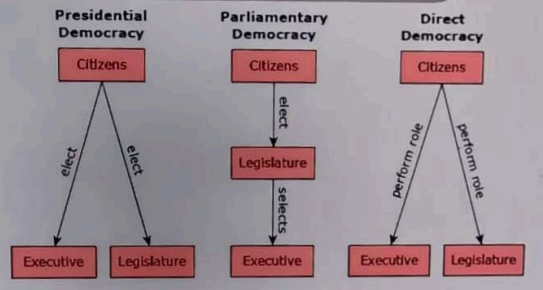
- A. The legislature is more representative of the people in a presidential democracy than in a parliamentary democracy.
- B. The branches of government are more independent of each other in a presidential democracy than in a parliamentary democracy.
- C. The executive branch is more accountable to the people in a parliamentary democracy than in a direct democracy.
- D. The people are more involved in governing in a presidential democracy than in a direct democracy.
Correct Answer & Rationale
Correct Answer: B
In a presidential democracy, the separation of powers is a key feature, allowing the executive, legislative, and judicial branches to operate independently. This independence enhances checks and balances, ensuring that no single branch can dominate. Option A is incorrect as both systems aim for representation, but the degree can vary based on specific contexts rather than the type of democracy. Option C misrepresents accountability; in parliamentary systems, the executive is directly accountable to the legislature, which is elected by the people. Option D is misleading; in a direct democracy, citizens have direct involvement in governance, often more so than in a presidential system.
In a presidential democracy, the separation of powers is a key feature, allowing the executive, legislative, and judicial branches to operate independently. This independence enhances checks and balances, ensuring that no single branch can dominate. Option A is incorrect as both systems aim for representation, but the degree can vary based on specific contexts rather than the type of democracy. Option C misrepresents accountability; in parliamentary systems, the executive is directly accountable to the legislature, which is elected by the people. Option D is misleading; in a direct democracy, citizens have direct involvement in governance, often more so than in a presidential system.
How did the position expressed by President Johnson differ from the position expressed by Senator Russell?
- A. Only Senator Russell said that state governments were sufficiently protecting the rights of citizens.
- B. Only Senator Russell supported the federal government's intervention.
- C. Only President Johnson supported the state governments' rights to manage their own affairs.
- D. Only President Johnson believed that the federal government was authorized to intervene.
Correct Answer & Rationale
Correct Answer: A
President Johnson emphasized the need for federal intervention to protect citizens' rights, believing that state governments were often inadequate. In contrast, Senator Russell argued that state governments were effectively safeguarding those rights, reflecting a stance of local governance. Option B is incorrect because Senator Russell did not support federal intervention. Option C misrepresents Johnson’s position; he favored federal oversight rather than state autonomy. Option D inaccurately attributes the belief in federal authority solely to Johnson, as Russell did not share this view. Thus, the distinction lies in Russell's confidence in state governments versus Johnson's call for federal action.
President Johnson emphasized the need for federal intervention to protect citizens' rights, believing that state governments were often inadequate. In contrast, Senator Russell argued that state governments were effectively safeguarding those rights, reflecting a stance of local governance. Option B is incorrect because Senator Russell did not support federal intervention. Option C misrepresents Johnson’s position; he favored federal oversight rather than state autonomy. Option D inaccurately attributes the belief in federal authority solely to Johnson, as Russell did not share this view. Thus, the distinction lies in Russell's confidence in state governments versus Johnson's call for federal action.
How did Chief Justice Marshall contribute to the U.S. government system of checks and balances?
- A. by establishing the Supreme Court's power to check Congress
- B. by creating the power to remove the president from office
- C. by expanding the president's power to check Congress
- D. by giving the Supreme Court the power to control itself
Correct Answer & Rationale
Correct Answer: A
Chief Justice Marshall played a pivotal role in defining the Supreme Court's authority, notably through the landmark case Marbury v. Madison, which established the principle of judicial review. This empowered the Court to invalidate laws passed by Congress that it deemed unconstitutional, effectively allowing it to check legislative power. Option B is incorrect as the power to remove a president lies with Congress through impeachment, not the Supreme Court. Option C misrepresents Marshall's contributions, as he did not expand presidential power but rather clarified judicial authority. Option D is also inaccurate; the Supreme Court does not have self-regulating powers but operates within the framework of checks and balances.
Chief Justice Marshall played a pivotal role in defining the Supreme Court's authority, notably through the landmark case Marbury v. Madison, which established the principle of judicial review. This empowered the Court to invalidate laws passed by Congress that it deemed unconstitutional, effectively allowing it to check legislative power. Option B is incorrect as the power to remove a president lies with Congress through impeachment, not the Supreme Court. Option C misrepresents Marshall's contributions, as he did not expand presidential power but rather clarified judicial authority. Option D is also inaccurate; the Supreme Court does not have self-regulating powers but operates within the framework of checks and balances.