President Woodrow Wilson's Fourteen Points
In a message delivered to Congress in early 1918, President Wilson presented a program of fourteen points. Eight of the fourteen points addressed specific territorial issues among enemy nations. Five of the other six concerned general principles for a peaceful world: open treaties or agreements, freedom of the seas, free trade, reduction of weapons, and the adjustment of colonial claims based on the principles of self-determination. The fourteenth point proposed what was to become the League of Nations.
Which historical event shaped President Wilson's point of view?
- A. the enactment of the Neutrality Acts
- B. the building of the Panama Canal
- C. the outcome of the Spanish-American War
- D. the fighting in World War I
Correct Answer & Rationale
Correct Answer: D
President Wilson's perspective was profoundly shaped by the fighting in World War I, as it highlighted the need for a new approach to international relations and the promotion of democracy. His commitment to a peaceful resolution and the establishment of the League of Nations stemmed from the devastation of the war. Option A, the Neutrality Acts, reflects a desire to avoid conflict, but they were enacted after Wilson's initial views were formed. Option B, the Panama Canal, was significant for U.S. expansion but did not directly influence Wilson's foreign policy. Option C, the Spanish-American War, marked an earlier phase of U.S. imperialism, contrasting with Wilson's focus on self-determination and peace.
President Wilson's perspective was profoundly shaped by the fighting in World War I, as it highlighted the need for a new approach to international relations and the promotion of democracy. His commitment to a peaceful resolution and the establishment of the League of Nations stemmed from the devastation of the war. Option A, the Neutrality Acts, reflects a desire to avoid conflict, but they were enacted after Wilson's initial views were formed. Option B, the Panama Canal, was significant for U.S. expansion but did not directly influence Wilson's foreign policy. Option C, the Spanish-American War, marked an earlier phase of U.S. imperialism, contrasting with Wilson's focus on self-determination and peace.
Other Related Questions
Which quotation from the excerpt reveals the author's bias about the relationship between the rule of the majority and the rights of the minority?
- A. "The wishes of the smaller group will override the wishes of the larger group and this will create resentment."
- B. "Requiring a unanimous vote or more than a majority vote is meant to provide a safeguard against oppression."
- C. "In these circumstances, expect constant scheming, trickery, and tiresome delays, resulting in disgraceful deals that violate the public good."
- D. "In times of national emergency, the goodness, badness, weakness, and strength of the government is supremely important."
Correct Answer & Rationale
Correct Answer: C
Option C highlights the author's bias by suggesting that the majority's decisions can lead to unethical behavior that undermines public welfare. This reveals a concern for minority rights, indicating that the author believes majority rule may result in negative consequences for those not in power. Option A misrepresents the author's view, as it suggests that the smaller group's wishes will always be overridden, which does not directly reflect bias against majority rule. Option B focuses on safeguards against oppression, which does not convey bias but rather a protective measure. Option D addresses the government's performance during emergencies but fails to connect to the relationship between majority rule and minority rights, missing the core issue of bias.
Option C highlights the author's bias by suggesting that the majority's decisions can lead to unethical behavior that undermines public welfare. This reveals a concern for minority rights, indicating that the author believes majority rule may result in negative consequences for those not in power. Option A misrepresents the author's view, as it suggests that the smaller group's wishes will always be overridden, which does not directly reflect bias against majority rule. Option B focuses on safeguards against oppression, which does not convey bias but rather a protective measure. Option D addresses the government's performance during emergencies but fails to connect to the relationship between majority rule and minority rights, missing the core issue of bias.
Which historical event most likely shaped the author's point of view?
- A. the development of the concept of Manifest Destiny
- B. the United States' involvement in World War I
- C. the United States' internal conflicts during the Great Depression
- D. the calls for social reform during Prohibition
Correct Answer & Rationale
Correct Answer: B
The author's perspective is significantly influenced by the United States' involvement in World War I, as this event marked a pivotal shift in national identity and global engagement. The war prompted discussions about democracy, freedom, and the role of the U.S. on the world stage, shaping the author's views on these themes. Option A, Manifest Destiny, pertains to 19th-century expansionism, which is less relevant to the author's context. Option C, the Great Depression, focuses on economic struggles rather than the broader geopolitical implications of war. Option D, social reform during Prohibition, addresses domestic issues but does not encompass the global impact and ideological shifts brought about by World War I.
The author's perspective is significantly influenced by the United States' involvement in World War I, as this event marked a pivotal shift in national identity and global engagement. The war prompted discussions about democracy, freedom, and the role of the U.S. on the world stage, shaping the author's views on these themes. Option A, Manifest Destiny, pertains to 19th-century expansionism, which is less relevant to the author's context. Option C, the Great Depression, focuses on economic struggles rather than the broader geopolitical implications of war. Option D, social reform during Prohibition, addresses domestic issues but does not encompass the global impact and ideological shifts brought about by World War I.
Which event counters the viewpoint expressed in the newspaper excerpt that African Americans refused to defend their civil rights?
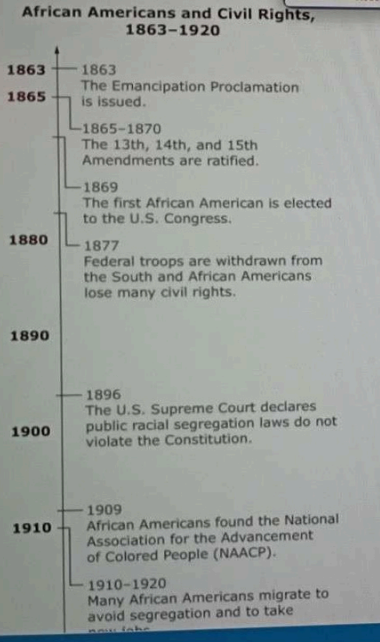
- A. the ratification of the 13th, 14th, and 15th Amendments
- B. the issuance of the Emancipation Proclamation
- C. the founding of the National Association for the Advancement of Colored People
- D. the start of the Great Migration
Correct Answer & Rationale
Correct Answer: C
The founding of the National Association for the Advancement of Colored People (NAACP) directly counters the viewpoint that African Americans refused to defend their civil rights. Established in 1909, the NAACP actively fought for civil rights through legal challenges, advocacy, and public education, demonstrating a strong commitment to defending their rights. Option A, the ratification of the 13th, 14th, and 15th Amendments, although significant, primarily established legal rights rather than showcasing active defense. Option B, the Emancipation Proclamation, ended slavery but did not directly address civil rights activism. Option D, the Great Migration, reflects a movement for better opportunities but does not specifically illustrate organized efforts to defend civil rights.
The founding of the National Association for the Advancement of Colored People (NAACP) directly counters the viewpoint that African Americans refused to defend their civil rights. Established in 1909, the NAACP actively fought for civil rights through legal challenges, advocacy, and public education, demonstrating a strong commitment to defending their rights. Option A, the ratification of the 13th, 14th, and 15th Amendments, although significant, primarily established legal rights rather than showcasing active defense. Option B, the Emancipation Proclamation, ended slavery but did not directly address civil rights activism. Option D, the Great Migration, reflects a movement for better opportunities but does not specifically illustrate organized efforts to defend civil rights.
Which sentence from the passage provides evidence that the Veterans Administration was involved in the development of suburban communities?
- A. "Men returned home from military service, got married, and started families." (paragraph 1)
- B. "Moreover, a separate government program made low-interest mortgage loans available to returning military personnel." (paragraph 4)
- C. "Even so, the success of Levittown depended not only on the efficiency of the Levitt brothers' process but also on the Federal Housing Administration, which guaranteed bank loans to builders." (paragraph 4)
- D. "William and his brother Alfred first gained experience in assembly-line techniques while building government housing for defense workers during World War II." (paragraph 2)
Correct Answer & Rationale
Correct Answer: B
Option B clearly highlights the involvement of the Veterans Administration by mentioning a specific government program that provided low-interest mortgage loans to returning military personnel. This directly links the agency's actions to the development of suburban communities, as affordable housing financing is crucial for homeownership. Option A discusses the general trend of returning veterans starting families but does not specifically reference the Veterans Administration's role. Option C mentions the Federal Housing Administration, not the Veterans Administration, which makes it irrelevant to the question. Option D focuses on the Levitt brothers’ prior experience and does not address the Veterans Administration's involvement in suburban development.
Option B clearly highlights the involvement of the Veterans Administration by mentioning a specific government program that provided low-interest mortgage loans to returning military personnel. This directly links the agency's actions to the development of suburban communities, as affordable housing financing is crucial for homeownership. Option A discusses the general trend of returning veterans starting families but does not specifically reference the Veterans Administration's role. Option C mentions the Federal Housing Administration, not the Veterans Administration, which makes it irrelevant to the question. Option D focuses on the Levitt brothers’ prior experience and does not address the Veterans Administration's involvement in suburban development.