War Powers in the U.S. Constitution
The framers of the U.S. Constitution divided war powers between Congress and the president. Congress has the power to declare war and to create and fund the military. The president, as commander in chief, has the power to command and control U.S. military forces.
In 1950, President Harry Truman deployed U.S. troops in South Korea as part of a United Nations military force. President Truman referred to the Korean War as a "police action" meant to uphold the rule of law. He never asked Congress for a declaration of war and one was never delivered. Later, as a result of the Vietnam War, Congress passed legislation requiring the president to withdraw troops from combat within 60 days if Congress has not declared war or approved the use of force.
Nevertheless, while Congress and the president continue to argue over war powers, the division of these powers in the U.S. Constitution remains unchanged.
Which statement provides the main idea of the passage?
- A. The founders understood the importance of dividing war powers in the U.S. Constitution.
- B. President Truman used presidential war powers to send troops to South Korea.
- C. Congress restricted presidential war powers as a result of the Vietnam War.
- D. A conflict over presidential war powers exists in the U.S. government.
Correct Answer & Rationale
Correct Answer: D
Option D effectively captures the overarching theme of the passage by highlighting the ongoing conflict regarding presidential war powers within the U.S. government. This statement reflects the central issue discussed throughout the text. Option A, while relevant, focuses solely on the founders' intentions rather than the current implications of war powers. Option B is too specific, addressing a single historical instance rather than the broader concept of power dynamics. Option C, although it mentions a relevant event, limits the discussion to the Vietnam War and does not encompass the ongoing nature of the conflict over these powers.
Option D effectively captures the overarching theme of the passage by highlighting the ongoing conflict regarding presidential war powers within the U.S. government. This statement reflects the central issue discussed throughout the text. Option A, while relevant, focuses solely on the founders' intentions rather than the current implications of war powers. Option B is too specific, addressing a single historical instance rather than the broader concept of power dynamics. Option C, although it mentions a relevant event, limits the discussion to the Vietnam War and does not encompass the ongoing nature of the conflict over these powers.
Other Related Questions
How does the U.S. Supreme Court's ruling differ from Justice Murphy's dissent?
- A. Only Justice Murphy's dissent acknowledged the dangers to the United States of having citizens from foreign lands.
- B. Only the Court's ruling acknowledged that the actions of fearful U.S. authorities can endanger the civil rights of citizens.
- C. Only the Court's ruling contended that Korematsu was ordered held in an internment camp because he was disloyal to the United States during time of war.
- D. Only Justice Murphy's dissent contended that U.S. internment camps were a clear-cut example of racial prejudice.
Correct Answer & Rationale
Correct Answer: D
Justice Murphy's dissent emphasized that the internment camps represented blatant racial prejudice, highlighting the unjust targeting of Japanese Americans based solely on their ethnicity. This perspective contrasts sharply with the majority opinion, which focused on national security concerns without addressing the racial implications. Option A is incorrect as both perspectives recognize the potential dangers of foreign nationals, albeit in different contexts. Option B misrepresents the majority's stance, which did not explicitly acknowledge civil rights violations. Option C inaccurately simplifies the Court's ruling, which did not solely attribute internment to disloyalty.
Justice Murphy's dissent emphasized that the internment camps represented blatant racial prejudice, highlighting the unjust targeting of Japanese Americans based solely on their ethnicity. This perspective contrasts sharply with the majority opinion, which focused on national security concerns without addressing the racial implications. Option A is incorrect as both perspectives recognize the potential dangers of foreign nationals, albeit in different contexts. Option B misrepresents the majority's stance, which did not explicitly acknowledge civil rights violations. Option C inaccurately simplifies the Court's ruling, which did not solely attribute internment to disloyalty.
Which statement best describes the action of the people in the photograph?
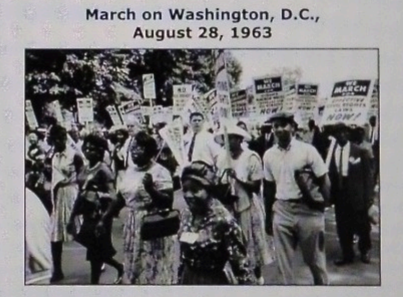
- A. They are utilizing an 8th Amendment right to secure the release of a colleague who was jailed unfairly.
- B. They are utilizing a 6th Amendment right to secure a fair trial for a jailed associate.
- C. They are utilizing a 1st Amendment right to secure equality under the law.
- D. They are utilizing a 14th Amendment right to secure the opportunity to vote in federal elections.
Correct Answer & Rationale
Correct Answer: C
The action depicted in the photograph aligns with the 1st Amendment, which guarantees freedoms concerning speech, assembly, and the right to petition the government. The individuals are likely advocating for equality under the law, a fundamental principle of democratic society. Option A incorrectly references the 8th Amendment, which focuses on protection against excessive bail and cruel punishment, not the right to protest for a colleague's release. Option B misapplies the 6th Amendment, which ensures the right to a fair trial, rather than addressing broader issues of equality. Option D inaccurately connects the situation to the 14th Amendment, which deals with citizenship rights and equal protection, not specifically voting rights.
The action depicted in the photograph aligns with the 1st Amendment, which guarantees freedoms concerning speech, assembly, and the right to petition the government. The individuals are likely advocating for equality under the law, a fundamental principle of democratic society. Option A incorrectly references the 8th Amendment, which focuses on protection against excessive bail and cruel punishment, not the right to protest for a colleague's release. Option B misapplies the 6th Amendment, which ensures the right to a fair trial, rather than addressing broader issues of equality. Option D inaccurately connects the situation to the 14th Amendment, which deals with citizenship rights and equal protection, not specifically voting rights.
According to this information, which philosopher would most likely support the presidential power to appoint federal judges with the consent of the U.S. Senate?
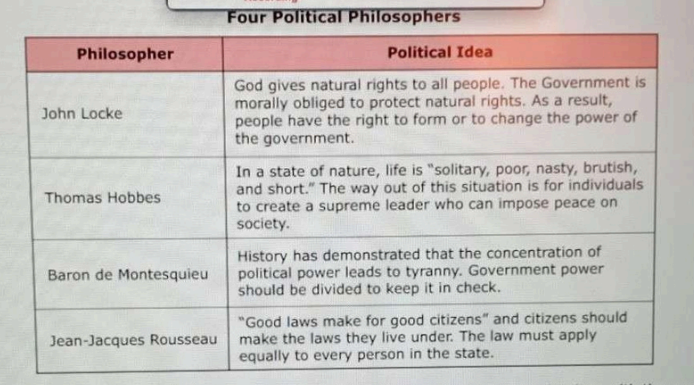
- A. Thomas Hobbes
- B. Baron de Montesquieu
- C. Jean-Jacques Rousseau
- D. John Locke
Correct Answer & Rationale
Correct Answer: B
Baron de Montesquieu advocated for the separation of powers within government, emphasizing the need for checks and balances to prevent tyranny. His support for a collaborative process in appointing judges aligns with the presidential power requiring Senate consent, ensuring that no single branch holds excessive authority. Thomas Hobbes, on the other hand, favored a strong central authority and would likely support concentrated power without the need for Senate approval. Jean-Jacques Rousseau emphasized the general will and popular sovereignty, which does not directly address the judicial appointment process. John Locke valued consent and governance but did not specifically advocate for the Senate's role in judicial appointments.
Baron de Montesquieu advocated for the separation of powers within government, emphasizing the need for checks and balances to prevent tyranny. His support for a collaborative process in appointing judges aligns with the presidential power requiring Senate consent, ensuring that no single branch holds excessive authority. Thomas Hobbes, on the other hand, favored a strong central authority and would likely support concentrated power without the need for Senate approval. Jean-Jacques Rousseau emphasized the general will and popular sovereignty, which does not directly address the judicial appointment process. John Locke valued consent and governance but did not specifically advocate for the Senate's role in judicial appointments.
Which statement from the passage is an opinion?
- A. "The ill-advised rush to extract new discoveries of shale oil and natural gas is a case in point."
- B. "...if the result is polluted water and ghost towns, it is not a sustainable model."
- C. “‘Sustainability' means using natural resources responsibly so that they are available to future generations."
- D. "... to achieve sustainability a business will not view profit only in terms of dollars."
Correct Answer & Rationale
Correct Answer: A
Option A expresses a subjective viewpoint about the extraction of shale oil and natural gas, labeling it as "ill-advised." This indicates a personal judgment rather than an objective fact. In contrast, Option B presents a consequence of unsustainable practices, framing it as a logical outcome rather than an opinion. Option C defines "sustainability" in a factual manner, outlining its meaning without personal bias. Lastly, Option D describes a business approach towards sustainability, focusing on a principle rather than expressing a personal belief. Thus, A stands out as the only statement rooted in opinion.
Option A expresses a subjective viewpoint about the extraction of shale oil and natural gas, labeling it as "ill-advised." This indicates a personal judgment rather than an objective fact. In contrast, Option B presents a consequence of unsustainable practices, framing it as a logical outcome rather than an opinion. Option C defines "sustainability" in a factual manner, outlining its meaning without personal bias. Lastly, Option D describes a business approach towards sustainability, focusing on a principle rather than expressing a personal belief. Thus, A stands out as the only statement rooted in opinion.