This passage describes some activities of the U.S. Department of Agriculture (USDA).
The U.S. Department of Agriculture Risk Management Agency oversees the Commodity Insurance program. This program offers farmers a variety of forms of insurance. One form is known as the Revenue Protection Plan. This plan protects farmers against losing income due to falling prices or crop failures.
Under this plan, a farmer may choose to purchase insurance to guarantee revenue of at least 75% of the Actual Production History of the farm. The insurance on some crops, such as corn, is subsidized by the federal government at a much higher rate than most other crops. The insurance rates vary depending on the type of crop grown.
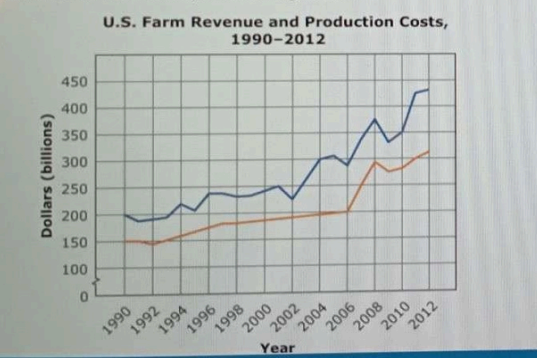
The USDA also has several agencies devoted to research. The Economic Research Service complies data about the total profits earned by U.S. farms. It measures the total income earned by farms and the total costs of production. Generally, both figures have increased over the past 10 years. This graph contains data from the U.S. Department of Agriculture.
What impact do the varying insurance rates of the Revenue Protection Plan have on farming?
- A. They maintain stable prices for certain crops.
- B. They give farmers an incentive to promote crop diversity.
- C. They ensure the steady increase of crop production levels.
- D. They give farmers an incentive to grow crops that have higher subsidies.
Correct Answer & Rationale
Correct Answer: D
The varying insurance rates of the Revenue Protection Plan incentivize farmers to cultivate crops that receive higher subsidies, as these crops can mitigate financial risks associated with farming. This option aligns with economic behavior, where farmers are likely to prioritize profitability. Option A is incorrect because insurance rates do not directly stabilize prices; they primarily provide financial protection. Option B misrepresents the incentive structure; while crop diversity is beneficial, the plan does not specifically encourage it through varying rates. Option C is misleading, as the plan does not guarantee increased production levels; it merely provides a safety net against revenue loss.
The varying insurance rates of the Revenue Protection Plan incentivize farmers to cultivate crops that receive higher subsidies, as these crops can mitigate financial risks associated with farming. This option aligns with economic behavior, where farmers are likely to prioritize profitability. Option A is incorrect because insurance rates do not directly stabilize prices; they primarily provide financial protection. Option B misrepresents the incentive structure; while crop diversity is beneficial, the plan does not specifically encourage it through varying rates. Option C is misleading, as the plan does not guarantee increased production levels; it merely provides a safety net against revenue loss.
Other Related Questions
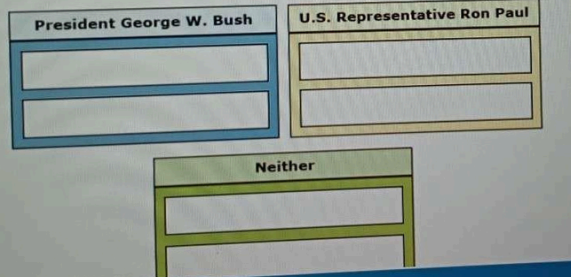
Based on the excerpts, which speaker would agree with each statement below? Drag each statement into the box labeled with that speaker's name. If neither would agree with a statement, drag it to the box labeled "Neither."
- A. Congress should spend money public education.
- B. Schools should meet federal education guidelines.
- C. Parents should hold public schools accountable.
- D. Local districts should set school guidelines.
Correct Answer & Rationale
Correct Answer:
Speaker A likely supports the idea that Congress should spend money on public education, as this aligns with a belief in federal investment in education for equitable access. Speaker B would agree that schools should meet federal education guidelines, as this emphasizes the importance of uniform standards for educational quality and accountability. Speaker C advocates for parental accountability in public schools, reflecting the belief that parents play a vital role in monitoring and improving educational outcomes. Speaker D likely supports the idea that local districts should set school guidelines, as this allows for tailored approaches that reflect community needs and values. If neither speaker aligns with a statement, it belongs in the "Neither" category.
Speaker A likely supports the idea that Congress should spend money on public education, as this aligns with a belief in federal investment in education for equitable access. Speaker B would agree that schools should meet federal education guidelines, as this emphasizes the importance of uniform standards for educational quality and accountability. Speaker C advocates for parental accountability in public schools, reflecting the belief that parents play a vital role in monitoring and improving educational outcomes. Speaker D likely supports the idea that local districts should set school guidelines, as this allows for tailored approaches that reflect community needs and values. If neither speaker aligns with a statement, it belongs in the "Neither" category.
Which statement identifies a purpose of Roosevelt's speech?
- A. to convince his audience that preserving the environment is as important as national security
- B. to convince his audience that preserving the environment is the responsibility of ordinary citizens
- C. to gain support for using public lands to obtain vital productive resources
- D. to gain support for a candidate who wants to preserve the environment
Correct Answer & Rationale
Correct Answer: A
Option A effectively captures Roosevelt's emphasis on the interconnectedness of environmental preservation and national security. He aimed to highlight that a healthy environment is crucial for the nation's well-being and stability. Option B is incorrect as Roosevelt’s speech focuses more on broader national priorities rather than individual responsibilities. Option C misinterprets the message; while resource management is important, the speech primarily advocates for environmental preservation rather than exploitation. Option D is misleading; Roosevelt's speech is not about promoting a candidate but rather advocating for a national commitment to environmental stewardship.
Option A effectively captures Roosevelt's emphasis on the interconnectedness of environmental preservation and national security. He aimed to highlight that a healthy environment is crucial for the nation's well-being and stability. Option B is incorrect as Roosevelt’s speech focuses more on broader national priorities rather than individual responsibilities. Option C misinterprets the message; while resource management is important, the speech primarily advocates for environmental preservation rather than exploitation. Option D is misleading; Roosevelt's speech is not about promoting a candidate but rather advocating for a national commitment to environmental stewardship.
Which one statement identifies the main idea of President Johnson's speech?
- A. The federal government has the responsibility to guarantee the rights of citizens.
- B. The expansion of educational opportunities should be the next goal of the civil rights movement.
- C. The expansion of voting rights can eliminate poverty.
- D. The federal government has power over state governments.
Correct Answer & Rationale
Correct Answer: A
Option A accurately captures the essence of President Johnson's speech, which emphasizes the government's duty to protect citizens' rights, particularly in the context of civil rights and social justice. Option B, while relevant to the civil rights movement, does not encapsulate the primary focus of the speech, which is broader than just education. Option C suggests a direct correlation between voting rights and poverty alleviation, which, though important, is not the main thrust of Johnson's address. Option D misrepresents the speech's intent, as it does not primarily discuss the federal government's authority over states but rather its role in ensuring citizen rights.
Option A accurately captures the essence of President Johnson's speech, which emphasizes the government's duty to protect citizens' rights, particularly in the context of civil rights and social justice. Option B, while relevant to the civil rights movement, does not encapsulate the primary focus of the speech, which is broader than just education. Option C suggests a direct correlation between voting rights and poverty alleviation, which, though important, is not the main thrust of Johnson's address. Option D misrepresents the speech's intent, as it does not primarily discuss the federal government's authority over states but rather its role in ensuring citizen rights.
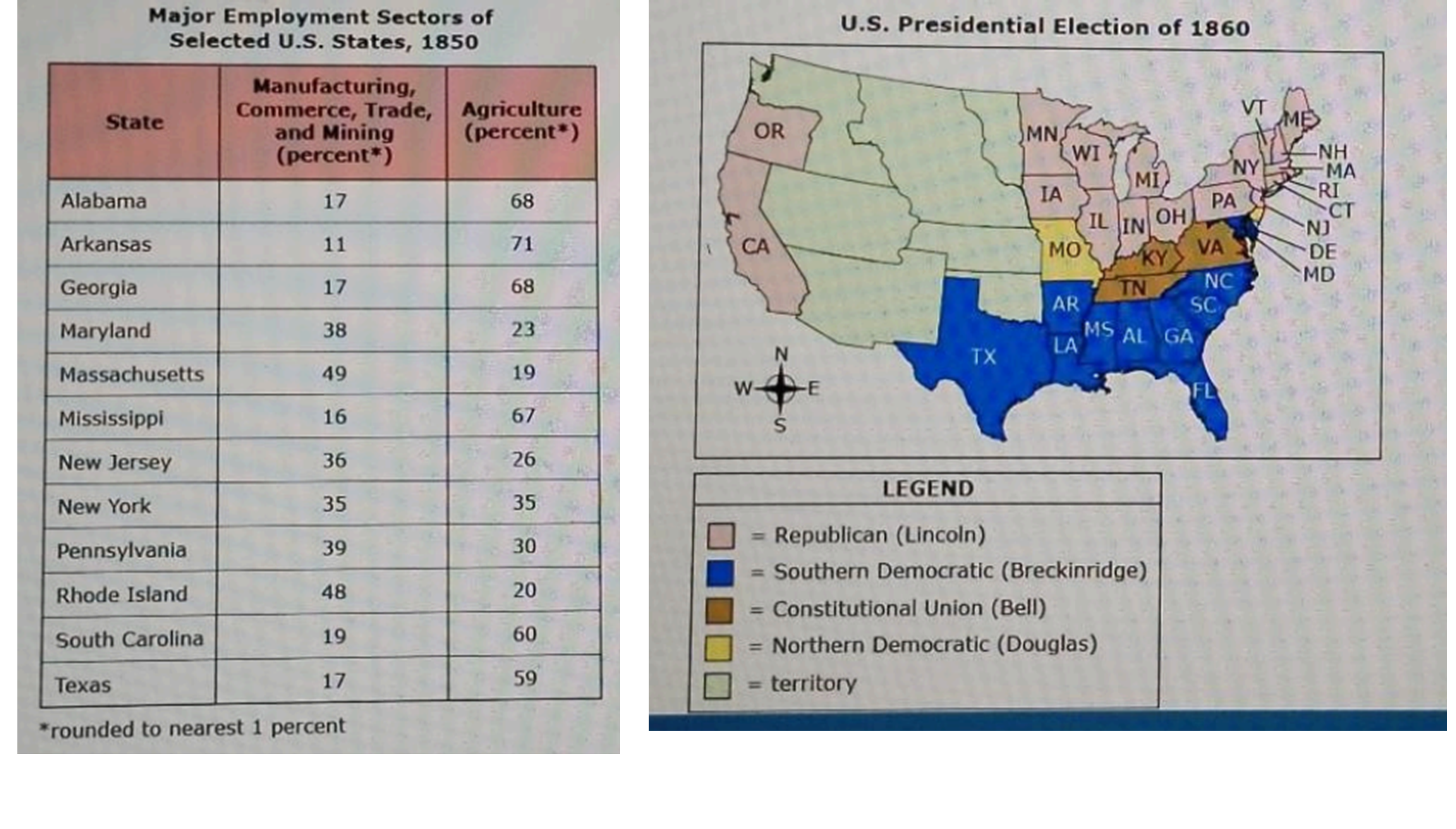
Which statement is supported by both the table and the map?
- A. Differences in the total populations of the states led to political differences between the North and the South.
- B. Differences among the economies of the states contributed to political differences between the North and the South.
- C. Political differences between the North and the South reflected differences in education among the states.
- D. Political differences between the North and the South reflected differences in the standards of living in the states.
Correct Answer & Rationale
Correct Answer: B
Option B is supported by both the table and the map, as they illustrate how varying economic structures—such as agriculture in the South versus industrialization in the North—contributed to distinct political ideologies and policies. Option A incorrectly attributes political differences solely to population size, overlooking the economic factors at play. Option C suggests education differences as the main cause, which is not evident in the provided data. Option D implies that living standards were the primary influence, but the economic context is more directly linked to the political divide. Thus, B effectively encapsulates the relationship between economy and political differences.
Option B is supported by both the table and the map, as they illustrate how varying economic structures—such as agriculture in the South versus industrialization in the North—contributed to distinct political ideologies and policies. Option A incorrectly attributes political differences solely to population size, overlooking the economic factors at play. Option C suggests education differences as the main cause, which is not evident in the provided data. Option D implies that living standards were the primary influence, but the economic context is more directly linked to the political divide. Thus, B effectively encapsulates the relationship between economy and political differences.