1st Amendment: Congress shall make no law respecting an establishrrment on feligioni, of promitung ute free exercise thereof; or abridging the freedom of speech, or of the press; or the right of the people peaceably to assemble, and to petition the Government for a redress of grievances.
6th Amendment: In all criminal prosecutions, the accused shall enjoy the right to a speedy and public trial by an impartial jury of the State and district wherein the crime shall have been committed......
8th Amendment: Excessive bail shall not be required, nor excessive fines imposed, nor cruel and unusual punishments inflicted.
14th Amendment: No State shall make or enforce any law which shall abridge the privileges or immunities of citizens of the United States; nor shall any State deprive any person of life, liberty, or property, without due process of law
Which statement best describes the action of the people in the photograph?
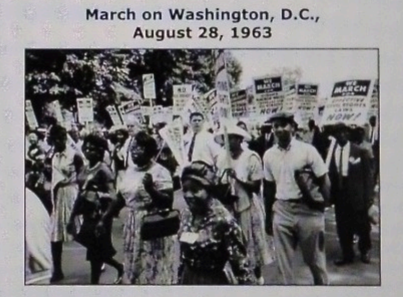
- A. They are utilizing an 8th Amendment right to secure the release of a colleague who was jailed unfairly.
- B. They are utilizing a 6th Amendment right to secure a fair trial for a jailed associate.
- C. They are utilizing a 1st Amendment right to secure equality under the law.
- D. They are utilizing a 14th Amendment right to secure the opportunity to vote in federal elections.
Correct Answer & Rationale
Correct Answer: C
The action depicted in the photograph aligns with the 1st Amendment, which guarantees freedoms concerning speech, assembly, and the right to petition the government. The individuals are likely advocating for equality under the law, a fundamental principle of democratic society. Option A incorrectly references the 8th Amendment, which focuses on protection against excessive bail and cruel punishment, not the right to protest for a colleague's release. Option B misapplies the 6th Amendment, which ensures the right to a fair trial, rather than addressing broader issues of equality. Option D inaccurately connects the situation to the 14th Amendment, which deals with citizenship rights and equal protection, not specifically voting rights.
The action depicted in the photograph aligns with the 1st Amendment, which guarantees freedoms concerning speech, assembly, and the right to petition the government. The individuals are likely advocating for equality under the law, a fundamental principle of democratic society. Option A incorrectly references the 8th Amendment, which focuses on protection against excessive bail and cruel punishment, not the right to protest for a colleague's release. Option B misapplies the 6th Amendment, which ensures the right to a fair trial, rather than addressing broader issues of equality. Option D inaccurately connects the situation to the 14th Amendment, which deals with citizenship rights and equal protection, not specifically voting rights.
Other Related Questions
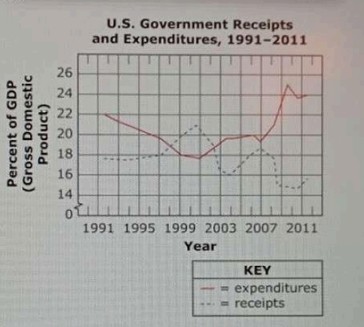
According to this graph, in which year did the U.S. government first achieve a budget surplus?
- A. 1996
- B. 1994
- C. 1998
- D. 2002
Correct Answer & Rationale
Correct Answer: C
The graph indicates that the U.S. government first achieved a budget surplus in 1998, as evidenced by the line crossing above the zero mark in that year. Option A (1996) shows a deficit, as the line remains below zero. Option B (1994) also reflects a deficit, indicating that the government had not yet balanced its budget. Option D (2002) is incorrect as it depicts a return to deficit after a surplus, confirming that the surplus was achieved earlier in 1998. Thus, 1998 is the first year when the budget surplus was realized.
The graph indicates that the U.S. government first achieved a budget surplus in 1998, as evidenced by the line crossing above the zero mark in that year. Option A (1996) shows a deficit, as the line remains below zero. Option B (1994) also reflects a deficit, indicating that the government had not yet balanced its budget. Option D (2002) is incorrect as it depicts a return to deficit after a surplus, confirming that the surplus was achieved earlier in 1998. Thus, 1998 is the first year when the budget surplus was realized.
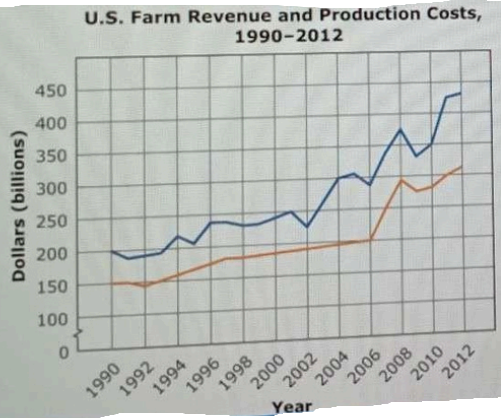
According to the information in the first graph, which statement correctly describes the period from 2006 to 2008?
- A. Gross farm income continued the decline that had characterized previous years.
- B. Gross farm income increased despite increases in production costs.
- C. Increases in production costs caused gross farm income to decline.
- D. Decreases in production costs continued throughout this period.
Correct Answer & Rationale
Correct Answer: B
During the period from 2006 to 2008, gross farm income saw an increase, even as production costs rose. This indicates that farmers managed to offset higher expenses with increased revenue. Option A is incorrect as it suggests a continuation of decline, which contradicts the data showing growth in income. Option C misinterprets the relationship between rising costs and income, as income actually increased despite those costs. Option D is inaccurate because it implies a consistent decrease in production costs, which is not supported by the graph indicating rising expenses during this timeframe.
During the period from 2006 to 2008, gross farm income saw an increase, even as production costs rose. This indicates that farmers managed to offset higher expenses with increased revenue. Option A is incorrect as it suggests a continuation of decline, which contradicts the data showing growth in income. Option C misinterprets the relationship between rising costs and income, as income actually increased despite those costs. Option D is inaccurate because it implies a consistent decrease in production costs, which is not supported by the graph indicating rising expenses during this timeframe.
What is the mean number of people who became legal residents of the United States during this five-year period?
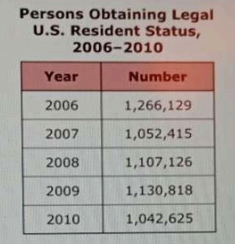
- A. 1,119,823
- B. 223,504
- C. 5,599,113
- D. 1,107,126
Correct Answer & Rationale
Correct Answer: A
To determine the mean number of legal residents over the five-year period, one must sum the total number of residents and divide by five. The correct calculation yields a mean of 1,119,823, reflecting the average annual influx. Option B (223,504) represents a miscalculation, likely reflecting a single year's data rather than an average. Option C (5,599,113) incorrectly totals the residents without division, suggesting a cumulative number rather than an average. Option D (1,107,126) is close but does not accurately reflect the mean, indicating a minor arithmetic error.
To determine the mean number of legal residents over the five-year period, one must sum the total number of residents and divide by five. The correct calculation yields a mean of 1,119,823, reflecting the average annual influx. Option B (223,504) represents a miscalculation, likely reflecting a single year's data rather than an average. Option C (5,599,113) incorrectly totals the residents without division, suggesting a cumulative number rather than an average. Option D (1,107,126) is close but does not accurately reflect the mean, indicating a minor arithmetic error.
What is the meaning of the word entrenched as used in this excerpt?
- A. in control
- B. strongly defended
- C. established and unlikely to change
- D. surrounded and unable to move
Correct Answer & Rationale
Correct Answer: C
The term "entrenched" conveys the idea of something that is firmly established and resistant to change, aligning with option C. This suggests a deep-rooted nature, often implying that it has become a significant part of a system or belief. Option A, "in control," does not capture the essence of being deeply embedded or resistant to alteration. Option B, "strongly defended," implies a protective stance rather than a state of being firmly established. Option D, "surrounded and unable to move," suggests physical confinement rather than the figurative sense of being firmly set in place.
The term "entrenched" conveys the idea of something that is firmly established and resistant to change, aligning with option C. This suggests a deep-rooted nature, often implying that it has become a significant part of a system or belief. Option A, "in control," does not capture the essence of being deeply embedded or resistant to alteration. Option B, "strongly defended," implies a protective stance rather than a state of being firmly established. Option D, "surrounded and unable to move," suggests physical confinement rather than the figurative sense of being firmly set in place.