This passage discusses the first national government in the United States.
In 1781, the 13 former British American colonies established a common government when they ratified the Articles of Confederation. The document established a "firm league of friendship" between the states and reserved the greatest share of political authority to the individual states. The new confederation had only one branch, which was made up of a one-house legislature in which the states were equally represented. Among other powers, the new government had the power to conduct foreign affairs for the 13 independent states. It had the power to make war and peace and to negotiate treaties with foreign countries. It could also settle disputes between the states, Including disputes over western territories. Each of the states retained their "sovereignty, freedom and independence." Under the Articles, Congress could not collect taxes, regulate trade between states, or enforce laws. The confederation was replaced in 1787 by the government created by the U.S. Constitution.
What is the meaning of confederation in this passage?
- A. a government in which the whole population of a country votes to make laws for the people
- B. a political union in which power is divided between a strong central authority and the various other political units
- C. a political union in which the component units retain significant independence from the central government
- D. a government in which people vote to elect representatives who make laws for the people
Correct Answer & Rationale
Correct Answer: C
Confederation refers to a political union where individual components maintain considerable autonomy while cooperating for mutual benefit. Option C accurately captures this definition, emphasizing the independence of component units from the central authority. Option A describes a direct democracy, which is not aligned with the concept of confederation. Option B suggests a balance of power that leans towards a strong central authority, contradicting the essence of a confederation. Option D outlines a representative democracy, which does not inherently involve the independence of component units, thus misrepresenting the nature of a confederation.
Confederation refers to a political union where individual components maintain considerable autonomy while cooperating for mutual benefit. Option C accurately captures this definition, emphasizing the independence of component units from the central authority. Option A describes a direct democracy, which is not aligned with the concept of confederation. Option B suggests a balance of power that leans towards a strong central authority, contradicting the essence of a confederation. Option D outlines a representative democracy, which does not inherently involve the independence of component units, thus misrepresenting the nature of a confederation.
Other Related Questions
Which statement best describes the action of the people in the photograph?
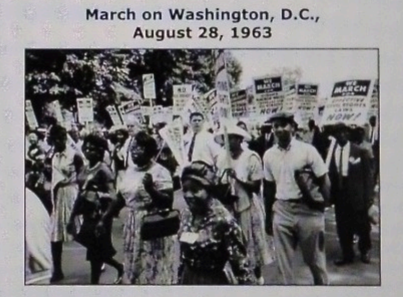
- A. They are utilizing an 8th Amendment right to secure the release of a colleague who was jailed unfairly.
- B. They are utilizing a 6th Amendment right to secure a fair trial for a jailed associate.
- C. They are utilizing a 1st Amendment right to secure equality under the law.
- D. They are utilizing a 14th Amendment right to secure the opportunity to vote in federal elections.
Correct Answer & Rationale
Correct Answer: C
The action depicted in the photograph aligns with the 1st Amendment, which guarantees freedoms concerning speech, assembly, and the right to petition the government. The individuals are likely advocating for equality under the law, a fundamental principle of democratic society. Option A incorrectly references the 8th Amendment, which focuses on protection against excessive bail and cruel punishment, not the right to protest for a colleague's release. Option B misapplies the 6th Amendment, which ensures the right to a fair trial, rather than addressing broader issues of equality. Option D inaccurately connects the situation to the 14th Amendment, which deals with citizenship rights and equal protection, not specifically voting rights.
The action depicted in the photograph aligns with the 1st Amendment, which guarantees freedoms concerning speech, assembly, and the right to petition the government. The individuals are likely advocating for equality under the law, a fundamental principle of democratic society. Option A incorrectly references the 8th Amendment, which focuses on protection against excessive bail and cruel punishment, not the right to protest for a colleague's release. Option B misapplies the 6th Amendment, which ensures the right to a fair trial, rather than addressing broader issues of equality. Option D inaccurately connects the situation to the 14th Amendment, which deals with citizenship rights and equal protection, not specifically voting rights.
How does the U.S. Supreme Court's ruling differ from Justice Murphy's dissent?
- A. Only Justice Murphy's dissent acknowledged the dangers to the United States of having citizens from foreign lands.
- B. Only the Court's ruling acknowledged that the actions of fearful U.S. authorities can endanger the civil rights of citizens.
- C. Only the Court's ruling contended that Korematsu was ordered held in an internment camp because he was disloyal to the United States during time of war.
- D. Only Justice Murphy's dissent contended that U.S. internment camps were a clear-cut example of racial prejudice.
Correct Answer & Rationale
Correct Answer: D
Justice Murphy's dissent emphasized that the internment camps represented blatant racial prejudice, highlighting the unjust targeting of Japanese Americans based solely on their ethnicity. This perspective contrasts sharply with the majority opinion, which focused on national security concerns without addressing the racial implications. Option A is incorrect as both perspectives recognize the potential dangers of foreign nationals, albeit in different contexts. Option B misrepresents the majority's stance, which did not explicitly acknowledge civil rights violations. Option C inaccurately simplifies the Court's ruling, which did not solely attribute internment to disloyalty.
Justice Murphy's dissent emphasized that the internment camps represented blatant racial prejudice, highlighting the unjust targeting of Japanese Americans based solely on their ethnicity. This perspective contrasts sharply with the majority opinion, which focused on national security concerns without addressing the racial implications. Option A is incorrect as both perspectives recognize the potential dangers of foreign nationals, albeit in different contexts. Option B misrepresents the majority's stance, which did not explicitly acknowledge civil rights violations. Option C inaccurately simplifies the Court's ruling, which did not solely attribute internment to disloyalty.
How did Chief Justice Marshall contribute to the U.S. government system of checks and balances?
- A. by establishing the Supreme Court's power to check Congress
- B. by creating the power to remove the president from office
- C. by expanding the president's power to check Congress
- D. by giving the Supreme Court the power to control itself
Correct Answer & Rationale
Correct Answer: A
Chief Justice Marshall played a pivotal role in defining the Supreme Court's authority, notably through the landmark case Marbury v. Madison, which established the principle of judicial review. This empowered the Court to invalidate laws passed by Congress that it deemed unconstitutional, effectively allowing it to check legislative power. Option B is incorrect as the power to remove a president lies with Congress through impeachment, not the Supreme Court. Option C misrepresents Marshall's contributions, as he did not expand presidential power but rather clarified judicial authority. Option D is also inaccurate; the Supreme Court does not have self-regulating powers but operates within the framework of checks and balances.
Chief Justice Marshall played a pivotal role in defining the Supreme Court's authority, notably through the landmark case Marbury v. Madison, which established the principle of judicial review. This empowered the Court to invalidate laws passed by Congress that it deemed unconstitutional, effectively allowing it to check legislative power. Option B is incorrect as the power to remove a president lies with Congress through impeachment, not the Supreme Court. Option C misrepresents Marshall's contributions, as he did not expand presidential power but rather clarified judicial authority. Option D is also inaccurate; the Supreme Court does not have self-regulating powers but operates within the framework of checks and balances.
Which statement from the excerpts provides evidence for the Inference that minority rights were not protected by the U.S. government as originally founded?
- A. "To the contrary, the government they devised was defective from the start, requiring several amendments, a civil war, and momentous social transformation to attain the system of constitutional government, and its respect for the individual freedoms and human rights, we hold as fundamental today."
- B. "In a very real sense, it was then, in 1787, that the Revolution truly began."
- C. "I do not believe that the meaning of the Constitution was forever 'fixed' at the Philadelphia Convention."
- D. "For it was with the writing of our Constitution, setting down the architecture of democratic government, that the noble sentiments and brave rhetoric of 1776 took on substance......"
Correct Answer & Rationale
Correct Answer: A
Option A highlights the inherent flaws in the original government structure, indicating that it required significant amendments and a civil war to address fundamental issues, including the protection of minority rights. This suggests that, from its inception, the government did not adequately safeguard these rights. Options B, C, and D, while relevant to the historical context, do not specifically address the inadequacies of minority rights protection. B focuses on the ongoing nature of the Revolution, C discusses the evolving interpretation of the Constitution, and D emphasizes the establishment of democratic principles without mentioning the lack of protections for minority rights.
Option A highlights the inherent flaws in the original government structure, indicating that it required significant amendments and a civil war to address fundamental issues, including the protection of minority rights. This suggests that, from its inception, the government did not adequately safeguard these rights. Options B, C, and D, while relevant to the historical context, do not specifically address the inadequacies of minority rights protection. B focuses on the ongoing nature of the Revolution, C discusses the evolving interpretation of the Constitution, and D emphasizes the establishment of democratic principles without mentioning the lack of protections for minority rights.