This excerpt is from the U.S. State Department document, Outline of U.S. History.
Virginian George Mason was one of three delegates to the Constitutional Convention who had refused to sign the final document because it did not [guarantee] individual rights. Together with Patrick Henry, he campaigned vigorously against ratification of the Constitution by Virginia.... [F]ive states, including Massachusetts, ratified the Constitution on the condition that such amendments be added immediately. When the first Congress [met] in New York City in September 1789, the calls for amendments protecting individual rights were [almost] unanimous [B]y December 1791, enough states had ratified 10 amendments to make them part of the Constitution. Collectively, [these amendments] are known as the Bill of Rights.
This excerpt is taken from the public domain.
Based on the excerpt, which conclusion can be drawn about the U.S. Constitution and the Bill of Rights?
- A. Ratification of the Bill of Rights was completed before the Constitution was drafted.
- B. Ratification of the Constitution was dependent on the passage of the Bill of Rights.
- C. Most leaders were worried that the Bill of Rights would weaken the ruling class protected by the Constitution.
- D. Many leaders were concerned that the Bill of Rights would upset the balance of powers outlined in the Constitution.
Correct Answer & Rationale
Correct Answer: B
The conclusion that ratification of the Constitution was dependent on the passage of the Bill of Rights is supported by historical context, as many states required assurance of individual rights to approve the Constitution. Option A is incorrect because the Bill of Rights was introduced after the Constitution was drafted. Option C misrepresents the intent of the Bill of Rights; leaders were primarily concerned with protecting individual liberties rather than preserving the ruling class. Option D is also inaccurate, as the Bill of Rights aimed to safeguard citizens' rights without disrupting the balance of powers established by the Constitution.
The conclusion that ratification of the Constitution was dependent on the passage of the Bill of Rights is supported by historical context, as many states required assurance of individual rights to approve the Constitution. Option A is incorrect because the Bill of Rights was introduced after the Constitution was drafted. Option C misrepresents the intent of the Bill of Rights; leaders were primarily concerned with protecting individual liberties rather than preserving the ruling class. Option D is also inaccurate, as the Bill of Rights aimed to safeguard citizens' rights without disrupting the balance of powers established by the Constitution.
Other Related Questions
Which historical event shaped President Wilson's point of view?
- A. the enactment of the Neutrality Acts
- B. the building of the Panama Canal
- C. the outcome of the Spanish-American War
- D. the fighting in World War I
Correct Answer & Rationale
Correct Answer: D
President Wilson's perspective was profoundly shaped by the fighting in World War I, as it highlighted the need for a new approach to international relations and the promotion of democracy. His commitment to a peaceful resolution and the establishment of the League of Nations stemmed from the devastation of the war. Option A, the Neutrality Acts, reflects a desire to avoid conflict, but they were enacted after Wilson's initial views were formed. Option B, the Panama Canal, was significant for U.S. expansion but did not directly influence Wilson's foreign policy. Option C, the Spanish-American War, marked an earlier phase of U.S. imperialism, contrasting with Wilson's focus on self-determination and peace.
President Wilson's perspective was profoundly shaped by the fighting in World War I, as it highlighted the need for a new approach to international relations and the promotion of democracy. His commitment to a peaceful resolution and the establishment of the League of Nations stemmed from the devastation of the war. Option A, the Neutrality Acts, reflects a desire to avoid conflict, but they were enacted after Wilson's initial views were formed. Option B, the Panama Canal, was significant for U.S. expansion but did not directly influence Wilson's foreign policy. Option C, the Spanish-American War, marked an earlier phase of U.S. imperialism, contrasting with Wilson's focus on self-determination and peace.
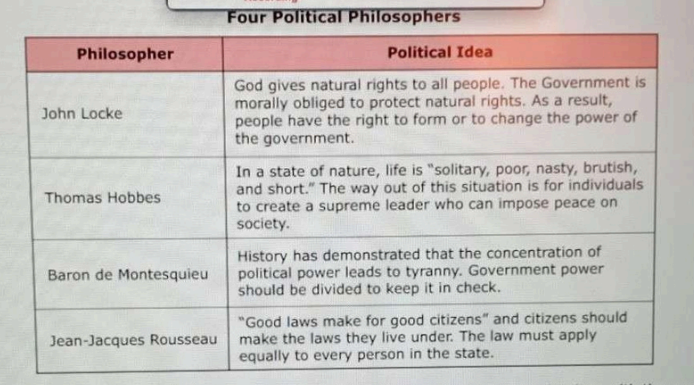
According to this information, which philosopher would most likely support the presidential power to appoint federal judges with the consent of the U.S. Senate?
- A. Thomas Hobbes
- B. Baron de Montesquieu
- C. Jean-Jacques Rousseau
- D. John Locke
Correct Answer & Rationale
Correct Answer: B
Baron de Montesquieu advocated for the separation of powers within government, emphasizing the need for checks and balances to prevent tyranny. His support for a collaborative process in appointing judges aligns with the presidential power requiring Senate consent, ensuring that no single branch holds excessive authority. Thomas Hobbes, on the other hand, favored a strong central authority and would likely support concentrated power without the need for Senate approval. Jean-Jacques Rousseau emphasized the general will and popular sovereignty, which does not directly address the judicial appointment process. John Locke valued consent and governance but did not specifically advocate for the Senate's role in judicial appointments.
Baron de Montesquieu advocated for the separation of powers within government, emphasizing the need for checks and balances to prevent tyranny. His support for a collaborative process in appointing judges aligns with the presidential power requiring Senate consent, ensuring that no single branch holds excessive authority. Thomas Hobbes, on the other hand, favored a strong central authority and would likely support concentrated power without the need for Senate approval. Jean-Jacques Rousseau emphasized the general will and popular sovereignty, which does not directly address the judicial appointment process. John Locke valued consent and governance but did not specifically advocate for the Senate's role in judicial appointments.
Which sentence from the passage provides evidence that the Veterans Administration was involved in the development of suburban communities?
- A. "Men returned home from military service, got married, and started families." (paragraph 1)
- B. "Moreover, a separate government program made low-interest mortgage loans available to returning military personnel." (paragraph 4)
- C. "Even so, the success of Levittown depended not only on the efficiency of the Levitt brothers' process but also on the Federal Housing Administration, which guaranteed bank loans to builders." (paragraph 4)
- D. "William and his brother Alfred first gained experience in assembly-line techniques while building government housing for defense workers during World War II." (paragraph 2)
Correct Answer & Rationale
Correct Answer: B
Option B clearly highlights the involvement of the Veterans Administration by mentioning a specific government program that provided low-interest mortgage loans to returning military personnel. This directly links the agency's actions to the development of suburban communities, as affordable housing financing is crucial for homeownership. Option A discusses the general trend of returning veterans starting families but does not specifically reference the Veterans Administration's role. Option C mentions the Federal Housing Administration, not the Veterans Administration, which makes it irrelevant to the question. Option D focuses on the Levitt brothers’ prior experience and does not address the Veterans Administration's involvement in suburban development.
Option B clearly highlights the involvement of the Veterans Administration by mentioning a specific government program that provided low-interest mortgage loans to returning military personnel. This directly links the agency's actions to the development of suburban communities, as affordable housing financing is crucial for homeownership. Option A discusses the general trend of returning veterans starting families but does not specifically reference the Veterans Administration's role. Option C mentions the Federal Housing Administration, not the Veterans Administration, which makes it irrelevant to the question. Option D focuses on the Levitt brothers’ prior experience and does not address the Veterans Administration's involvement in suburban development.
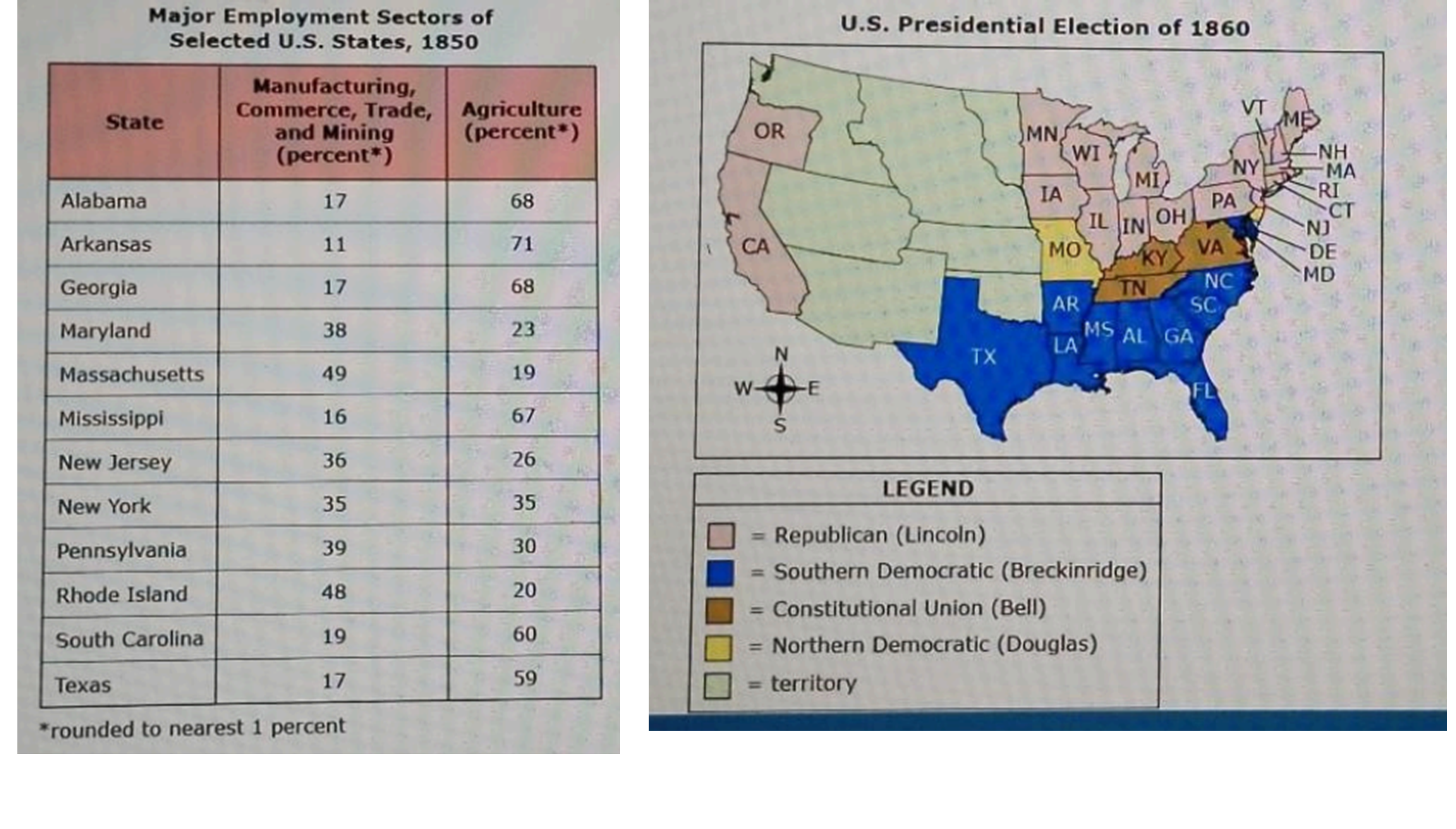
Which statement is supported by both the table and the map?
- A. Differences in the total populations of the states led to political differences between the North and the South.
- B. Differences among the economies of the states contributed to political differences between the North and the South.
- C. Political differences between the North and the South reflected differences in education among the states.
- D. Political differences between the North and the South reflected differences in the standards of living in the states.
Correct Answer & Rationale
Correct Answer: B
Option B is supported by both the table and the map, as they illustrate how varying economic structures—such as agriculture in the South versus industrialization in the North—contributed to distinct political ideologies and policies. Option A incorrectly attributes political differences solely to population size, overlooking the economic factors at play. Option C suggests education differences as the main cause, which is not evident in the provided data. Option D implies that living standards were the primary influence, but the economic context is more directly linked to the political divide. Thus, B effectively encapsulates the relationship between economy and political differences.
Option B is supported by both the table and the map, as they illustrate how varying economic structures—such as agriculture in the South versus industrialization in the North—contributed to distinct political ideologies and policies. Option A incorrectly attributes political differences solely to population size, overlooking the economic factors at play. Option C suggests education differences as the main cause, which is not evident in the provided data. Option D implies that living standards were the primary influence, but the economic context is more directly linked to the political divide. Thus, B effectively encapsulates the relationship between economy and political differences.