This passage summarizes the struggle for woman suffrage.
The struggle for woman suffrage began in the colonial era. Abigail Adams urged her husband John to "remember the ladies" prior to the writing of the Declaration of Independence. As the country expanded westward, women worked alongside men. The 1848 Seneca Falls Convention produced the "Declaration of Sentiments and Resolutions," a document modeled on the Declaration of Independence and calling for women to be granted the same civil and political rights as those of American men. As abolition became a political issue in the mid-nineteenth century, many women joined the abolitionist movement. Upon the ratification of the Civil War Amendments, women anticipated that gender would no longer prevent their casting ballots in national elections. However, passage of a woman suffrage amendment was delayed until after World War I, during which women's work to support the war effort was greatly admired. Finally, in 1920, ratification of the 19th Amendment granted women the right to vote.
Which statement about the ratification of the 19th Amendment is based on the passage?
- A. Ratification was the result of the Seneca Falls Convention.
- B. Ratification occurred in return for the military service of women during World War I.
- C. Ratification occurred prior to the granting of voting rights to freed slaves.
- D. Ratification was the result of the accumulated efforts of women for decades.
Correct Answer & Rationale
Correct Answer: D
The ratification of the 19th Amendment was the culmination of decades of advocacy and activism by women who fought tirelessly for their voting rights, making option D the most accurate statement. Option A incorrectly attributes the ratification solely to the Seneca Falls Convention, which was just one of many events in the long struggle for women's suffrage. Option B suggests a direct exchange of military service for voting rights, which oversimplifies the complex social and political factors involved. Option C misrepresents the timeline, as the 19th Amendment was ratified after the Civil War, but the fight for voting rights for freed slaves and women evolved concurrently, not sequentially.
The ratification of the 19th Amendment was the culmination of decades of advocacy and activism by women who fought tirelessly for their voting rights, making option D the most accurate statement. Option A incorrectly attributes the ratification solely to the Seneca Falls Convention, which was just one of many events in the long struggle for women's suffrage. Option B suggests a direct exchange of military service for voting rights, which oversimplifies the complex social and political factors involved. Option C misrepresents the timeline, as the 19th Amendment was ratified after the Civil War, but the fight for voting rights for freed slaves and women evolved concurrently, not sequentially.
Other Related Questions
Assuming that the majority of senators and representatives voted along party lines, which conclusion about the U.S. government in 2011 does the table support?
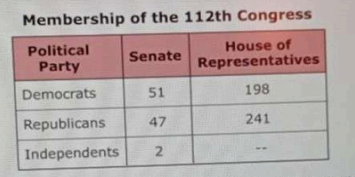
- A. The party that passed more legislation could be anticipated.
- B. The party that would win the next presidential election could be predicted.
- C. Party divisions were a challenge to the legislative process.
- D. Party affiliations are a requirement for congressional membership.
Correct Answer & Rationale
Correct Answer: C
The data suggests that party divisions significantly impacted the legislative process in 2011, indicating that partisan alignment often hindered bipartisan cooperation. Option A incorrectly implies that the quantity of legislation passed directly correlates with party strength, which is not supported by the information. Option B assumes a direct link between legislative success and electoral outcomes, which cannot be inferred from party voting patterns alone. Option D misrepresents the nature of congressional membership, as party affiliation is not a formal requirement but rather a common practice among members.
The data suggests that party divisions significantly impacted the legislative process in 2011, indicating that partisan alignment often hindered bipartisan cooperation. Option A incorrectly implies that the quantity of legislation passed directly correlates with party strength, which is not supported by the information. Option B assumes a direct link between legislative success and electoral outcomes, which cannot be inferred from party voting patterns alone. Option D misrepresents the nature of congressional membership, as party affiliation is not a formal requirement but rather a common practice among members.
According to Justice Marshall, what historical factor has contradicted the ideas expressed in the U.S. Constitution?
- A. slavery
- B. free enterprise
- C. religion
- D. class war
Correct Answer & Rationale
Correct Answer: A
Justice Marshall highlighted slavery as a significant historical contradiction to the principles of freedom and equality enshrined in the U.S. Constitution. Slavery directly undermined the Constitution's assertion that all men are created equal, creating a profound moral and ethical conflict. In contrast, free enterprise (B) aligns with the Constitution's emphasis on individual rights and economic freedom. Religion (C) is protected under the First Amendment, promoting freedom rather than contradiction. Class war (D) is a socio-economic conflict that, while relevant, does not directly challenge the foundational ideals of the Constitution in the same way slavery does.
Justice Marshall highlighted slavery as a significant historical contradiction to the principles of freedom and equality enshrined in the U.S. Constitution. Slavery directly undermined the Constitution's assertion that all men are created equal, creating a profound moral and ethical conflict. In contrast, free enterprise (B) aligns with the Constitution's emphasis on individual rights and economic freedom. Religion (C) is protected under the First Amendment, promoting freedom rather than contradiction. Class war (D) is a socio-economic conflict that, while relevant, does not directly challenge the foundational ideals of the Constitution in the same way slavery does.
Which statement provides the main idea of the passage?
- A. The founders understood the importance of dividing war powers in the U.S. Constitution.
- B. President Truman used presidential war powers to send troops to South Korea.
- C. Congress restricted presidential war powers as a result of the Vietnam War.
- D. A conflict over presidential war powers exists in the U.S. government.
Correct Answer & Rationale
Correct Answer: D
Option D effectively captures the overarching theme of the passage by highlighting the ongoing conflict regarding presidential war powers within the U.S. government. This statement reflects the central issue discussed throughout the text. Option A, while relevant, focuses solely on the founders' intentions rather than the current implications of war powers. Option B is too specific, addressing a single historical instance rather than the broader concept of power dynamics. Option C, although it mentions a relevant event, limits the discussion to the Vietnam War and does not encompass the ongoing nature of the conflict over these powers.
Option D effectively captures the overarching theme of the passage by highlighting the ongoing conflict regarding presidential war powers within the U.S. government. This statement reflects the central issue discussed throughout the text. Option A, while relevant, focuses solely on the founders' intentions rather than the current implications of war powers. Option B is too specific, addressing a single historical instance rather than the broader concept of power dynamics. Option C, although it mentions a relevant event, limits the discussion to the Vietnam War and does not encompass the ongoing nature of the conflict over these powers.
Which historical event most likely shaped the author's point of view?
- A. the development of the concept of Manifest Destiny
- B. the United States' involvement in World War I
- C. the United States' internal conflicts during the Great Depression
- D. the calls for social reform during Prohibition
Correct Answer & Rationale
Correct Answer: B
The author's perspective is significantly influenced by the United States' involvement in World War I, as this event marked a pivotal shift in national identity and global engagement. The war prompted discussions about democracy, freedom, and the role of the U.S. on the world stage, shaping the author's views on these themes. Option A, Manifest Destiny, pertains to 19th-century expansionism, which is less relevant to the author's context. Option C, the Great Depression, focuses on economic struggles rather than the broader geopolitical implications of war. Option D, social reform during Prohibition, addresses domestic issues but does not encompass the global impact and ideological shifts brought about by World War I.
The author's perspective is significantly influenced by the United States' involvement in World War I, as this event marked a pivotal shift in national identity and global engagement. The war prompted discussions about democracy, freedom, and the role of the U.S. on the world stage, shaping the author's views on these themes. Option A, Manifest Destiny, pertains to 19th-century expansionism, which is less relevant to the author's context. Option C, the Great Depression, focuses on economic struggles rather than the broader geopolitical implications of war. Option D, social reform during Prohibition, addresses domestic issues but does not encompass the global impact and ideological shifts brought about by World War I.