Markets
The interaction between the buyers and sellers of a good or service is called a market. Two important economic markets are factor markets and product markets.
The factor market refers to the buying and selling of the factors of production. The factors of production (land, labor, capital, and entrepreneurship) are the resources used to produce goods and services.
Producers offer goods and services for sale in product markets. Individuals spend the money they have earned in the factor market (for instance, wages or the income from selling land) to make purchases in product markets.
Which statement is based on the text?
- A. Individuals spend their income in factor markets.
- B. Entrepreneurs profit from participation in product markets.
- C. Individuals sell their labor in factor markets.
- D. Resources are traded in product markets.
Correct Answer & Rationale
Correct Answer: C
Option C accurately reflects the concept that individuals offer their labor in factor markets, where resources like labor are exchanged for wages. This aligns with economic principles regarding labor supply. Option A is incorrect since individuals do not spend income in factor markets; rather, they purchase goods and services in product markets. Option B misrepresents the role of entrepreneurs, who primarily earn profits through innovation and sales in product markets, not simply from participation. Option D is also misleading, as resources are exchanged in factor markets, while product markets focus on the sale of finished goods and services.
Option C accurately reflects the concept that individuals offer their labor in factor markets, where resources like labor are exchanged for wages. This aligns with economic principles regarding labor supply. Option A is incorrect since individuals do not spend income in factor markets; rather, they purchase goods and services in product markets. Option B misrepresents the role of entrepreneurs, who primarily earn profits through innovation and sales in product markets, not simply from participation. Option D is also misleading, as resources are exchanged in factor markets, while product markets focus on the sale of finished goods and services.
Other Related Questions
Based on the excerpt, which conclusion can be drawn about the U.S. Constitution and the Bill of Rights?
- A. Ratification of the Bill of Rights was completed before the Constitution was drafted.
- B. Ratification of the Constitution was dependent on the passage of the Bill of Rights.
- C. Most leaders were worried that the Bill of Rights would weaken the ruling class protected by the Constitution.
- D. Many leaders were concerned that the Bill of Rights would upset the balance of powers outlined in the Constitution.
Correct Answer & Rationale
Correct Answer: B
The conclusion that ratification of the Constitution was dependent on the passage of the Bill of Rights is supported by historical context, as many states required assurance of individual rights to approve the Constitution. Option A is incorrect because the Bill of Rights was introduced after the Constitution was drafted. Option C misrepresents the intent of the Bill of Rights; leaders were primarily concerned with protecting individual liberties rather than preserving the ruling class. Option D is also inaccurate, as the Bill of Rights aimed to safeguard citizens' rights without disrupting the balance of powers established by the Constitution.
The conclusion that ratification of the Constitution was dependent on the passage of the Bill of Rights is supported by historical context, as many states required assurance of individual rights to approve the Constitution. Option A is incorrect because the Bill of Rights was introduced after the Constitution was drafted. Option C misrepresents the intent of the Bill of Rights; leaders were primarily concerned with protecting individual liberties rather than preserving the ruling class. Option D is also inaccurate, as the Bill of Rights aimed to safeguard citizens' rights without disrupting the balance of powers established by the Constitution.
How did the position expressed by President Johnson differ from the position expressed by Senator Russell?
- A. Only Senator Russell said that state governments were sufficiently protecting the rights of citizens.
- B. Only Senator Russell supported the federal government's intervention.
- C. Only President Johnson supported the state governments' rights to manage their own affairs.
- D. Only President Johnson believed that the federal government was authorized to intervene.
Correct Answer & Rationale
Correct Answer: A
President Johnson emphasized the need for federal intervention to protect citizens' rights, believing that state governments were often inadequate. In contrast, Senator Russell argued that state governments were effectively safeguarding those rights, reflecting a stance of local governance. Option B is incorrect because Senator Russell did not support federal intervention. Option C misrepresents Johnson’s position; he favored federal oversight rather than state autonomy. Option D inaccurately attributes the belief in federal authority solely to Johnson, as Russell did not share this view. Thus, the distinction lies in Russell's confidence in state governments versus Johnson's call for federal action.
President Johnson emphasized the need for federal intervention to protect citizens' rights, believing that state governments were often inadequate. In contrast, Senator Russell argued that state governments were effectively safeguarding those rights, reflecting a stance of local governance. Option B is incorrect because Senator Russell did not support federal intervention. Option C misrepresents Johnson’s position; he favored federal oversight rather than state autonomy. Option D inaccurately attributes the belief in federal authority solely to Johnson, as Russell did not share this view. Thus, the distinction lies in Russell's confidence in state governments versus Johnson's call for federal action.
Which statement from the passage is an opinion?
- A. "Even so, the success of Levittown depended not only on the efficiency of the Levitt brothers' process but also on the Federal Housing Administration" (paragraph 4)
- B. "Shortly after World War II, many changes led to the development of suburbs." (paragraph 1)
- C. "This, much of the baby-boom generation had well-constructed homes in which to grow up." (paragraph 4)
- D. "With this financing in place, more homes could be built and more veterans could afford to buy them." (paragraph 4)
Correct Answer & Rationale
Correct Answer: C
Option C expresses a subjective view about the quality of homes available to the baby-boom generation, indicating an opinion that these homes were "well-constructed." This characterization is not a factual statement and reflects a personal judgment. In contrast, Option A presents a factual statement about the factors contributing to Levittown's success, grounded in historical context. Option B provides a straightforward observation regarding the timeline of suburban development, without personal interpretation. Option D outlines a factual cause-and-effect relationship regarding financing and home construction, remaining objective. Thus, only Option C conveys a personal opinion.
Option C expresses a subjective view about the quality of homes available to the baby-boom generation, indicating an opinion that these homes were "well-constructed." This characterization is not a factual statement and reflects a personal judgment. In contrast, Option A presents a factual statement about the factors contributing to Levittown's success, grounded in historical context. Option B provides a straightforward observation regarding the timeline of suburban development, without personal interpretation. Option D outlines a factual cause-and-effect relationship regarding financing and home construction, remaining objective. Thus, only Option C conveys a personal opinion.
Which conclusion can be drawn from the diagrams?
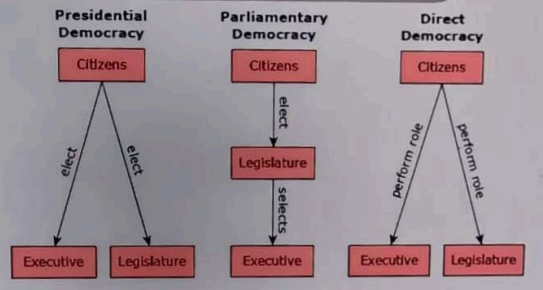
- A. The legislature is more representative of the people in a presidential democracy than in a parliamentary democracy.
- B. The branches of government are more independent of each other in a presidential democracy than in a parliamentary democracy.
- C. The executive branch is more accountable to the people in a parliamentary democracy than in a direct democracy.
- D. The people are more involved in governing in a presidential democracy than in a direct democracy.
Correct Answer & Rationale
Correct Answer: B
In a presidential democracy, the separation of powers is a key feature, allowing the executive, legislative, and judicial branches to operate independently. This independence enhances checks and balances, ensuring that no single branch can dominate. Option A is incorrect as both systems aim for representation, but the degree can vary based on specific contexts rather than the type of democracy. Option C misrepresents accountability; in parliamentary systems, the executive is directly accountable to the legislature, which is elected by the people. Option D is misleading; in a direct democracy, citizens have direct involvement in governance, often more so than in a presidential system.
In a presidential democracy, the separation of powers is a key feature, allowing the executive, legislative, and judicial branches to operate independently. This independence enhances checks and balances, ensuring that no single branch can dominate. Option A is incorrect as both systems aim for representation, but the degree can vary based on specific contexts rather than the type of democracy. Option C misrepresents accountability; in parliamentary systems, the executive is directly accountable to the legislature, which is elected by the people. Option D is misleading; in a direct democracy, citizens have direct involvement in governance, often more so than in a presidential system.