This excerpt is from a message delivered by President Richard Nixon to the U.S. Congress in 1970.
[W]e in this century have too casually and too long abused our natural environment.
The fight against pollution is not a search for villains. For the most part, the damage done to our environment has not been the work of evil men, nor has it been the inevitable by-product either of advancing technology or of growing population. It results not so much from choices made, as from choices neglected; not from [evil] intention, but from failure to take into account the full consequences of our actions.
The tasks that need doing... call for fundamentally new philosophies of land, air and water use, for stricter regulation, for expanded government action, for greater citizen involvement, and for new programs to ensure that government, industry and individuals all are called on to do their share of the job and to pay their share of the cost.
Which statement identifies the purpose of President Nixon's message?
- A. to convince Congress that technological advancement and population growth must be slowed to protect the environment
- B. to convince Congress that industrial polluters of the air and water should not pay for cleaning the environment
- C. to convince Congress that it must take part in action to address human damage to the environment
- D. to convince Congress that there should be no benefits for businesses that pollute the environment
Correct Answer & Rationale
Correct Answer: C
President Nixon's message aimed to mobilize Congress to actively engage in addressing environmental degradation caused by human activities. This focus on collective action underscores the urgency of legislative involvement in environmental protection. Option A misinterprets the goal, as Nixon did not advocate for slowing technological advancement but rather for responsible management. Option B inaccurately suggests that he supported industrial polluters avoiding responsibility, which contradicts his environmental stance. Option D implies a complete lack of support for businesses, neglecting the balanced approach Nixon promoted towards regulatory measures and economic growth.
President Nixon's message aimed to mobilize Congress to actively engage in addressing environmental degradation caused by human activities. This focus on collective action underscores the urgency of legislative involvement in environmental protection. Option A misinterprets the goal, as Nixon did not advocate for slowing technological advancement but rather for responsible management. Option B inaccurately suggests that he supported industrial polluters avoiding responsibility, which contradicts his environmental stance. Option D implies a complete lack of support for businesses, neglecting the balanced approach Nixon promoted towards regulatory measures and economic growth.
Other Related Questions
What basic assumption behind Marshall's remarks is not behind Reagan's remarks?
- A. The framers of the U.S. Constitution have received more credit than they deserve for the governmental protections Americans enjoy.
- B. The framers of the U.S. Constitution have been credited with creating a document that protects all free people around the world.
- C. The U.S. Constitution created a government whose promises are yet to be realized by many around the world.
- D. The U.S. Constitution created a government based on the principles expressed in the Declaration of Independence.
Correct Answer & Rationale
Correct Answer: A
Marshall's remarks imply a critical view of the framers' contributions, suggesting they may not deserve as much credit for governmental protections as commonly believed. This contrasts with Reagan's perspective, which typically emphasizes the positive legacy of the framers. Option B incorrectly assumes that both figures share the belief in the global impact of the Constitution, which Reagan often highlighted. Option C suggests an acknowledgment of unrealized promises, aligning with both perspectives, while option D reinforces a foundational agreement on principles that both figures would likely support. Thus, A stands out as the unique assumption absent in Reagan's remarks.
Marshall's remarks imply a critical view of the framers' contributions, suggesting they may not deserve as much credit for governmental protections as commonly believed. This contrasts with Reagan's perspective, which typically emphasizes the positive legacy of the framers. Option B incorrectly assumes that both figures share the belief in the global impact of the Constitution, which Reagan often highlighted. Option C suggests an acknowledgment of unrealized promises, aligning with both perspectives, while option D reinforces a foundational agreement on principles that both figures would likely support. Thus, A stands out as the unique assumption absent in Reagan's remarks.
Which statement is supported by the diagrams?
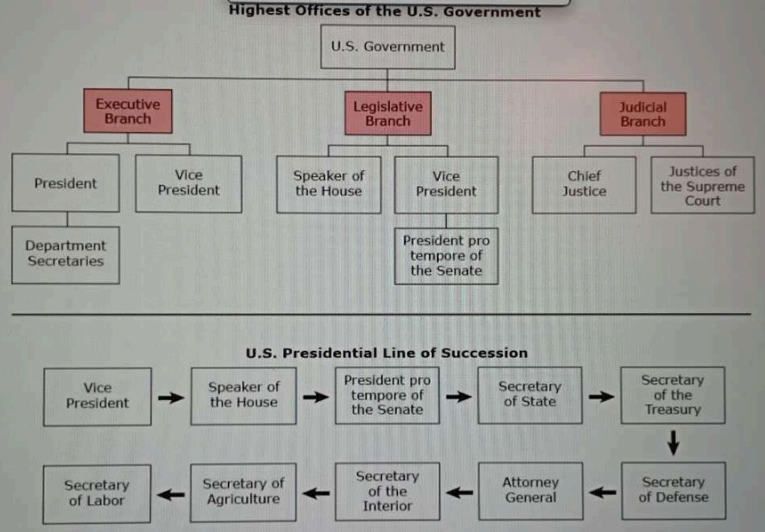
- A. Only the vice president and the president pro tempore of the Senate serve in two branches.
- B. Only officials from the executive and legislative branches are in the line of presidential succession.
- C. The order of presidential succession is determined by the members of the executive branch.
- D. The leaders of Congress are accountable to the members of the executive branch.
Correct Answer & Rationale
Correct Answer: B
Option B accurately reflects the structure of presidential succession, which includes officials from both the executive and legislative branches, specifically the vice president and the leaders of Congress. Option A is misleading; while the vice president and president pro tempore serve in both branches, other officials in the line of succession also include members from the cabinet, which is part of the executive branch. Option C is incorrect as the order of succession is established by law, not determined solely by the executive branch members. Option D misrepresents accountability; Congress leaders are accountable to their constituents, not the executive branch.
Option B accurately reflects the structure of presidential succession, which includes officials from both the executive and legislative branches, specifically the vice president and the leaders of Congress. Option A is misleading; while the vice president and president pro tempore serve in both branches, other officials in the line of succession also include members from the cabinet, which is part of the executive branch. Option C is incorrect as the order of succession is established by law, not determined solely by the executive branch members. Option D misrepresents accountability; Congress leaders are accountable to their constituents, not the executive branch.
Which statement from the passage is an opinion?
- A. "Even so, the success of Levittown depended not only on the efficiency of the Levitt brothers' process but also on the Federal Housing Administration" (paragraph 4)
- B. "Shortly after World War II, many changes led to the development of suburbs." (paragraph 1)
- C. "This, much of the baby-boom generation had well-constructed homes in which to grow up." (paragraph 4)
- D. "With this financing in place, more homes could be built and more veterans could afford to buy them." (paragraph 4)
Correct Answer & Rationale
Correct Answer: C
Option C expresses a subjective view about the quality of homes available to the baby-boom generation, indicating an opinion that these homes were "well-constructed." This characterization is not a factual statement and reflects a personal judgment. In contrast, Option A presents a factual statement about the factors contributing to Levittown's success, grounded in historical context. Option B provides a straightforward observation regarding the timeline of suburban development, without personal interpretation. Option D outlines a factual cause-and-effect relationship regarding financing and home construction, remaining objective. Thus, only Option C conveys a personal opinion.
Option C expresses a subjective view about the quality of homes available to the baby-boom generation, indicating an opinion that these homes were "well-constructed." This characterization is not a factual statement and reflects a personal judgment. In contrast, Option A presents a factual statement about the factors contributing to Levittown's success, grounded in historical context. Option B provides a straightforward observation regarding the timeline of suburban development, without personal interpretation. Option D outlines a factual cause-and-effect relationship regarding financing and home construction, remaining objective. Thus, only Option C conveys a personal opinion.
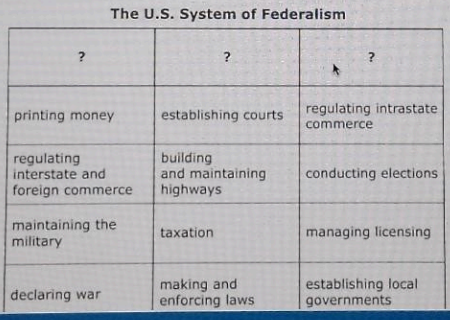
Complete the U.S. System of Federalism chart based on information from the passage. Click on the title below you want to select and drag it into the top of each column in the chart. - State Government Powers - National Government Powers - Shared Powers of National and State Governments -
Correct Answer & Rationale
Correct Answer:
In the U.S. system of federalism, powers are distributed among different levels of government. **State Government Powers** include authority over education, transportation, and local law enforcement, allowing states to address local needs effectively. **National Government Powers** encompass defense, foreign affairs, and immigration, ensuring a unified national policy in these critical areas. **Shared Powers** involve taxation, infrastructure, and law enforcement, illustrating collaboration between state and national governments to maintain order and promote welfare. Other options may misplace powers or overlook the collaborative nature of federalism, leading to misunderstandings about government functions.
In the U.S. system of federalism, powers are distributed among different levels of government. **State Government Powers** include authority over education, transportation, and local law enforcement, allowing states to address local needs effectively. **National Government Powers** encompass defense, foreign affairs, and immigration, ensuring a unified national policy in these critical areas. **Shared Powers** involve taxation, infrastructure, and law enforcement, illustrating collaboration between state and national governments to maintain order and promote welfare. Other options may misplace powers or overlook the collaborative nature of federalism, leading to misunderstandings about government functions.