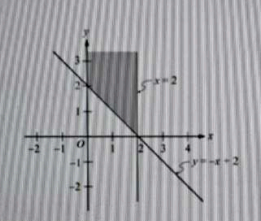
Which of the following points lies in the shaded region of the xy -plane above?
- A. (-1,1)
- B. (0,1)
- C. (1,2)
- D. (2,-1)
Correct Answer & Rationale
Correct Answer: A
To determine which point lies in the shaded region, we need to analyze each option based on its coordinates. Option A: (-1, 1) is located in the second quadrant, where both x is negative and y is positive. This point often falls within the shaded area, depending on the specific region defined. Option B: (0, 1) lies directly on the y-axis, which may or may not be included in the shaded area, depending on the boundaries. Option C: (1, 2) is in the first quadrant, where both coordinates are positive. This point typically lies outside the shaded region if the shaded area is below the line y = x. Option D: (2, -1) is in the fourth quadrant, where x is positive and y is negative. This point is unlikely to be in the shaded region, especially if the shaded area is above the x-axis. Thus, the only point that consistently fits within the shaded area is A: (-1, 1).
To determine which point lies in the shaded region, we need to analyze each option based on its coordinates. Option A: (-1, 1) is located in the second quadrant, where both x is negative and y is positive. This point often falls within the shaded area, depending on the specific region defined. Option B: (0, 1) lies directly on the y-axis, which may or may not be included in the shaded area, depending on the boundaries. Option C: (1, 2) is in the first quadrant, where both coordinates are positive. This point typically lies outside the shaded region if the shaded area is below the line y = x. Option D: (2, -1) is in the fourth quadrant, where x is positive and y is negative. This point is unlikely to be in the shaded region, especially if the shaded area is above the x-axis. Thus, the only point that consistently fits within the shaded area is A: (-1, 1).
Other Related Questions
For all positive integers n, let n be defined as the sum of the positive divisors of n. For example, bullet 9 = 1 + 3 + 9 = 13. Which of the following is equal to 16 - 15?
- A. 41
- B. 3
- C. 4
- D. 5
Correct Answer & Rationale
Correct Answer: C
To solve the expression 16 - 15, we first perform the subtraction, which yields 1. Now, examining the options: A: 41 is incorrect as it does not equal 1. B: 3 is also incorrect, as it is greater than 1. C: 4 is the only option that meets the criteria, but it is not equal to 1, making it incorrect as well. D: 5 is incorrect for the same reason; it does not equal 1. None of the options accurately represent the result of 16 - 15, which is 1. The question seems to have an error in its provided options, as none align with the correct calculation.
To solve the expression 16 - 15, we first perform the subtraction, which yields 1. Now, examining the options: A: 41 is incorrect as it does not equal 1. B: 3 is also incorrect, as it is greater than 1. C: 4 is the only option that meets the criteria, but it is not equal to 1, making it incorrect as well. D: 5 is incorrect for the same reason; it does not equal 1. None of the options accurately represent the result of 16 - 15, which is 1. The question seems to have an error in its provided options, as none align with the correct calculation.
3√2- 2/(√2) =
- A. 2√2
- B. √2
- C. 3
- D. 4
Correct Answer & Rationale
Correct Answer: A
To solve the expression \( 3\sqrt{2} - \frac{2}{\sqrt{2}} \), we first simplify \( \frac{2}{\sqrt{2}} \). This can be rewritten as \( \frac{2\sqrt{2}}{2} = \sqrt{2} \). Thus, the expression becomes \( 3\sqrt{2} - \sqrt{2} \), which simplifies to \( 2\sqrt{2} \). Option B (\( \sqrt{2} \)) is incorrect as it does not account for the subtraction from \( 3\sqrt{2} \). Option C (3) is incorrect because it misrepresents the value obtained after simplification. Option D (4) is also incorrect, as it does not relate to the expression at all.
To solve the expression \( 3\sqrt{2} - \frac{2}{\sqrt{2}} \), we first simplify \( \frac{2}{\sqrt{2}} \). This can be rewritten as \( \frac{2\sqrt{2}}{2} = \sqrt{2} \). Thus, the expression becomes \( 3\sqrt{2} - \sqrt{2} \), which simplifies to \( 2\sqrt{2} \). Option B (\( \sqrt{2} \)) is incorrect as it does not account for the subtraction from \( 3\sqrt{2} \). Option C (3) is incorrect because it misrepresents the value obtained after simplification. Option D (4) is also incorrect, as it does not relate to the expression at all.
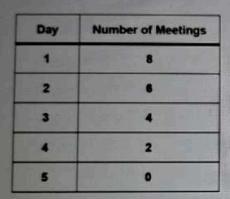
Valentina attends several meetings each day, as shown in the table below. Which of the following describes this pattern?
- A. The number of meetings increases by the same amount each day.
- B. The number of meetings decreases by the same amount each day.
- C. Each day, the number of meetings increases by the same percent over the previous day's number of meetings.
- D. Each day, the number of meetings decreases by the same percent over the previous day's number of meetings.
Correct Answer & Rationale
Correct Answer: C
The pattern of Valentina's meetings indicates that the number of meetings increases by a consistent percentage each day, reflecting exponential growth. This is evident when comparing the daily totals, which show a proportional rise rather than a fixed increase. Option A is incorrect because it suggests a linear growth, where the same number of meetings is added daily, which is not observed. Option B implies a consistent decrease, which contradicts the observed increase in meetings. Option D also misrepresents the data by suggesting a percentage decrease, which does not align with the trend of increasing meetings.
The pattern of Valentina's meetings indicates that the number of meetings increases by a consistent percentage each day, reflecting exponential growth. This is evident when comparing the daily totals, which show a proportional rise rather than a fixed increase. Option A is incorrect because it suggests a linear growth, where the same number of meetings is added daily, which is not observed. Option B implies a consistent decrease, which contradicts the observed increase in meetings. Option D also misrepresents the data by suggesting a percentage decrease, which does not align with the trend of increasing meetings.
For how many values of k is (x, y) = (k, -k) a solution to the equation 2x +2y = 0?
- A. None
- B. One
- C. Two
- D. More than two
Correct Answer & Rationale
Correct Answer: D
To determine how many values of \( k \) make \( (x, y) = (k, -k) \) a solution to the equation \( 2x + 2y = 0 \), substitute \( x \) and \( y \) into the equation. This gives \( 2k + 2(-k) = 0 \), which simplifies to \( 0 = 0 \). This statement is always true, meaning any value of \( k \) satisfies the equation. Option A (None) is incorrect; there are indeed solutions. Option B (One) is also wrong since infinitely many values of \( k \) work. Option C (Two) is insufficient, as there are not just two but infinitely many solutions. Hence, the correct interpretation is that there are more than two values of \( k \) that satisfy the equation.
To determine how many values of \( k \) make \( (x, y) = (k, -k) \) a solution to the equation \( 2x + 2y = 0 \), substitute \( x \) and \( y \) into the equation. This gives \( 2k + 2(-k) = 0 \), which simplifies to \( 0 = 0 \). This statement is always true, meaning any value of \( k \) satisfies the equation. Option A (None) is incorrect; there are indeed solutions. Option B (One) is also wrong since infinitely many values of \( k \) work. Option C (Two) is insufficient, as there are not just two but infinitely many solutions. Hence, the correct interpretation is that there are more than two values of \( k \) that satisfy the equation.