If |x|+|y| = 4 and x ≠y, then x CANNOT be equal to
- A. 2
- C. -2
- D. -5
Correct Answer & Rationale
Correct Answer: D
The equation |x| + |y| = 4 defines a diamond-shaped region in the coordinate plane, where the sum of the absolute values of x and y equals 4. Option A (2) is possible since |2| + |y| = 4 allows y to be 2 or -2. Option C (-2) is also valid, as |-2| + |y| = 4 permits y to be 2 or -2. Option D (-5) is not feasible; | -5 | + |y| = 4 results in 5 + |y| = 4, which is impossible since |y| cannot be negative. Thus, -5 cannot satisfy the given equation while ensuring x ≠ y.
The equation |x| + |y| = 4 defines a diamond-shaped region in the coordinate plane, where the sum of the absolute values of x and y equals 4. Option A (2) is possible since |2| + |y| = 4 allows y to be 2 or -2. Option C (-2) is also valid, as |-2| + |y| = 4 permits y to be 2 or -2. Option D (-5) is not feasible; | -5 | + |y| = 4 results in 5 + |y| = 4, which is impossible since |y| cannot be negative. Thus, -5 cannot satisfy the given equation while ensuring x ≠ y.
Other Related Questions
For how many values of k is (x, y) = (k, -k) a solution to the equation 2x +2y = 0?
- A. None
- B. One
- C. Two
- D. More than two
Correct Answer & Rationale
Correct Answer: D
To determine how many values of \( k \) make \( (x, y) = (k, -k) \) a solution to the equation \( 2x + 2y = 0 \), substitute \( x \) and \( y \) into the equation. This gives \( 2k + 2(-k) = 0 \), which simplifies to \( 0 = 0 \). This statement is always true, meaning any value of \( k \) satisfies the equation. Option A (None) is incorrect; there are indeed solutions. Option B (One) is also wrong since infinitely many values of \( k \) work. Option C (Two) is insufficient, as there are not just two but infinitely many solutions. Hence, the correct interpretation is that there are more than two values of \( k \) that satisfy the equation.
To determine how many values of \( k \) make \( (x, y) = (k, -k) \) a solution to the equation \( 2x + 2y = 0 \), substitute \( x \) and \( y \) into the equation. This gives \( 2k + 2(-k) = 0 \), which simplifies to \( 0 = 0 \). This statement is always true, meaning any value of \( k \) satisfies the equation. Option A (None) is incorrect; there are indeed solutions. Option B (One) is also wrong since infinitely many values of \( k \) work. Option C (Two) is insufficient, as there are not just two but infinitely many solutions. Hence, the correct interpretation is that there are more than two values of \( k \) that satisfy the equation.
3√2- 2/(√2) =
- A. 2√2
- B. √2
- C. 3
- D. 4
Correct Answer & Rationale
Correct Answer: A
To solve the expression \( 3\sqrt{2} - \frac{2}{\sqrt{2}} \), we first simplify \( \frac{2}{\sqrt{2}} \). This can be rewritten as \( \frac{2\sqrt{2}}{2} = \sqrt{2} \). Thus, the expression becomes \( 3\sqrt{2} - \sqrt{2} \), which simplifies to \( 2\sqrt{2} \). Option B (\( \sqrt{2} \)) is incorrect as it does not account for the subtraction from \( 3\sqrt{2} \). Option C (3) is incorrect because it misrepresents the value obtained after simplification. Option D (4) is also incorrect, as it does not relate to the expression at all.
To solve the expression \( 3\sqrt{2} - \frac{2}{\sqrt{2}} \), we first simplify \( \frac{2}{\sqrt{2}} \). This can be rewritten as \( \frac{2\sqrt{2}}{2} = \sqrt{2} \). Thus, the expression becomes \( 3\sqrt{2} - \sqrt{2} \), which simplifies to \( 2\sqrt{2} \). Option B (\( \sqrt{2} \)) is incorrect as it does not account for the subtraction from \( 3\sqrt{2} \). Option C (3) is incorrect because it misrepresents the value obtained after simplification. Option D (4) is also incorrect, as it does not relate to the expression at all.
In the xy-plane above, the circle has center (0, 0) and AB is a diameter of the circle. What is the equation of the line passing through points A and B?
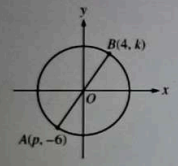
- A. y=-2/3 x
- B. y=2/3 x
- C. y=3/2 x
- D. y=4x
Correct Answer & Rationale
Correct Answer: B
The line passing through points A and B, which are endpoints of a diameter of the circle centered at (0, 0), must be a straight line that passes through the origin. Option B, \(y = \frac{2}{3}x\), represents a line with a positive slope, indicating that as x increases, y also increases, which is consistent with the properties of a diameter. Option A, \(y = -\frac{2}{3}x\), has a negative slope, suggesting a downward trend, which does not align with the upward direction of a diameter in the first quadrant. Option C, \(y = \frac{3}{2}x\), has a steeper slope than option B, which may not accurately represent the diameter's angle unless specified. Option D, \(y = 4x\), has an even steeper slope, making it unlikely to be the diameter unless A and B are positioned at extreme angles, which is not given in the problem.
The line passing through points A and B, which are endpoints of a diameter of the circle centered at (0, 0), must be a straight line that passes through the origin. Option B, \(y = \frac{2}{3}x\), represents a line with a positive slope, indicating that as x increases, y also increases, which is consistent with the properties of a diameter. Option A, \(y = -\frac{2}{3}x\), has a negative slope, suggesting a downward trend, which does not align with the upward direction of a diameter in the first quadrant. Option C, \(y = \frac{3}{2}x\), has a steeper slope than option B, which may not accurately represent the diameter's angle unless specified. Option D, \(y = 4x\), has an even steeper slope, making it unlikely to be the diameter unless A and B are positioned at extreme angles, which is not given in the problem.
Square S has area 2√2 square units. What is the length of a side of square S?
- A. ∜128
- B. ∜32
- C. ∜8
- D. ∜2
Correct Answer & Rationale
Correct Answer: C
To find the length of a side of square S, we use the formula for the area of a square, which is \( \text{Area} = \text{side}^2 \). Given that the area is \( 2\sqrt{2} \), we set up the equation \( \text{side}^2 = 2\sqrt{2} \). Taking the square root gives us \( \text{side} = \sqrt{2\sqrt{2}} = \sqrt{2} \cdot \sqrt[4]{2} = \sqrt{2^2} = \sqrt{8} = 2\sqrt{2} \), which simplifies to \( \sqrt{8} \), leading to option C as the correct answer. Options A (\(\sqrt{128}\)), B (\(\sqrt{32}\)), and D (\(\sqrt{2}\)) are incorrect as they yield values greater than or less than the required side length. Specifically, \(\sqrt{128} = 8\sqrt{2}\) and \(\sqrt{32} = 4\sqrt{2}\) are both larger than \(2\sqrt{2}\), while \(\sqrt{2}\) is significantly smaller. Thus, option C accurately represents the side length of square S.
To find the length of a side of square S, we use the formula for the area of a square, which is \( \text{Area} = \text{side}^2 \). Given that the area is \( 2\sqrt{2} \), we set up the equation \( \text{side}^2 = 2\sqrt{2} \). Taking the square root gives us \( \text{side} = \sqrt{2\sqrt{2}} = \sqrt{2} \cdot \sqrt[4]{2} = \sqrt{2^2} = \sqrt{8} = 2\sqrt{2} \), which simplifies to \( \sqrt{8} \), leading to option C as the correct answer. Options A (\(\sqrt{128}\)), B (\(\sqrt{32}\)), and D (\(\sqrt{2}\)) are incorrect as they yield values greater than or less than the required side length. Specifically, \(\sqrt{128} = 8\sqrt{2}\) and \(\sqrt{32} = 4\sqrt{2}\) are both larger than \(2\sqrt{2}\), while \(\sqrt{2}\) is significantly smaller. Thus, option C accurately represents the side length of square S.