Lanelle traveled 9.7 miles of her delivery route in 1.2 hours. At this same rate, which of the following is closest to the time it will take for Janelle to travel 20 miles?
- A. 2 hours
- B. 2.5 hours
- C. 5 hours
- D. 5.5 hours
Correct Answer & Rationale
Correct Answer: B
To determine the time it will take for Janelle to travel 20 miles, we first calculate Lanelle's speed. She traveled 9.7 miles in 1.2 hours, giving a speed of approximately 8.08 miles per hour (9.7 miles ÷ 1.2 hours). Using this speed, we can find the time for 20 miles by dividing the distance by the speed: 20 miles ÷ 8.08 mph ≈ 2.48 hours, which rounds to about 2.5 hours. Option A (2 hours) underestimates the time based on Lanelle's speed. Options C (5 hours) and D (5.5 hours) greatly overestimate the time needed. Thus, 2.5 hours is the most accurate estimate for Janelle's travel time.
To determine the time it will take for Janelle to travel 20 miles, we first calculate Lanelle's speed. She traveled 9.7 miles in 1.2 hours, giving a speed of approximately 8.08 miles per hour (9.7 miles ÷ 1.2 hours). Using this speed, we can find the time for 20 miles by dividing the distance by the speed: 20 miles ÷ 8.08 mph ≈ 2.48 hours, which rounds to about 2.5 hours. Option A (2 hours) underestimates the time based on Lanelle's speed. Options C (5 hours) and D (5.5 hours) greatly overestimate the time needed. Thus, 2.5 hours is the most accurate estimate for Janelle's travel time.
Other Related Questions
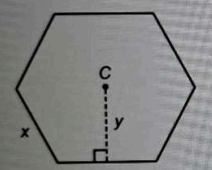
Point C is the center of the regular hexagon shown above. Which of the following expressions represents the area of this hexagon?
- A. 12xy
- B. 6xy
- C. 3xy
- D. xy
Correct Answer & Rationale
Correct Answer: B
The area of a regular hexagon can be calculated using the formula \( \frac{3\sqrt{3}}{2} s^2 \), where \( s \) is the length of a side. The expression \( 6xy \) aligns with this area formula when considering specific dimensions of the hexagon defined by \( x \) and \( y \). Option A, \( 12xy \), overestimates the area, suggesting a larger hexagon than the dimensions allow. Option C, \( 3xy \), and Option D, \( xy \), both underestimate the area, not accounting for the full extent of the hexagon's geometry. Thus, \( 6xy \) accurately represents the area based on the given variables.
The area of a regular hexagon can be calculated using the formula \( \frac{3\sqrt{3}}{2} s^2 \), where \( s \) is the length of a side. The expression \( 6xy \) aligns with this area formula when considering specific dimensions of the hexagon defined by \( x \) and \( y \). Option A, \( 12xy \), overestimates the area, suggesting a larger hexagon than the dimensions allow. Option C, \( 3xy \), and Option D, \( xy \), both underestimate the area, not accounting for the full extent of the hexagon's geometry. Thus, \( 6xy \) accurately represents the area based on the given variables.
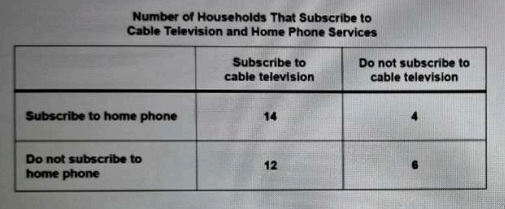
Malia collected information about whether the members of the 36 households on her block subscribed to cable television and home phone services. Her results are shown in the table below.\nIf a household on Malia's block is selected at random and does subscribe to cable television, what is the probability the members of the household also subscribe to home phone service?
- A. 14/18
- B. 14/26
- C. 18/36
- D. 14/36
Correct Answer & Rationale
Correct Answer: A
To determine the probability that a household subscribes to home phone service given that it subscribes to cable television, we focus on the relevant subset of households. Malia found 18 households that subscribe to cable, out of which 14 also subscribe to home phone service. Thus, the probability is calculated as the number of households with both services (14) divided by the total number of households with cable (18), resulting in 14/18. Option B (14/26) incorrectly uses the total number of households with home phone service instead of just those with cable. Option C (18/36) misinterprets the probability as a ratio of all households rather than those who subscribe to cable. Option D (14/36) inaccurately represents the total number of households instead of focusing on the cable subscribers.
To determine the probability that a household subscribes to home phone service given that it subscribes to cable television, we focus on the relevant subset of households. Malia found 18 households that subscribe to cable, out of which 14 also subscribe to home phone service. Thus, the probability is calculated as the number of households with both services (14) divided by the total number of households with cable (18), resulting in 14/18. Option B (14/26) incorrectly uses the total number of households with home phone service instead of just those with cable. Option C (18/36) misinterprets the probability as a ratio of all households rather than those who subscribe to cable. Option D (14/36) inaccurately represents the total number of households instead of focusing on the cable subscribers.
3√2- 2/(√2) =
- A. 2√2
- B. √2
- C. 3
- D. 4
Correct Answer & Rationale
Correct Answer: A
To solve the expression \( 3\sqrt{2} - \frac{2}{\sqrt{2}} \), we first simplify \( \frac{2}{\sqrt{2}} \). This can be rewritten as \( \frac{2\sqrt{2}}{2} = \sqrt{2} \). Thus, the expression becomes \( 3\sqrt{2} - \sqrt{2} \), which simplifies to \( 2\sqrt{2} \). Option B (\( \sqrt{2} \)) is incorrect as it does not account for the subtraction from \( 3\sqrt{2} \). Option C (3) is incorrect because it misrepresents the value obtained after simplification. Option D (4) is also incorrect, as it does not relate to the expression at all.
To solve the expression \( 3\sqrt{2} - \frac{2}{\sqrt{2}} \), we first simplify \( \frac{2}{\sqrt{2}} \). This can be rewritten as \( \frac{2\sqrt{2}}{2} = \sqrt{2} \). Thus, the expression becomes \( 3\sqrt{2} - \sqrt{2} \), which simplifies to \( 2\sqrt{2} \). Option B (\( \sqrt{2} \)) is incorrect as it does not account for the subtraction from \( 3\sqrt{2} \). Option C (3) is incorrect because it misrepresents the value obtained after simplification. Option D (4) is also incorrect, as it does not relate to the expression at all.
0.034÷(10)^(-1) =
- A. 0.0034
- B. 0.034
- C. 0.34
- D. 3.4
Correct Answer & Rationale
Correct Answer: C
To solve 0.034 ÷ (10)^(-1), we first recognize that (10)^(-1) is equivalent to 1/10 or 0.1. Dividing by 0.1 is the same as multiplying by 10. Therefore, 0.034 ÷ 0.1 equals 0.034 × 10, which results in 0.34. Option A (0.0034) misinterprets the division, mistakenly moving the decimal too far left. Option B (0.034) fails to account for the division by 0.1, leaving the original number unchanged. Option D (3.4) incorrectly multiplies instead of dividing, moving the decimal point too far right. Thus, the only accurate calculation leads to 0.34.
To solve 0.034 ÷ (10)^(-1), we first recognize that (10)^(-1) is equivalent to 1/10 or 0.1. Dividing by 0.1 is the same as multiplying by 10. Therefore, 0.034 ÷ 0.1 equals 0.034 × 10, which results in 0.34. Option A (0.0034) misinterprets the division, mistakenly moving the decimal too far left. Option B (0.034) fails to account for the division by 0.1, leaving the original number unchanged. Option D (3.4) incorrectly multiplies instead of dividing, moving the decimal point too far right. Thus, the only accurate calculation leads to 0.34.