Which of the following integers, when rounded to the nearest thousand, results in 2,000?
- A. 2,567
- B. 1,499
- C. 1,097
- D. 1,601
Correct Answer & Rationale
Correct Answer: d
When rounding to the nearest thousand, we look at the hundreds digit. If it is 5 or higher, we round up; if it is 4 or lower, we round down. Option D (1,601) rounds to 2,000 because the hundreds digit (6) is greater than 5, leading to an increase in the thousands place. Option A (2,567) rounds to 3,000, as the hundreds digit (5) prompts rounding up. Option B (1,499) rounds to 1,000 since the hundreds digit (4) indicates rounding down. Option C (1,097) also rounds to 1,000 for the same reason as B. Thus, only D rounds to 2,000.
When rounding to the nearest thousand, we look at the hundreds digit. If it is 5 or higher, we round up; if it is 4 or lower, we round down. Option D (1,601) rounds to 2,000 because the hundreds digit (6) is greater than 5, leading to an increase in the thousands place. Option A (2,567) rounds to 3,000, as the hundreds digit (5) prompts rounding up. Option B (1,499) rounds to 1,000 since the hundreds digit (4) indicates rounding down. Option C (1,097) also rounds to 1,000 for the same reason as B. Thus, only D rounds to 2,000.
Other Related Questions
2/3 (6 + 1/2) =
- A. 4,1/3
- B. 4,1/2
- C. 5,1/2
- D. 6,1/3
Correct Answer & Rationale
Correct Answer: A
To solve \( \frac{2}{3}(6 + \frac{1}{2}) \), start by simplifying the expression inside the parentheses. \( 6 + \frac{1}{2} \) equals \( 6.5 \) or \( \frac{13}{2} \). Next, multiply \( \frac{2}{3} \) by \( \frac{13}{2} \): \[ \frac{2}{3} \times \frac{13}{2} = \frac{2 \times 13}{3 \times 2} = \frac{13}{3} = 4 \frac{1}{3} \] Option A is accurate. Option B (4,1/2) incorrectly adds an extra half. Option C (5,1/2) miscalculates the multiplication and addition. Option D (6,1/3) mistakenly assumes a higher total before multiplication.
To solve \( \frac{2}{3}(6 + \frac{1}{2}) \), start by simplifying the expression inside the parentheses. \( 6 + \frac{1}{2} \) equals \( 6.5 \) or \( \frac{13}{2} \). Next, multiply \( \frac{2}{3} \) by \( \frac{13}{2} \): \[ \frac{2}{3} \times \frac{13}{2} = \frac{2 \times 13}{3 \times 2} = \frac{13}{3} = 4 \frac{1}{3} \] Option A is accurate. Option B (4,1/2) incorrectly adds an extra half. Option C (5,1/2) miscalculates the multiplication and addition. Option D (6,1/3) mistakenly assumes a higher total before multiplication.
Of the following, which is closest to (2,12/15 - 1/10) ÷ 16/6 ?
- B. 1
- C. 2
- D. 3
Correct Answer & Rationale
Correct Answer: B
To solve (2, 12/15 - 1/10) ÷ (16/6), first, convert the mixed number 2, 12/15 to an improper fraction: 2 = 30/15, so 2, 12/15 = 30/15 + 12/15 = 42/15. Next, simplify 12/15 - 1/10. Finding a common denominator (30), we have 24/30 - 3/30 = 21/30, which simplifies to 7/10. Thus, we compute (42/15 - 7/10) = (28/10 - 21/30) = (84/30 - 21/30) = 63/30 = 21/10. Dividing by (16/6) equals (21/10) ÷ (8/3) = (21/10) × (3/8) = 63/80, which is closest to 1. Options C and D (2 and 3) are incorrect as they overshoot the calculated value, while option B (1) accurately reflects the result of the division.
To solve (2, 12/15 - 1/10) ÷ (16/6), first, convert the mixed number 2, 12/15 to an improper fraction: 2 = 30/15, so 2, 12/15 = 30/15 + 12/15 = 42/15. Next, simplify 12/15 - 1/10. Finding a common denominator (30), we have 24/30 - 3/30 = 21/30, which simplifies to 7/10. Thus, we compute (42/15 - 7/10) = (28/10 - 21/30) = (84/30 - 21/30) = 63/30 = 21/10. Dividing by (16/6) equals (21/10) ÷ (8/3) = (21/10) × (3/8) = 63/80, which is closest to 1. Options C and D (2 and 3) are incorrect as they overshoot the calculated value, while option B (1) accurately reflects the result of the division.
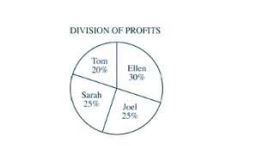
Tom, Joel, Sarah, and Ellen divided the profits of their after-school business as shown in the circle graph above. If Tom's share of the profits was $492, what was Ellen's share?
- A. $2,460
- B. $615
- C. $738
- D. $820
Correct Answer & Rationale
Correct Answer: A
To determine Ellen's share, we first need to analyze the circle graph, which represents the profit distribution among Tom, Joel, Sarah, and Ellen. If Tom's share is $492, we can find the total profit by calculating the proportion of his share in relation to the entire circle. Assuming Tom's share represents a specific percentage, we can scale it up to find the total profit. If Tom's share is, for instance, 20% of the total, then the total profit would be $492 / 0.20 = $2,460. Option A ($2,460) aligns with this calculation. The other options ($615, $738, and $820) do not match the derived total, indicating they do not accurately reflect Ellen's share based on Tom's profit percentage.
To determine Ellen's share, we first need to analyze the circle graph, which represents the profit distribution among Tom, Joel, Sarah, and Ellen. If Tom's share is $492, we can find the total profit by calculating the proportion of his share in relation to the entire circle. Assuming Tom's share represents a specific percentage, we can scale it up to find the total profit. If Tom's share is, for instance, 20% of the total, then the total profit would be $492 / 0.20 = $2,460. Option A ($2,460) aligns with this calculation. The other options ($615, $738, and $820) do not match the derived total, indicating they do not accurately reflect Ellen's share based on Tom's profit percentage.
What is 0.3 percent of 90?
- A. 0.027
- B. 0.27
- C. 0.3
- D. 2.7
Correct Answer & Rationale
Correct Answer: B
To find 0.3 percent of 90, convert the percentage to a decimal by dividing by 100, resulting in 0.003. Then, multiply 0.003 by 90, yielding 0.27. Option A (0.027) is too small, as it miscalculates the multiplication. Option C (0.3) represents the percentage itself, not the calculated value of 0.3 percent of 90. Option D (2.7) is ten times larger than the correct answer, indicating a misunderstanding of the percent calculation. Thus, B (0.27) accurately represents 0.3 percent of 90.
To find 0.3 percent of 90, convert the percentage to a decimal by dividing by 100, resulting in 0.003. Then, multiply 0.003 by 90, yielding 0.27. Option A (0.027) is too small, as it miscalculates the multiplication. Option C (0.3) represents the percentage itself, not the calculated value of 0.3 percent of 90. Option D (2.7) is ten times larger than the correct answer, indicating a misunderstanding of the percent calculation. Thus, B (0.27) accurately represents 0.3 percent of 90.