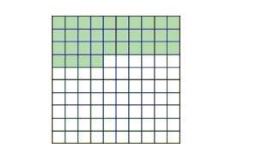
The large square above has sides of length 1. It is divided into smaller squares by dividing each side into 10 equal parts. In the figure, 3 full rows and 4 smaller squares in the next row are shaded. What is the area of the shaded region?
- A. 0.34
- B. 0.37
- C. 0.43
- D. 0.7
Correct Answer & Rationale
Correct Answer: A
To determine the area of the shaded region, first note that the large square has a side length of 1, resulting in a total area of 1 square unit. Each side is divided into 10 equal parts, creating a grid of 100 smaller squares, each with an area of 0.01 (1/100). In the figure, 3 full rows of squares are shaded, which accounts for 30 squares (3 rows x 10 squares per row). Additionally, 4 squares are shaded in the fourth row, bringing the total shaded squares to 34. Thus, the area of the shaded region is 34 squares x 0.01 = 0.34. Option B (0.37) incorrectly suggests 37 squares shaded. Option C (0.43) implies 43 squares, which is not possible given the shading described. Option D (0.7) overestimates the shaded area, miscounting the total squares shaded.
To determine the area of the shaded region, first note that the large square has a side length of 1, resulting in a total area of 1 square unit. Each side is divided into 10 equal parts, creating a grid of 100 smaller squares, each with an area of 0.01 (1/100). In the figure, 3 full rows of squares are shaded, which accounts for 30 squares (3 rows x 10 squares per row). Additionally, 4 squares are shaded in the fourth row, bringing the total shaded squares to 34. Thus, the area of the shaded region is 34 squares x 0.01 = 0.34. Option B (0.37) incorrectly suggests 37 squares shaded. Option C (0.43) implies 43 squares, which is not possible given the shading described. Option D (0.7) overestimates the shaded area, miscounting the total squares shaded.
Other Related Questions
50.50 ÷ 0.25
- A. 202
- B. 2.2
- C. 2.02
- D. 0.22
Correct Answer & Rationale
Correct Answer: A
To solve 50.50 ÷ 0.25, converting the division into a simpler form is helpful. Dividing both numbers by 0.25 effectively transforms the problem into 50.50 ÷ 0.25 = 50.50 × 4, which equals 202. Option B (2.2) is incorrect as it misrepresents the scale of the division, resulting from a misunderstanding of decimal placement. Option C (2.02) also miscalculates the division, likely stemming from incorrect multiplication or division steps. Option D (0.22) is far too low, indicating a significant error in understanding the relationship between the dividend and divisor.
To solve 50.50 ÷ 0.25, converting the division into a simpler form is helpful. Dividing both numbers by 0.25 effectively transforms the problem into 50.50 ÷ 0.25 = 50.50 × 4, which equals 202. Option B (2.2) is incorrect as it misrepresents the scale of the division, resulting from a misunderstanding of decimal placement. Option C (2.02) also miscalculates the division, likely stemming from incorrect multiplication or division steps. Option D (0.22) is far too low, indicating a significant error in understanding the relationship between the dividend and divisor.
At the Crest Coffee Shop, the cost of a plain bagel was $0.75 last year. This year the cost of a plain bagel is $0.90. By what percent did the cost of a plain bagel increase from last year to this year?
- A. 10%
- B. 15%
- C. 17%
- D. 20%
Correct Answer & Rationale
Correct Answer: D
To determine the percent increase in the cost of a plain bagel, the formula used is: \[ \text{Percent Increase} = \left( \frac{\text{New Price} - \text{Old Price}}{\text{Old Price}} \right) \times 100 \] Substituting the given values: \[ \text{Percent Increase} = \left( \frac{0.90 - 0.75}{0.75} \right) \times 100 = \left( \frac{0.15}{0.75} \right) \times 100 = 20\% \] Option A (10%) underestimates the increase, while B (15%) and C (17%) also fail to reflect the correct calculation. Therefore, the accurate calculation confirms a 20% increase in cost.
To determine the percent increase in the cost of a plain bagel, the formula used is: \[ \text{Percent Increase} = \left( \frac{\text{New Price} - \text{Old Price}}{\text{Old Price}} \right) \times 100 \] Substituting the given values: \[ \text{Percent Increase} = \left( \frac{0.90 - 0.75}{0.75} \right) \times 100 = \left( \frac{0.15}{0.75} \right) \times 100 = 20\% \] Option A (10%) underestimates the increase, while B (15%) and C (17%) also fail to reflect the correct calculation. Therefore, the accurate calculation confirms a 20% increase in cost.
1,500 ÷ (15 + 5) =
- A. 75
- B. 130
- C. 315
- D. 400
Correct Answer & Rationale
Correct Answer: A
To solve the expression 1,500 ÷ (15 + 5), first calculate the sum inside the parentheses: 15 + 5 equals 20. Next, divide 1,500 by 20. Performing the division, 1,500 ÷ 20 equals 75, making option A the correct choice. Option B (130) results from incorrect calculations, possibly misapplying the division. Option C (315) may stem from an error in interpreting the division or addition. Option D (400) could arise from mistakenly multiplying instead of dividing. Thus, only option A accurately reflects the correct computation.
To solve the expression 1,500 ÷ (15 + 5), first calculate the sum inside the parentheses: 15 + 5 equals 20. Next, divide 1,500 by 20. Performing the division, 1,500 ÷ 20 equals 75, making option A the correct choice. Option B (130) results from incorrect calculations, possibly misapplying the division. Option C (315) may stem from an error in interpreting the division or addition. Option D (400) could arise from mistakenly multiplying instead of dividing. Thus, only option A accurately reflects the correct computation.
Which of the following inequalities is correct?
- A. 2/3 < 3/5 < 5/7
- B. 2/3 < 5/7 < 3/5
- C. 3/5 < 2/3 < 5/7
- D. 3/5 < 5/7 < 2/3
Correct Answer & Rationale
Correct Answer: C
To determine the order of the fractions, we can convert them to decimals or find a common denominator. - **Option A (2/3 < 3/5 < 5/7)** is incorrect because 2/3 (approximately 0.67) is greater than 3/5 (0.6), violating the first inequality. - **Option B (2/3 < 5/7 < 3/5)** is also incorrect, as 5/7 (approximately 0.71) is greater than 2/3, making the first inequality false. - **Option D (3/5 < 5/7 < 2/3)** is incorrect because, while 3/5 is less than 5/7, 5/7 is greater than 2/3, contradicting the second inequality. - **Option C (3/5 < 2/3 < 5/7)** is accurate; 3/5 is indeed less than 2/3, and 2/3 is less than 5/7, maintaining the correct order.
To determine the order of the fractions, we can convert them to decimals or find a common denominator. - **Option A (2/3 < 3/5 < 5/7)** is incorrect because 2/3 (approximately 0.67) is greater than 3/5 (0.6), violating the first inequality. - **Option B (2/3 < 5/7 < 3/5)** is also incorrect, as 5/7 (approximately 0.71) is greater than 2/3, making the first inequality false. - **Option D (3/5 < 5/7 < 2/3)** is incorrect because, while 3/5 is less than 5/7, 5/7 is greater than 2/3, contradicting the second inequality. - **Option C (3/5 < 2/3 < 5/7)** is accurate; 3/5 is indeed less than 2/3, and 2/3 is less than 5/7, maintaining the correct order.