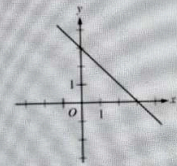
Which of the following could be an equation of the line graphed in the xy-plane above?
- A. y=-x-3
- B. y=-x+3
- C. y=x-3
- D. y=x+3
Correct Answer & Rationale
Correct Answer: D
To determine the equation of the line, we analyze its slope and y-intercept. The line in the graph has a positive slope, indicating that as \(x\) increases, \(y\) also increases. Option D, \(y = x + 3\), has a positive slope of 1 and a y-intercept of 3, aligning with the graph's characteristics. Option A, \(y = -x - 3\), has a negative slope and would decrease as \(x\) increases, which contradicts the graph. Option B, \(y = -x + 3\), also has a negative slope, leading to a downward trend. Option C, \(y = x - 3\), has a positive slope but a y-intercept of -3, placing it below the graph. Thus, D is the only option that fits the observed line.
To determine the equation of the line, we analyze its slope and y-intercept. The line in the graph has a positive slope, indicating that as \(x\) increases, \(y\) also increases. Option D, \(y = x + 3\), has a positive slope of 1 and a y-intercept of 3, aligning with the graph's characteristics. Option A, \(y = -x - 3\), has a negative slope and would decrease as \(x\) increases, which contradicts the graph. Option B, \(y = -x + 3\), also has a negative slope, leading to a downward trend. Option C, \(y = x - 3\), has a positive slope but a y-intercept of -3, placing it below the graph. Thus, D is the only option that fits the observed line.
Other Related Questions
Lanelle traveled 9.7 miles of her delivery route in 1.2 hours. At this same rate, which of the following is closest to the time it will take for Janelle to travel 20 miles?
- A. 2 hours
- B. 2.5 hours
- C. 5 hours
- D. 5.5 hours
Correct Answer & Rationale
Correct Answer: B
To determine the time it will take for Janelle to travel 20 miles, we first calculate Lanelle's speed. She traveled 9.7 miles in 1.2 hours, giving a speed of approximately 8.08 miles per hour (9.7 miles ÷ 1.2 hours). Using this speed, we can find the time for 20 miles by dividing the distance by the speed: 20 miles ÷ 8.08 mph ≈ 2.48 hours, which rounds to about 2.5 hours. Option A (2 hours) underestimates the time based on Lanelle's speed. Options C (5 hours) and D (5.5 hours) greatly overestimate the time needed. Thus, 2.5 hours is the most accurate estimate for Janelle's travel time.
To determine the time it will take for Janelle to travel 20 miles, we first calculate Lanelle's speed. She traveled 9.7 miles in 1.2 hours, giving a speed of approximately 8.08 miles per hour (9.7 miles ÷ 1.2 hours). Using this speed, we can find the time for 20 miles by dividing the distance by the speed: 20 miles ÷ 8.08 mph ≈ 2.48 hours, which rounds to about 2.5 hours. Option A (2 hours) underestimates the time based on Lanelle's speed. Options C (5 hours) and D (5.5 hours) greatly overestimate the time needed. Thus, 2.5 hours is the most accurate estimate for Janelle's travel time.
A salesperson's commission is k percent of the selling price of a car. Which of the following represents the commission, in dollars, on 2 cars that sold for $14,000 each?
- A. 280k
- B. 28,000k
- C. 14,000/(100+2k)
- D. (28,000+k)/100
Correct Answer & Rationale
Correct Answer: A
To determine the commission on 2 cars sold for $14,000 each, first calculate the total selling price: 2 × $14,000 = $28,000. The commission, being k percent of this total, is expressed as (k/100) × $28,000, which simplifies to $280k. Option B, 28,000k, incorrectly suggests the commission is k percent of the total without dividing by 100. Option C, 14,000/(100+2k), misrepresents the calculation entirely by altering the formula. Option D, (28,000+k)/100, incorrectly adds k to the total selling price before calculating the percentage, which is not aligned with commission calculation principles.
To determine the commission on 2 cars sold for $14,000 each, first calculate the total selling price: 2 × $14,000 = $28,000. The commission, being k percent of this total, is expressed as (k/100) × $28,000, which simplifies to $280k. Option B, 28,000k, incorrectly suggests the commission is k percent of the total without dividing by 100. Option C, 14,000/(100+2k), misrepresents the calculation entirely by altering the formula. Option D, (28,000+k)/100, incorrectly adds k to the total selling price before calculating the percentage, which is not aligned with commission calculation principles.
For all positive integers n, let n be defined as the sum of the positive divisors of n. For example, bullet 9 = 1 + 3 + 9 = 13. Which of the following is equal to 16 - 15?
- A. 41
- B. 3
- C. 4
- D. 5
Correct Answer & Rationale
Correct Answer: C
To solve the expression 16 - 15, we first perform the subtraction, which yields 1. Now, examining the options: A: 41 is incorrect as it does not equal 1. B: 3 is also incorrect, as it is greater than 1. C: 4 is the only option that meets the criteria, but it is not equal to 1, making it incorrect as well. D: 5 is incorrect for the same reason; it does not equal 1. None of the options accurately represent the result of 16 - 15, which is 1. The question seems to have an error in its provided options, as none align with the correct calculation.
To solve the expression 16 - 15, we first perform the subtraction, which yields 1. Now, examining the options: A: 41 is incorrect as it does not equal 1. B: 3 is also incorrect, as it is greater than 1. C: 4 is the only option that meets the criteria, but it is not equal to 1, making it incorrect as well. D: 5 is incorrect for the same reason; it does not equal 1. None of the options accurately represent the result of 16 - 15, which is 1. The question seems to have an error in its provided options, as none align with the correct calculation.
0.034÷(10)^(-1) =
- A. 0.0034
- B. 0.034
- C. 0.34
- D. 3.4
Correct Answer & Rationale
Correct Answer: C
To solve 0.034 ÷ (10)^(-1), we first recognize that (10)^(-1) is equivalent to 1/10 or 0.1. Dividing by 0.1 is the same as multiplying by 10. Therefore, 0.034 ÷ 0.1 equals 0.034 × 10, which results in 0.34. Option A (0.0034) misinterprets the division, mistakenly moving the decimal too far left. Option B (0.034) fails to account for the division by 0.1, leaving the original number unchanged. Option D (3.4) incorrectly multiplies instead of dividing, moving the decimal point too far right. Thus, the only accurate calculation leads to 0.34.
To solve 0.034 ÷ (10)^(-1), we first recognize that (10)^(-1) is equivalent to 1/10 or 0.1. Dividing by 0.1 is the same as multiplying by 10. Therefore, 0.034 ÷ 0.1 equals 0.034 × 10, which results in 0.34. Option A (0.0034) misinterprets the division, mistakenly moving the decimal too far left. Option B (0.034) fails to account for the division by 0.1, leaving the original number unchanged. Option D (3.4) incorrectly multiplies instead of dividing, moving the decimal point too far right. Thus, the only accurate calculation leads to 0.34.