3√2- 2/(√2) =
- A. 2√2
- B. √2
- C. 3
- D. 4
Correct Answer & Rationale
Correct Answer: A
To solve the expression \( 3\sqrt{2} - \frac{2}{\sqrt{2}} \), we first simplify \( \frac{2}{\sqrt{2}} \). This can be rewritten as \( \frac{2\sqrt{2}}{2} = \sqrt{2} \). Thus, the expression becomes \( 3\sqrt{2} - \sqrt{2} \), which simplifies to \( 2\sqrt{2} \). Option B (\( \sqrt{2} \)) is incorrect as it does not account for the subtraction from \( 3\sqrt{2} \). Option C (3) is incorrect because it misrepresents the value obtained after simplification. Option D (4) is also incorrect, as it does not relate to the expression at all.
To solve the expression \( 3\sqrt{2} - \frac{2}{\sqrt{2}} \), we first simplify \( \frac{2}{\sqrt{2}} \). This can be rewritten as \( \frac{2\sqrt{2}}{2} = \sqrt{2} \). Thus, the expression becomes \( 3\sqrt{2} - \sqrt{2} \), which simplifies to \( 2\sqrt{2} \). Option B (\( \sqrt{2} \)) is incorrect as it does not account for the subtraction from \( 3\sqrt{2} \). Option C (3) is incorrect because it misrepresents the value obtained after simplification. Option D (4) is also incorrect, as it does not relate to the expression at all.
Other Related Questions
Trevani bought a book. She paid a total of $13.50, including 8% sales tax. How much tax did Trevani pay on the book?
- A. $0.96
- B. $1.00
- C. $1.04
- D. $1.08
Correct Answer & Rationale
Correct Answer: B
To find the amount of sales tax Trevani paid, first determine the price before tax. The total amount paid, $13.50, includes an 8% tax. To find the pre-tax amount, divide the total by 1.08 (which accounts for the original price plus tax): $13.50 ÷ 1.08 = $12.50. Next, calculate the sales tax by subtracting the pre-tax amount from the total: $13.50 - $12.50 = $1.00. This confirms that Trevani paid $1.00 in tax. - Option A ($0.96) is incorrect as it underestimates the tax. - Option C ($1.04) slightly overestimates the tax. - Option D ($1.08) incorrectly assumes the total is all tax without accounting for the book's price.
To find the amount of sales tax Trevani paid, first determine the price before tax. The total amount paid, $13.50, includes an 8% tax. To find the pre-tax amount, divide the total by 1.08 (which accounts for the original price plus tax): $13.50 ÷ 1.08 = $12.50. Next, calculate the sales tax by subtracting the pre-tax amount from the total: $13.50 - $12.50 = $1.00. This confirms that Trevani paid $1.00 in tax. - Option A ($0.96) is incorrect as it underestimates the tax. - Option C ($1.04) slightly overestimates the tax. - Option D ($1.08) incorrectly assumes the total is all tax without accounting for the book's price.
0.034÷(10)^(-1) =
- A. 0.0034
- B. 0.034
- C. 0.34
- D. 3.4
Correct Answer & Rationale
Correct Answer: C
To solve 0.034 ÷ (10)^(-1), we first recognize that (10)^(-1) is equivalent to 1/10 or 0.1. Dividing by 0.1 is the same as multiplying by 10. Therefore, 0.034 ÷ 0.1 equals 0.034 × 10, which results in 0.34. Option A (0.0034) misinterprets the division, mistakenly moving the decimal too far left. Option B (0.034) fails to account for the division by 0.1, leaving the original number unchanged. Option D (3.4) incorrectly multiplies instead of dividing, moving the decimal point too far right. Thus, the only accurate calculation leads to 0.34.
To solve 0.034 ÷ (10)^(-1), we first recognize that (10)^(-1) is equivalent to 1/10 or 0.1. Dividing by 0.1 is the same as multiplying by 10. Therefore, 0.034 ÷ 0.1 equals 0.034 × 10, which results in 0.34. Option A (0.0034) misinterprets the division, mistakenly moving the decimal too far left. Option B (0.034) fails to account for the division by 0.1, leaving the original number unchanged. Option D (3.4) incorrectly multiplies instead of dividing, moving the decimal point too far right. Thus, the only accurate calculation leads to 0.34.
In the xy-plane above, the circle has center (0, 0) and AB is a diameter of the circle. What is the equation of the line passing through points A and B?
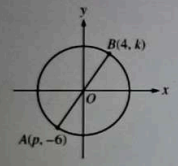
- A. y=-2/3 x
- B. y=2/3 x
- C. y=3/2 x
- D. y=4x
Correct Answer & Rationale
Correct Answer: B
The line passing through points A and B, which are endpoints of a diameter of the circle centered at (0, 0), must be a straight line that passes through the origin. Option B, \(y = \frac{2}{3}x\), represents a line with a positive slope, indicating that as x increases, y also increases, which is consistent with the properties of a diameter. Option A, \(y = -\frac{2}{3}x\), has a negative slope, suggesting a downward trend, which does not align with the upward direction of a diameter in the first quadrant. Option C, \(y = \frac{3}{2}x\), has a steeper slope than option B, which may not accurately represent the diameter's angle unless specified. Option D, \(y = 4x\), has an even steeper slope, making it unlikely to be the diameter unless A and B are positioned at extreme angles, which is not given in the problem.
The line passing through points A and B, which are endpoints of a diameter of the circle centered at (0, 0), must be a straight line that passes through the origin. Option B, \(y = \frac{2}{3}x\), represents a line with a positive slope, indicating that as x increases, y also increases, which is consistent with the properties of a diameter. Option A, \(y = -\frac{2}{3}x\), has a negative slope, suggesting a downward trend, which does not align with the upward direction of a diameter in the first quadrant. Option C, \(y = \frac{3}{2}x\), has a steeper slope than option B, which may not accurately represent the diameter's angle unless specified. Option D, \(y = 4x\), has an even steeper slope, making it unlikely to be the diameter unless A and B are positioned at extreme angles, which is not given in the problem.
If |x|+|y| = 4 and x ≠y, then x CANNOT be equal to
- A. 2
- C. -2
- D. -5
Correct Answer & Rationale
Correct Answer: D
The equation |x| + |y| = 4 defines a diamond-shaped region in the coordinate plane, where the sum of the absolute values of x and y equals 4. Option A (2) is possible since |2| + |y| = 4 allows y to be 2 or -2. Option C (-2) is also valid, as |-2| + |y| = 4 permits y to be 2 or -2. Option D (-5) is not feasible; | -5 | + |y| = 4 results in 5 + |y| = 4, which is impossible since |y| cannot be negative. Thus, -5 cannot satisfy the given equation while ensuring x ≠ y.
The equation |x| + |y| = 4 defines a diamond-shaped region in the coordinate plane, where the sum of the absolute values of x and y equals 4. Option A (2) is possible since |2| + |y| = 4 allows y to be 2 or -2. Option C (-2) is also valid, as |-2| + |y| = 4 permits y to be 2 or -2. Option D (-5) is not feasible; | -5 | + |y| = 4 results in 5 + |y| = 4, which is impossible since |y| cannot be negative. Thus, -5 cannot satisfy the given equation while ensuring x ≠ y.