The great inventor Thomas Edison received more than one thousand patents during his career and made a large contribution to how we live today. For example, in 1877, after discovering a way to record sound, Edison introduced the phonograph. In 1893 he invented the first motion-picture camera. Eight years before inventing the phonograph, Edison received his first patent for a vote recorder, which was intended to help record legislative votes quickly. The Innovation he is most known for is the electric light bulb. He filed a patent for his light bulb in 1879. Though others contributed to the invention of the light bulb, Edison's work made this invention a long-lasting, practical household item.
Which technology mentioned in the passage was the first one invented by Edison?
- A. vote recorder
- B. motion-picture camera
- C. electric light bulb
- D. phonograph
Correct Answer & Rationale
Correct Answer: A
The vote recorder was the first technology invented by Edison, designed to streamline the voting process. This innovation predates his more famous inventions. The motion-picture camera (B) and electric light bulb (C) came later, showcasing Edison's evolution as an inventor. The phonograph (D), although significant in audio technology, was also developed after the vote recorder. Understanding the chronological order of these inventions highlights Edison's early contributions to technology and their impact on society.
The vote recorder was the first technology invented by Edison, designed to streamline the voting process. This innovation predates his more famous inventions. The motion-picture camera (B) and electric light bulb (C) came later, showcasing Edison's evolution as an inventor. The phonograph (D), although significant in audio technology, was also developed after the vote recorder. Understanding the chronological order of these inventions highlights Edison's early contributions to technology and their impact on society.
Other Related Questions
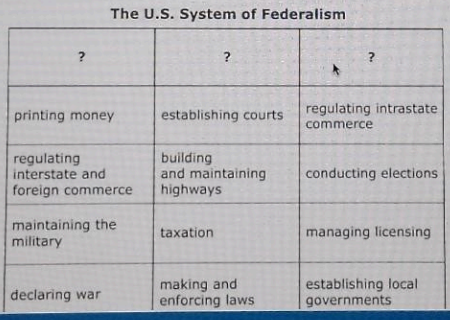
Complete the U.S. System of Federalism chart based on information from the passage. Click on the title below you want to select and drag it into the top of each column in the chart. - State Government Powers - National Government Powers - Shared Powers of National and State Governments -
Correct Answer & Rationale
Correct Answer:
In the U.S. system of federalism, powers are distributed among different levels of government. **State Government Powers** include authority over education, transportation, and local law enforcement, allowing states to address local needs effectively. **National Government Powers** encompass defense, foreign affairs, and immigration, ensuring a unified national policy in these critical areas. **Shared Powers** involve taxation, infrastructure, and law enforcement, illustrating collaboration between state and national governments to maintain order and promote welfare. Other options may misplace powers or overlook the collaborative nature of federalism, leading to misunderstandings about government functions.
In the U.S. system of federalism, powers are distributed among different levels of government. **State Government Powers** include authority over education, transportation, and local law enforcement, allowing states to address local needs effectively. **National Government Powers** encompass defense, foreign affairs, and immigration, ensuring a unified national policy in these critical areas. **Shared Powers** involve taxation, infrastructure, and law enforcement, illustrating collaboration between state and national governments to maintain order and promote welfare. Other options may misplace powers or overlook the collaborative nature of federalism, leading to misunderstandings about government functions.
Which statement is supported by the diagrams?
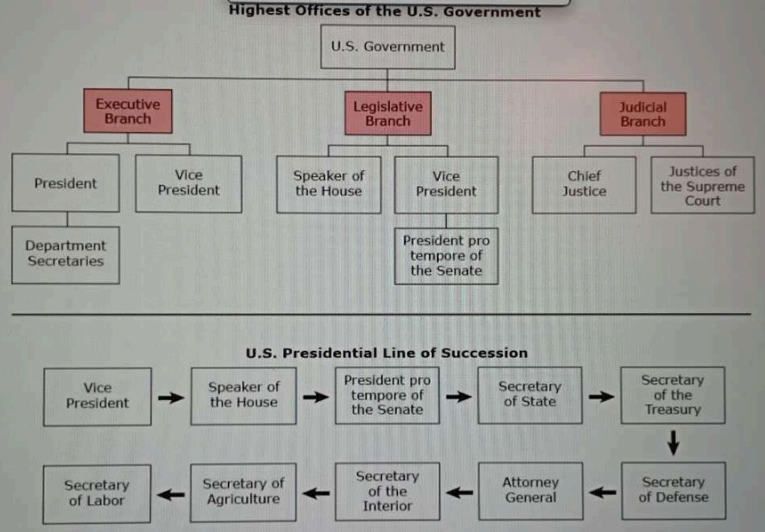
- A. Only the vice president and the president pro tempore of the Senate serve in two branches.
- B. Only officials from the executive and legislative branches are in the line of presidential succession.
- C. The order of presidential succession is determined by the members of the executive branch.
- D. The leaders of Congress are accountable to the members of the executive branch.
Correct Answer & Rationale
Correct Answer: B
Option B accurately reflects the structure of presidential succession, which includes officials from both the executive and legislative branches, specifically the vice president and the leaders of Congress. Option A is misleading; while the vice president and president pro tempore serve in both branches, other officials in the line of succession also include members from the cabinet, which is part of the executive branch. Option C is incorrect as the order of succession is established by law, not determined solely by the executive branch members. Option D misrepresents accountability; Congress leaders are accountable to their constituents, not the executive branch.
Option B accurately reflects the structure of presidential succession, which includes officials from both the executive and legislative branches, specifically the vice president and the leaders of Congress. Option A is misleading; while the vice president and president pro tempore serve in both branches, other officials in the line of succession also include members from the cabinet, which is part of the executive branch. Option C is incorrect as the order of succession is established by law, not determined solely by the executive branch members. Option D misrepresents accountability; Congress leaders are accountable to their constituents, not the executive branch.
How did Chief Justice Marshall contribute to the U.S. government system of checks and balances?
- A. by establishing the Supreme Court's power to check Congress
- B. by creating the power to remove the president from office
- C. by expanding the president's power to check Congress
- D. by giving the Supreme Court the power to control itself
Correct Answer & Rationale
Correct Answer: A
Chief Justice Marshall played a pivotal role in defining the Supreme Court's authority, notably through the landmark case Marbury v. Madison, which established the principle of judicial review. This empowered the Court to invalidate laws passed by Congress that it deemed unconstitutional, effectively allowing it to check legislative power. Option B is incorrect as the power to remove a president lies with Congress through impeachment, not the Supreme Court. Option C misrepresents Marshall's contributions, as he did not expand presidential power but rather clarified judicial authority. Option D is also inaccurate; the Supreme Court does not have self-regulating powers but operates within the framework of checks and balances.
Chief Justice Marshall played a pivotal role in defining the Supreme Court's authority, notably through the landmark case Marbury v. Madison, which established the principle of judicial review. This empowered the Court to invalidate laws passed by Congress that it deemed unconstitutional, effectively allowing it to check legislative power. Option B is incorrect as the power to remove a president lies with Congress through impeachment, not the Supreme Court. Option C misrepresents Marshall's contributions, as he did not expand presidential power but rather clarified judicial authority. Option D is also inaccurate; the Supreme Court does not have self-regulating powers but operates within the framework of checks and balances.
Which statement can be made based on both the passage and the table?
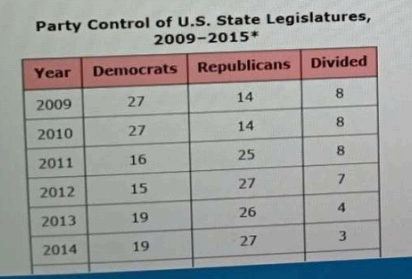
- A. The increase in independent voters has strengthened the influence of Democrats on the national level.
- B. The best political campaigns of Republicans and Democrats use modern media to communicate with voters.
- C. The most recent data shows that Republicans controlled almost three times the number of state legislatures as Democrats.
- D. The decrease in party identification has strengthened the influence of Republicans in state legislatures.
Correct Answer & Rationale
Correct Answer: B
Option B accurately reflects the information provided in both the passage and the table, highlighting the importance of modern media in effective political campaigns for both major parties. This statement emphasizes a shared strategy that transcends partisan lines, indicating a common approach to engaging voters. Option A incorrectly suggests a direct correlation between independent voters and the strengthening of Democrats, which is not supported by the data. Option C misrepresents the statistics regarding state legislature control, as the table likely shows a different ratio. Option D assumes that a decrease in party identification universally benefits Republicans, ignoring the complexities of voter behavior and preferences that the passage may address.
Option B accurately reflects the information provided in both the passage and the table, highlighting the importance of modern media in effective political campaigns for both major parties. This statement emphasizes a shared strategy that transcends partisan lines, indicating a common approach to engaging voters. Option A incorrectly suggests a direct correlation between independent voters and the strengthening of Democrats, which is not supported by the data. Option C misrepresents the statistics regarding state legislature control, as the table likely shows a different ratio. Option D assumes that a decrease in party identification universally benefits Republicans, ignoring the complexities of voter behavior and preferences that the passage may address.