Square side 5(1/2)cm. Area?
Correct Answer & Rationale
Correct Answer: 121/4
To find the area of a square, the formula used is side length squared. Here, the side length is 5(1/2) cm, which converts to 5.5 cm or 11/2 cm. Squaring this value gives (11/2)² = 121/4 cm², confirming the correct area. The other options are incorrect because: - If calculated as 5 cm, the area would be 25 cm², neglecting the fractional part. - If 5.5 cm is incorrectly squared as 30.25 cm², it miscalculates the area. - Any other value derived from misinterpretation of the side length will not yield the correct area.
To find the area of a square, the formula used is side length squared. Here, the side length is 5(1/2) cm, which converts to 5.5 cm or 11/2 cm. Squaring this value gives (11/2)² = 121/4 cm², confirming the correct area. The other options are incorrect because: - If calculated as 5 cm, the area would be 25 cm², neglecting the fractional part. - If 5.5 cm is incorrectly squared as 30.25 cm², it miscalculates the area. - Any other value derived from misinterpretation of the side length will not yield the correct area.
Other Related Questions
Greatest?
- A. 245 thousandths
- B. 24 hundredths
- C. 3 tenths
- D. 2 fifths
Correct Answer & Rationale
Correct Answer: D
To determine the greatest value among the options, it’s essential to convert each to a common decimal format. A: 245 thousandths equals 0.245. B: 24 hundredths equals 0.24. C: 3 tenths equals 0.3. D: 2 fifths equals 0.4 (since 2 divided by 5 is 0.4). Comparing these values, 0.4 (D) is greater than 0.3 (C), 0.24 (B), and 0.245 (A). Thus, option D represents the largest value. Options A, B, and C are all less than D, making them incorrect choices.
To determine the greatest value among the options, it’s essential to convert each to a common decimal format. A: 245 thousandths equals 0.245. B: 24 hundredths equals 0.24. C: 3 tenths equals 0.3. D: 2 fifths equals 0.4 (since 2 divided by 5 is 0.4). Comparing these values, 0.4 (D) is greater than 0.3 (C), 0.24 (B), and 0.245 (A). Thus, option D represents the largest value. Options A, B, and C are all less than D, making them incorrect choices.
36 pencils in equal groups? Select THREE.
- A. 3
- B. 4
- C. 5
- D. 6
- E. 8
Correct Answer & Rationale
Correct Answer: A,B,D
To determine how many equal groups can be formed from 36 pencils, we need to identify the factors of 36. Option A (3) is valid because 36 ÷ 3 = 12, resulting in 12 pencils per group. Option B (4) is also correct since 36 ÷ 4 = 9, yielding 9 pencils per group. Option D (6) works as well, as 36 ÷ 6 = 6, giving 6 pencils per group. Options C (5) and E (8) are incorrect because 36 is not divisible by 5 (36 ÷ 5 = 7.2, which is not a whole number) and 8 (36 ÷ 8 = 4.5, also not a whole number). Thus, only 3, 4, and 6 are valid factors of 36.
To determine how many equal groups can be formed from 36 pencils, we need to identify the factors of 36. Option A (3) is valid because 36 ÷ 3 = 12, resulting in 12 pencils per group. Option B (4) is also correct since 36 ÷ 4 = 9, yielding 9 pencils per group. Option D (6) works as well, as 36 ÷ 6 = 6, giving 6 pencils per group. Options C (5) and E (8) are incorrect because 36 is not divisible by 5 (36 ÷ 5 = 7.2, which is not a whole number) and 8 (36 ÷ 8 = 4.5, also not a whole number). Thus, only 3, 4, and 6 are valid factors of 36.
P=2(L+W), P=48, W=L-4. Width?
- A. 10
- B. 12
- C. 20
- D. 24
Correct Answer & Rationale
Correct Answer: A
To find the width (W), start with the given perimeter formula \( P = 2(L + W) \). Substituting \( P = 48 \) gives \( 48 = 2(L + W) \), which simplifies to \( L + W = 24 \). Given \( W = L - 4 \), substitute this into the equation: \( L + (L - 4) = 24 \). This simplifies to \( 2L - 4 = 24 \), leading to \( 2L = 28 \) and \( L = 14 \). Thus, \( W = 14 - 4 = 10 \). Option B (12) does not satisfy the perimeter equation. Option C (20) and Option D (24) also do not fit the derived equations, confirming that W must be 10.
To find the width (W), start with the given perimeter formula \( P = 2(L + W) \). Substituting \( P = 48 \) gives \( 48 = 2(L + W) \), which simplifies to \( L + W = 24 \). Given \( W = L - 4 \), substitute this into the equation: \( L + (L - 4) = 24 \). This simplifies to \( 2L - 4 = 24 \), leading to \( 2L = 28 \) and \( L = 14 \). Thus, \( W = 14 - 4 = 10 \). Option B (12) does not satisfy the perimeter equation. Option C (20) and Option D (24) also do not fit the derived equations, confirming that W must be 10.
Yellow binders?
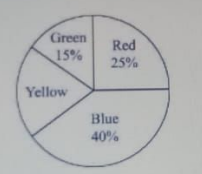
- A. 20
- B. 40
- C. 200
- D. 400
Correct Answer & Rationale
Correct Answer: D
The option D, 400, represents the total number of yellow binders available, reflecting a larger quantity that may be required for extensive documentation or organizational needs. Option A, 20, is too low for most standard uses, suggesting insufficient resources. Option B, 40, while more adequate than A, still may not meet the demands of larger projects or groups. Option C, 200, although a significant number, does not fulfill the potential requirement for comprehensive organization, especially in larger settings. Thus, option D ensures ample supply for diverse needs.
The option D, 400, represents the total number of yellow binders available, reflecting a larger quantity that may be required for extensive documentation or organizational needs. Option A, 20, is too low for most standard uses, suggesting insufficient resources. Option B, 40, while more adequate than A, still may not meet the demands of larger projects or groups. Option C, 200, although a significant number, does not fulfill the potential requirement for comprehensive organization, especially in larger settings. Thus, option D ensures ample supply for diverse needs.