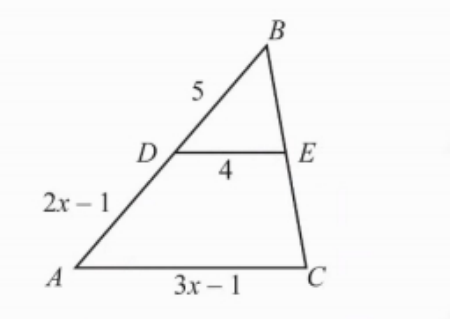
In triangle ABC above, AC ||DE. If AD = 2x - 1 and AC = 3x - 1 , what is the value of x ?
- A. 3
- B. 4
- C. 5
- D. 6
Correct Answer & Rationale
Correct Answer: A
In triangle ABC, since AC is parallel to DE, the segments AD and AC are proportional. This relationship can be expressed as AD = AC. Substituting the expressions gives us the equation: 2x - 1 = 3x - 1. Solving for x, we simplify to 2x - 3x = -1 + 1, leading to -x = 0, or x = 3. Option B (4), C (5), and D (6) do not satisfy the equation derived from the parallel lines, making them incorrect. Only x = 3 maintains the equality, confirming the proportional relationship in the triangle.
In triangle ABC, since AC is parallel to DE, the segments AD and AC are proportional. This relationship can be expressed as AD = AC. Substituting the expressions gives us the equation: 2x - 1 = 3x - 1. Solving for x, we simplify to 2x - 3x = -1 + 1, leading to -x = 0, or x = 3. Option B (4), C (5), and D (6) do not satisfy the equation derived from the parallel lines, making them incorrect. Only x = 3 maintains the equality, confirming the proportional relationship in the triangle.
Other Related Questions
If the function g is defined by g (x) = x/(x+1)', which of the following is true?
- A. g (10) <g (20)
- B. g (20) <g (10)
- C. g(0) =1
- D. g(1)=0
Correct Answer & Rationale
Correct Answer: A
To analyze the function \( g(x) = \frac{x}{x+1} \), we first observe its behavior as \( x \) increases. The function \( g(x) \) is a rational function that approaches 1 as \( x \) approaches infinity. For option A, evaluating \( g(10) \) and \( g(20) \): - \( g(10) = \frac{10}{11} \approx 0.909 \) - \( g(20) = \frac{20}{21} \approx 0.952 \) Since \( 0.909 < 0.952 \), option A is true. For option B, it incorrectly suggests \( g(20) < g(10) \), which contradicts the findings. Option C states \( g(0) = 1 \), but \( g(0) = 0 \), making this option false. Option D claims \( g(1) = 0 \), while \( g(1) = \frac{1}{2} \), which is also incorrect. Thus, only option A holds true.
To analyze the function \( g(x) = \frac{x}{x+1} \), we first observe its behavior as \( x \) increases. The function \( g(x) \) is a rational function that approaches 1 as \( x \) approaches infinity. For option A, evaluating \( g(10) \) and \( g(20) \): - \( g(10) = \frac{10}{11} \approx 0.909 \) - \( g(20) = \frac{20}{21} \approx 0.952 \) Since \( 0.909 < 0.952 \), option A is true. For option B, it incorrectly suggests \( g(20) < g(10) \), which contradicts the findings. Option C states \( g(0) = 1 \), but \( g(0) = 0 \), making this option false. Option D claims \( g(1) = 0 \), while \( g(1) = \frac{1}{2} \), which is also incorrect. Thus, only option A holds true.
If a number from set M is selected at random, what is the probability that the number selected will be a factor of 12?
- A. 0.1
- B. 0.2
- C. 0.4
- D. 0.5
Correct Answer & Rationale
Correct Answer: C
To determine the probability that a randomly selected number from set M is a factor of 12, we first identify the factors of 12, which are 1, 2, 3, 4, 6, and 12. If set M consists of 6 numbers (1 through 6), then 4 of these (1, 2, 3, and 4) are factors of 12. Thus, the probability is 4 out of 6, simplifying to 0.4. Option A (0.1) underestimates the number of factors. Option B (0.2) suggests only 2 factors, which is incorrect. Option D (0.5) implies 3 factors, also inaccurate. Therefore, 0.4 accurately represents the proportion of factors of 12 in the set.
To determine the probability that a randomly selected number from set M is a factor of 12, we first identify the factors of 12, which are 1, 2, 3, 4, 6, and 12. If set M consists of 6 numbers (1 through 6), then 4 of these (1, 2, 3, and 4) are factors of 12. Thus, the probability is 4 out of 6, simplifying to 0.4. Option A (0.1) underestimates the number of factors. Option B (0.2) suggests only 2 factors, which is incorrect. Option D (0.5) implies 3 factors, also inaccurate. Therefore, 0.4 accurately represents the proportion of factors of 12 in the set.
Allison drives her car at an average speed of x miles per hour for y hours and travels 150 miles. Which of the following equations represents this situation?
- A. x + y = 150
- B. xy = 150
- C. y/x = 150
- D. x/y = 150
Correct Answer & Rationale
Correct Answer: B
The relationship between speed, time, and distance is expressed by the formula: distance = speed × time. In this scenario, Allison travels 150 miles at an average speed of x miles per hour for y hours, which translates to the equation xy = 150. Option A (x + y = 150) incorrectly suggests that speed and time add up to distance, which is not accurate. Option C (y/x = 150) misrepresents the relationship by implying that the ratio of time to speed equals distance, which is incorrect. Option D (x/y = 150) also misinterprets the relationship, suggesting that the ratio of speed to time equals distance. Thus, option B correctly captures the relationship among the variables.
The relationship between speed, time, and distance is expressed by the formula: distance = speed × time. In this scenario, Allison travels 150 miles at an average speed of x miles per hour for y hours, which translates to the equation xy = 150. Option A (x + y = 150) incorrectly suggests that speed and time add up to distance, which is not accurate. Option C (y/x = 150) misrepresents the relationship by implying that the ratio of time to speed equals distance, which is incorrect. Option D (x/y = 150) also misinterprets the relationship, suggesting that the ratio of speed to time equals distance. Thus, option B correctly captures the relationship among the variables.
If the combined amount of donations collected by Kevin, Fran, and Brooke exceeded the amount Lamar collected by $250, what was the total amount of donations collected by all five club members?
- A. $500
- B. $1,200
- C. $2,500
- D. $3,200
Correct Answer & Rationale
Correct Answer: C
To determine the total amount of donations collected by all five club members, we start with the information that the combined donations of Kevin, Fran, and Brooke exceeded Lamar's by $250. If we denote Lamar's donations as \( L \), then the amount collected by Kevin, Fran, and Brooke is \( L + 250 \). Thus, the total donations from all five members can be expressed as \( L + (L + 250) = 2L + 250 \). To find a plausible total, we consider the options. - A: $500 is too low, as it doesn't allow for both \( L \) and the excess amount. - B: $1,200 also falls short since it would imply \( L \) is negative. - D: $3,200 would require \( L \) to be too high, exceeding reasonable donation limits. C: $2,500 fits perfectly, allowing \( L \) to be $1,125, which is a feasible figure. Therefore, the total amount is logically $2,500.
To determine the total amount of donations collected by all five club members, we start with the information that the combined donations of Kevin, Fran, and Brooke exceeded Lamar's by $250. If we denote Lamar's donations as \( L \), then the amount collected by Kevin, Fran, and Brooke is \( L + 250 \). Thus, the total donations from all five members can be expressed as \( L + (L + 250) = 2L + 250 \). To find a plausible total, we consider the options. - A: $500 is too low, as it doesn't allow for both \( L \) and the excess amount. - B: $1,200 also falls short since it would imply \( L \) is negative. - D: $3,200 would require \( L \) to be too high, exceeding reasonable donation limits. C: $2,500 fits perfectly, allowing \( L \) to be $1,125, which is a feasible figure. Therefore, the total amount is logically $2,500.