If a number from set M is selected at random, what is the probability that the number selected will be a factor of 12?
- A. 0.1
- B. 0.2
- C. 0.4
- D. 0.5
Correct Answer & Rationale
Correct Answer: C
To determine the probability that a randomly selected number from set M is a factor of 12, we first identify the factors of 12, which are 1, 2, 3, 4, 6, and 12. If set M consists of 6 numbers (1 through 6), then 4 of these (1, 2, 3, and 4) are factors of 12. Thus, the probability is 4 out of 6, simplifying to 0.4. Option A (0.1) underestimates the number of factors. Option B (0.2) suggests only 2 factors, which is incorrect. Option D (0.5) implies 3 factors, also inaccurate. Therefore, 0.4 accurately represents the proportion of factors of 12 in the set.
To determine the probability that a randomly selected number from set M is a factor of 12, we first identify the factors of 12, which are 1, 2, 3, 4, 6, and 12. If set M consists of 6 numbers (1 through 6), then 4 of these (1, 2, 3, and 4) are factors of 12. Thus, the probability is 4 out of 6, simplifying to 0.4. Option A (0.1) underestimates the number of factors. Option B (0.2) suggests only 2 factors, which is incorrect. Option D (0.5) implies 3 factors, also inaccurate. Therefore, 0.4 accurately represents the proportion of factors of 12 in the set.
Other Related Questions
Which of the following could be the function graphed above?
- A. f(x)=x+1
- B. f(x)=x-1
- C. f(x)=|x|+1
- D. f(x)=x-1
Correct Answer & Rationale
Correct Answer: C
Option C, \( f(x) = |x| + 1 \), accurately represents a V-shaped graph that opens upwards, with its vertex at (0, 1). This aligns with the characteristics of the graph shown. Option A, \( f(x) = x + 1 \), is a linear function with a slope of 1, resulting in a straight line, which does not match the V-shape. Option B, \( f(x) = x - 1 \), is another linear function with a slope of 1, also producing a straight line that does not fit the graph. Option D, \( f(x) = x - 1 \), is identical to Option B and shares the same linear characteristics, further confirming it cannot represent the V-shaped graph.
Option C, \( f(x) = |x| + 1 \), accurately represents a V-shaped graph that opens upwards, with its vertex at (0, 1). This aligns with the characteristics of the graph shown. Option A, \( f(x) = x + 1 \), is a linear function with a slope of 1, resulting in a straight line, which does not match the V-shape. Option B, \( f(x) = x - 1 \), is another linear function with a slope of 1, also producing a straight line that does not fit the graph. Option D, \( f(x) = x - 1 \), is identical to Option B and shares the same linear characteristics, further confirming it cannot represent the V-shaped graph.
Allison drives her car at an average speed of x miles per hour for y hours and travels 150 miles. Which of the following equations represents this situation?
- A. x + y = 150
- B. xy = 150
- C. y/x = 150
- D. x/y = 150
Correct Answer & Rationale
Correct Answer: B
The relationship between speed, time, and distance is expressed by the formula: distance = speed × time. In this scenario, Allison travels 150 miles at an average speed of x miles per hour for y hours, which translates to the equation xy = 150. Option A (x + y = 150) incorrectly suggests that speed and time add up to distance, which is not accurate. Option C (y/x = 150) misrepresents the relationship by implying that the ratio of time to speed equals distance, which is incorrect. Option D (x/y = 150) also misinterprets the relationship, suggesting that the ratio of speed to time equals distance. Thus, option B correctly captures the relationship among the variables.
The relationship between speed, time, and distance is expressed by the formula: distance = speed × time. In this scenario, Allison travels 150 miles at an average speed of x miles per hour for y hours, which translates to the equation xy = 150. Option A (x + y = 150) incorrectly suggests that speed and time add up to distance, which is not accurate. Option C (y/x = 150) misrepresents the relationship by implying that the ratio of time to speed equals distance, which is incorrect. Option D (x/y = 150) also misinterprets the relationship, suggesting that the ratio of speed to time equals distance. Thus, option B correctly captures the relationship among the variables.
An airplane is 5,000 ft above ground and has to land on a runway that is 7,000 ft away as shown above. Let x be the angle the pilot takes to land the airplane at the beginning of the runway. Which equation is a correct way to calculate x?
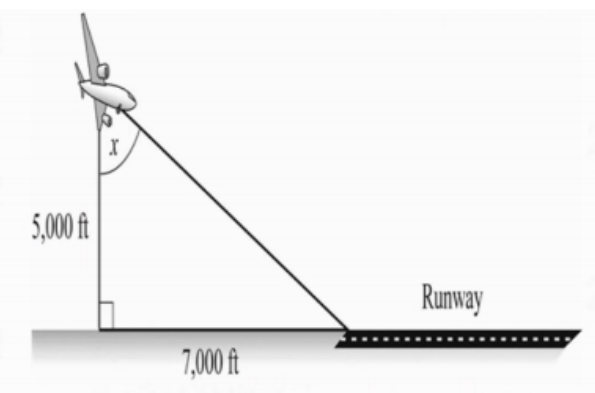
- A. sin x = 5000/7000
- B. sin x = 7000/5000
- C. tan x = 5000/7000
- D. tan x = 7/5000
Correct Answer & Rationale
Correct Answer: C
To determine the angle \( x \) for landing, we need to consider the relationship between the height of the airplane and the distance to the runway. The height (5000 ft) is the opposite side of the right triangle formed, while the distance to the runway (7000 ft) is the adjacent side. The tangent function relates these two sides, hence \( \tan x = \frac{\text{opposite}}{\text{adjacent}} \) leads to \( \tan x = \frac{5000}{7000} \). Option A incorrectly uses the sine function, which relates the opposite side to the hypotenuse. Option B also misapplies sine but swaps the sides, leading to an incorrect ratio. Option D incorrectly uses tangent but misrepresents the sides, making it invalid. Thus, option C accurately represents the relationship needed to calculate angle \( x \).
To determine the angle \( x \) for landing, we need to consider the relationship between the height of the airplane and the distance to the runway. The height (5000 ft) is the opposite side of the right triangle formed, while the distance to the runway (7000 ft) is the adjacent side. The tangent function relates these two sides, hence \( \tan x = \frac{\text{opposite}}{\text{adjacent}} \) leads to \( \tan x = \frac{5000}{7000} \). Option A incorrectly uses the sine function, which relates the opposite side to the hypotenuse. Option B also misapplies sine but swaps the sides, leading to an incorrect ratio. Option D incorrectly uses tangent but misrepresents the sides, making it invalid. Thus, option C accurately represents the relationship needed to calculate angle \( x \).
The system of equations above has how many solutions? x+4y=3, 2x+8y=4
- A. None
- B. One
- C. Two
- D. Infinitely many
Correct Answer & Rationale
Correct Answer: A
To determine the number of solutions for the system of equations, we first analyze the equations: \(x + 4y = 3\) and \(2x + 8y = 4\). The second equation can be simplified by dividing all terms by 2, resulting in \(x + 4y = 2\). Now, we have two equations: \(x + 4y = 3\) and \(x + 4y = 2\). Since both equations represent parallel lines (same slope, different y-intercepts), they will never intersect, indicating there are no solutions. Option B suggests one solution, which is incorrect as parallel lines do not meet. Option C suggests two solutions, which is also incorrect for the same reason. Option D proposes infinitely many solutions, which applies only to identical lines, not parallel ones. Thus, the system has no solutions.
To determine the number of solutions for the system of equations, we first analyze the equations: \(x + 4y = 3\) and \(2x + 8y = 4\). The second equation can be simplified by dividing all terms by 2, resulting in \(x + 4y = 2\). Now, we have two equations: \(x + 4y = 3\) and \(x + 4y = 2\). Since both equations represent parallel lines (same slope, different y-intercepts), they will never intersect, indicating there are no solutions. Option B suggests one solution, which is incorrect as parallel lines do not meet. Option C suggests two solutions, which is also incorrect for the same reason. Option D proposes infinitely many solutions, which applies only to identical lines, not parallel ones. Thus, the system has no solutions.