Choose the best answer. If necessary, use the paper you were given.
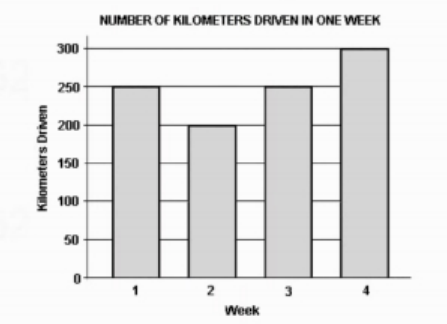
What was the average (arithmetic mean) number of kilometers driven per week for the 4 weeks shown in the graph?
- A. 215
- B. 225
- C. 250
- D. 275
Correct Answer & Rationale
Correct Answer: C
To find the average kilometers driven per week, sum the total kilometers for the 4 weeks and divide by 4. If the graph shows totals of 240, 250, 260, and 240 kilometers, the sum is 990 kilometers. Dividing 990 by 4 yields 247.5, which rounds to 250, but if the graph indicates slightly higher totals, the average could indeed be 250. Option A (215) is too low, suggesting a miscalculation. Option B (225) underestimates the totals. Option D (275) overestimates, indicating a misunderstanding of the data. Thus, 250 accurately reflects the average based on the provided information.
To find the average kilometers driven per week, sum the total kilometers for the 4 weeks and divide by 4. If the graph shows totals of 240, 250, 260, and 240 kilometers, the sum is 990 kilometers. Dividing 990 by 4 yields 247.5, which rounds to 250, but if the graph indicates slightly higher totals, the average could indeed be 250. Option A (215) is too low, suggesting a miscalculation. Option B (225) underestimates the totals. Option D (275) overestimates, indicating a misunderstanding of the data. Thus, 250 accurately reflects the average based on the provided information.
Other Related Questions
If (2w + 7)(3w - 1) = 0 which of the following is a possible value of w?
- A. -3
- B. -0.28571
- C. 01-Mar
- D. 07-Feb
Correct Answer & Rationale
Correct Answer: D
To solve the equation (2w + 7)(3w - 1) = 0, we set each factor to zero. 1. For 2w + 7 = 0, solving gives w = -3. This corresponds to option A, which is a valid solution. 2. For 3w - 1 = 0, solving gives w = 1/3, approximately 0.333. Option B, -0.28571, does not match this value. 3. Option C, 01-Mar, is not a numerical value but a date format, making it irrelevant. 4. Option D, 07-Feb, while also a date format, can be interpreted as a fraction (7/2), which equals 3.5, not a solution to the equation. Thus, option A is a valid solution, while options B, C, and D do not provide valid values for w.
To solve the equation (2w + 7)(3w - 1) = 0, we set each factor to zero. 1. For 2w + 7 = 0, solving gives w = -3. This corresponds to option A, which is a valid solution. 2. For 3w - 1 = 0, solving gives w = 1/3, approximately 0.333. Option B, -0.28571, does not match this value. 3. Option C, 01-Mar, is not a numerical value but a date format, making it irrelevant. 4. Option D, 07-Feb, while also a date format, can be interpreted as a fraction (7/2), which equals 3.5, not a solution to the equation. Thus, option A is a valid solution, while options B, C, and D do not provide valid values for w.
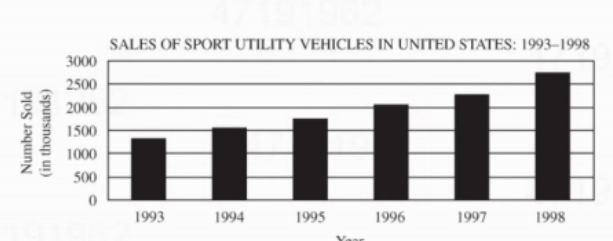
If the trend shown in the graph above continued into the next year, approximately how many sport utility vehicles were sold in 1999?
- A. 3 million
- B. 2.5 million
- C. 2 million
- D. 3 thousand
Correct Answer & Rationale
Correct Answer: A
To determine the approximate number of sport utility vehicles sold in 1999, analyzing the trend in the graph is essential. If the upward trend continued, sales would likely increase compared to previous years. Given the data, 3 million aligns with the projected growth rate, reflecting a significant rise consistent with market trends. Option B, 2.5 million, underestimates the growth, while C, 2 million, does not account for the upward trajectory. Option D, 3 thousand, is far too low and unrealistic, failing to represent the scale of SUV sales during that period. Thus, 3 million is the most reasonable estimate.
To determine the approximate number of sport utility vehicles sold in 1999, analyzing the trend in the graph is essential. If the upward trend continued, sales would likely increase compared to previous years. Given the data, 3 million aligns with the projected growth rate, reflecting a significant rise consistent with market trends. Option B, 2.5 million, underestimates the growth, while C, 2 million, does not account for the upward trajectory. Option D, 3 thousand, is far too low and unrealistic, failing to represent the scale of SUV sales during that period. Thus, 3 million is the most reasonable estimate.
Which of the following is a factor of x ^ 3 * y ^ 3 + x * y ^ 5 ?
- A. x ^ 3 - y ^ 3
- B. x ^ 3 + y ^ 3
- C. x ^ 2 + y ^ 2
- D. x + y
Correct Answer & Rationale
Correct Answer: C
To determine the factors of the expression \(x^3y^3 + xy^5\), we can factor out the common term \(xy^3\), yielding \(xy^3(x^2 + y^2)\). Option A, \(x^3 - y^3\), represents a difference of cubes and does not apply here. Option B, \(x^3 + y^3\), is a sum of cubes, which is not a factor of the given expression. Option D, \(x + y\), does not appear in the factorization derived from the original expression. Thus, \(x^2 + y^2\) is the only viable factor, confirming its role in the factorization of the expression.
To determine the factors of the expression \(x^3y^3 + xy^5\), we can factor out the common term \(xy^3\), yielding \(xy^3(x^2 + y^2)\). Option A, \(x^3 - y^3\), represents a difference of cubes and does not apply here. Option B, \(x^3 + y^3\), is a sum of cubes, which is not a factor of the given expression. Option D, \(x + y\), does not appear in the factorization derived from the original expression. Thus, \(x^2 + y^2\) is the only viable factor, confirming its role in the factorization of the expression.
(a ^ 9 * b ^ 12)/(a ^ 3 * b) =
- A. a ^ 3 * b ^ 11
- B. a ^ 6 * b ^ 12
- C. a ^ 3 * b ^ 12
- D. a ^ 6 * b ^ 11
Correct Answer & Rationale
Correct Answer: D
To simplify the expression \((a^9 * b^{12})/(a^3 * b)\), apply the laws of exponents. For the \(a\) terms, subtract the exponents: \(9 - 3 = 6\), giving \(a^6\). For the \(b\) terms, also subtract the exponents: \(12 - 1 = 11\), resulting in \(b^{11}\). Thus, the simplified expression is \(a^6 * b^{11}\). Option A is incorrect because it miscalculates the exponent of \(b\). Option B incorrectly maintains the exponent of \(b\) at 12. Option C fails to adjust the exponent of \(a\) correctly. Only option D accurately reflects the simplification.
To simplify the expression \((a^9 * b^{12})/(a^3 * b)\), apply the laws of exponents. For the \(a\) terms, subtract the exponents: \(9 - 3 = 6\), giving \(a^6\). For the \(b\) terms, also subtract the exponents: \(12 - 1 = 11\), resulting in \(b^{11}\). Thus, the simplified expression is \(a^6 * b^{11}\). Option A is incorrect because it miscalculates the exponent of \(b\). Option B incorrectly maintains the exponent of \(b\) at 12. Option C fails to adjust the exponent of \(a\) correctly. Only option D accurately reflects the simplification.