Choose the best answer. If necessary, use the paper you were given.
A playground at a mall is in the shape of a rectangle, and there is a 144 foot long fence around it. If the rectangle is 6 feet longer than it is wide, what is the width, in feet, of the rectangle?
- A. 33
- B. 39
- C. 69
- D. 75
Correct Answer & Rationale
Correct Answer: A
To find the width of the rectangle, let the width be represented as \( w \). The length, being 6 feet longer, can be expressed as \( w + 6 \). The perimeter of a rectangle is given by the formula \( P = 2(l + w) \). Here, the perimeter is 144 feet, leading to the equation \( 2(w + (w + 6)) = 144 \). Simplifying this gives \( 2(2w + 6) = 144 \), which reduces to \( 4w + 12 = 144 \), and further simplifies to \( 4w = 132 \), resulting in \( w = 33 \). Option B (39) is incorrect as it gives a perimeter of 156 feet. Option C (69) would lead to an impossible perimeter of 150 feet. Option D (75) results in a perimeter of 162 feet, which exceeds the given value. Thus, only option A satisfies all conditions, confirming the width as 33 feet.
To find the width of the rectangle, let the width be represented as \( w \). The length, being 6 feet longer, can be expressed as \( w + 6 \). The perimeter of a rectangle is given by the formula \( P = 2(l + w) \). Here, the perimeter is 144 feet, leading to the equation \( 2(w + (w + 6)) = 144 \). Simplifying this gives \( 2(2w + 6) = 144 \), which reduces to \( 4w + 12 = 144 \), and further simplifies to \( 4w = 132 \), resulting in \( w = 33 \). Option B (39) is incorrect as it gives a perimeter of 156 feet. Option C (69) would lead to an impossible perimeter of 150 feet. Option D (75) results in a perimeter of 162 feet, which exceeds the given value. Thus, only option A satisfies all conditions, confirming the width as 33 feet.
Other Related Questions
If a number from set M is selected at random, what is the probability that the number selected will be a factor of 12?
- A. 0.1
- B. 0.2
- C. 0.4
- D. 0.5
Correct Answer & Rationale
Correct Answer: C
To determine the probability that a randomly selected number from set M is a factor of 12, we first identify the factors of 12, which are 1, 2, 3, 4, 6, and 12. If set M consists of 6 numbers (1 through 6), then 4 of these (1, 2, 3, and 4) are factors of 12. Thus, the probability is 4 out of 6, simplifying to 0.4. Option A (0.1) underestimates the number of factors. Option B (0.2) suggests only 2 factors, which is incorrect. Option D (0.5) implies 3 factors, also inaccurate. Therefore, 0.4 accurately represents the proportion of factors of 12 in the set.
To determine the probability that a randomly selected number from set M is a factor of 12, we first identify the factors of 12, which are 1, 2, 3, 4, 6, and 12. If set M consists of 6 numbers (1 through 6), then 4 of these (1, 2, 3, and 4) are factors of 12. Thus, the probability is 4 out of 6, simplifying to 0.4. Option A (0.1) underestimates the number of factors. Option B (0.2) suggests only 2 factors, which is incorrect. Option D (0.5) implies 3 factors, also inaccurate. Therefore, 0.4 accurately represents the proportion of factors of 12 in the set.
During a sale, the regular price of a pair of running shoes is reduced by 20 percent. $64.00, what is the regular price of the running shoes?
- A. $48.00
- B. $51.20
- C. $76.80
- D. $80.00
Correct Answer & Rationale
Correct Answer: D
To find the regular price of the running shoes, we need to determine what amount, when reduced by 20%, equals $64.00. This can be calculated using the formula: Sale Price = Regular Price × (1 - Discount Rate). Here, the discount rate is 20%, or 0.20. Therefore, the equation becomes $64.00 = Regular Price × 0.80. Solving for Regular Price gives us $64.00 / 0.80 = $80.00. Option A ($48.00) is incorrect because it suggests a much larger discount than 20%. Option B ($51.20) miscalculates the reduction, indicating a 36% discount. Option C ($76.80) inaccurately reflects a smaller discount, resulting in an incorrect sale price. Thus, only option D correctly represents the regular price before the 20% reduction.
To find the regular price of the running shoes, we need to determine what amount, when reduced by 20%, equals $64.00. This can be calculated using the formula: Sale Price = Regular Price × (1 - Discount Rate). Here, the discount rate is 20%, or 0.20. Therefore, the equation becomes $64.00 = Regular Price × 0.80. Solving for Regular Price gives us $64.00 / 0.80 = $80.00. Option A ($48.00) is incorrect because it suggests a much larger discount than 20%. Option B ($51.20) miscalculates the reduction, indicating a 36% discount. Option C ($76.80) inaccurately reflects a smaller discount, resulting in an incorrect sale price. Thus, only option D correctly represents the regular price before the 20% reduction.
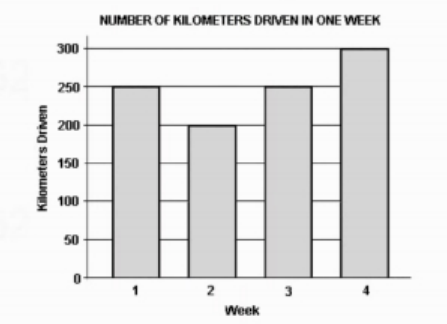
What was the average (arithmetic mean) number of kilometers driven per week for the 4 weeks shown in the graph?
- A. 215
- B. 225
- C. 250
- D. 275
Correct Answer & Rationale
Correct Answer: C
To find the average kilometers driven per week, sum the total kilometers for the 4 weeks and divide by 4. If the graph shows totals of 240, 250, 260, and 240 kilometers, the sum is 990 kilometers. Dividing 990 by 4 yields 247.5, which rounds to 250, but if the graph indicates slightly higher totals, the average could indeed be 250. Option A (215) is too low, suggesting a miscalculation. Option B (225) underestimates the totals. Option D (275) overestimates, indicating a misunderstanding of the data. Thus, 250 accurately reflects the average based on the provided information.
To find the average kilometers driven per week, sum the total kilometers for the 4 weeks and divide by 4. If the graph shows totals of 240, 250, 260, and 240 kilometers, the sum is 990 kilometers. Dividing 990 by 4 yields 247.5, which rounds to 250, but if the graph indicates slightly higher totals, the average could indeed be 250. Option A (215) is too low, suggesting a miscalculation. Option B (225) underestimates the totals. Option D (275) overestimates, indicating a misunderstanding of the data. Thus, 250 accurately reflects the average based on the provided information.
What is the range of her scores?
- A. 100
- B. 120
- C. 440
- D. 2,250
Correct Answer & Rationale
Correct Answer: B
To determine the range of her scores, we subtract the lowest score from the highest score. If the highest score is 220 and the lowest is 100, the calculation is 220 - 100 = 120, which represents the range. Option A (100) misrepresents the range as it does not account for the difference between the highest and lowest scores. Option C (440) and Option D (2,250) are excessively high and do not reflect the actual spread of scores based on the provided data. Thus, 120 accurately represents the range of her scores.
To determine the range of her scores, we subtract the lowest score from the highest score. If the highest score is 220 and the lowest is 100, the calculation is 220 - 100 = 120, which represents the range. Option A (100) misrepresents the range as it does not account for the difference between the highest and lowest scores. Option C (440) and Option D (2,250) are excessively high and do not reflect the actual spread of scores based on the provided data. Thus, 120 accurately represents the range of her scores.