Choose the best answer. If necessary, use the paper you were given.
Allison drives her car at an average speed of x miles per hour for y hours and travels 150 miles. Which of the following equations represents this situation?
- A. x + y = 150
- B. xy = 150
- C. y/x = 150
- D. x/y = 150
Correct Answer & Rationale
Correct Answer: B
The relationship between speed, time, and distance is expressed by the formula: distance = speed × time. In this scenario, Allison travels 150 miles at an average speed of x miles per hour for y hours, which translates to the equation xy = 150. Option A (x + y = 150) incorrectly suggests that speed and time add up to distance, which is not accurate. Option C (y/x = 150) misrepresents the relationship by implying that the ratio of time to speed equals distance, which is incorrect. Option D (x/y = 150) also misinterprets the relationship, suggesting that the ratio of speed to time equals distance. Thus, option B correctly captures the relationship among the variables.
The relationship between speed, time, and distance is expressed by the formula: distance = speed × time. In this scenario, Allison travels 150 miles at an average speed of x miles per hour for y hours, which translates to the equation xy = 150. Option A (x + y = 150) incorrectly suggests that speed and time add up to distance, which is not accurate. Option C (y/x = 150) misrepresents the relationship by implying that the ratio of time to speed equals distance, which is incorrect. Option D (x/y = 150) also misinterprets the relationship, suggesting that the ratio of speed to time equals distance. Thus, option B correctly captures the relationship among the variables.
Other Related Questions
In triangle ABC above, AC ||DE. If AD = 2x - 1 and AC = 3x - 1 , what is the value of x ?
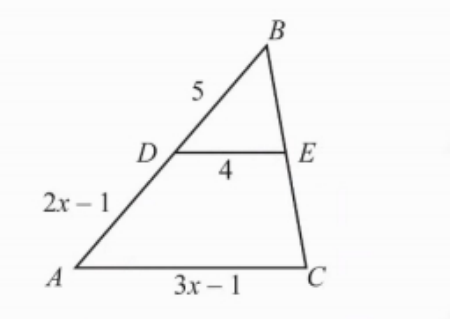
- A. 3
- B. 4
- C. 5
- D. 6
Correct Answer & Rationale
Correct Answer: A
In triangle ABC, since AC is parallel to DE, the segments AD and AC are proportional. This relationship can be expressed as AD = AC. Substituting the expressions gives us the equation: 2x - 1 = 3x - 1. Solving for x, we simplify to 2x - 3x = -1 + 1, leading to -x = 0, or x = 3. Option B (4), C (5), and D (6) do not satisfy the equation derived from the parallel lines, making them incorrect. Only x = 3 maintains the equality, confirming the proportional relationship in the triangle.
In triangle ABC, since AC is parallel to DE, the segments AD and AC are proportional. This relationship can be expressed as AD = AC. Substituting the expressions gives us the equation: 2x - 1 = 3x - 1. Solving for x, we simplify to 2x - 3x = -1 + 1, leading to -x = 0, or x = 3. Option B (4), C (5), and D (6) do not satisfy the equation derived from the parallel lines, making them incorrect. Only x = 3 maintains the equality, confirming the proportional relationship in the triangle.
The expressions x - 2 and x + 3 represent the length and width of a rectangle, respectively. If the area of the rectangle is 24, what is the perimeter of the rectangle?
- A. 20
- B. 22
- C. 24
- D. 28
Correct Answer & Rationale
Correct Answer: B
To find the perimeter of the rectangle, first calculate its dimensions using the area formula. The area is given by multiplying length and width: \[ (x - 2)(x + 3) = 24 \] Expanding this, we get: \[ x^2 + x - 6 = 24 \implies x^2 + x - 30 = 0 \] Factoring yields: \[ (x - 5)(x + 6) = 0 \implies x = 5 \text{ (valid)} \text{ or } x = -6 \text{ (not valid)} \] Using \(x = 5\), the dimensions are \(3\) (length) and \(8\) (width). The perimeter is: \[ 2(3 + 8) = 22 \] Options A (20), C (24), and D (28) do not match the calculated perimeter of 22, confirming they are incorrect.
To find the perimeter of the rectangle, first calculate its dimensions using the area formula. The area is given by multiplying length and width: \[ (x - 2)(x + 3) = 24 \] Expanding this, we get: \[ x^2 + x - 6 = 24 \implies x^2 + x - 30 = 0 \] Factoring yields: \[ (x - 5)(x + 6) = 0 \implies x = 5 \text{ (valid)} \text{ or } x = -6 \text{ (not valid)} \] Using \(x = 5\), the dimensions are \(3\) (length) and \(8\) (width). The perimeter is: \[ 2(3 + 8) = 22 \] Options A (20), C (24), and D (28) do not match the calculated perimeter of 22, confirming they are incorrect.
(a ^ 9 * b ^ 12)/(a ^ 3 * b) =
- A. a ^ 3 * b ^ 11
- B. a ^ 6 * b ^ 12
- C. a ^ 3 * b ^ 12
- D. a ^ 6 * b ^ 11
Correct Answer & Rationale
Correct Answer: D
To simplify the expression \((a^9 * b^{12})/(a^3 * b)\), apply the laws of exponents. For the \(a\) terms, subtract the exponents: \(9 - 3 = 6\), giving \(a^6\). For the \(b\) terms, also subtract the exponents: \(12 - 1 = 11\), resulting in \(b^{11}\). Thus, the simplified expression is \(a^6 * b^{11}\). Option A is incorrect because it miscalculates the exponent of \(b\). Option B incorrectly maintains the exponent of \(b\) at 12. Option C fails to adjust the exponent of \(a\) correctly. Only option D accurately reflects the simplification.
To simplify the expression \((a^9 * b^{12})/(a^3 * b)\), apply the laws of exponents. For the \(a\) terms, subtract the exponents: \(9 - 3 = 6\), giving \(a^6\). For the \(b\) terms, also subtract the exponents: \(12 - 1 = 11\), resulting in \(b^{11}\). Thus, the simplified expression is \(a^6 * b^{11}\). Option A is incorrect because it miscalculates the exponent of \(b\). Option B incorrectly maintains the exponent of \(b\) at 12. Option C fails to adjust the exponent of \(a\) correctly. Only option D accurately reflects the simplification.
Which of the following is equivalent to 12x +8?
- A. 4(3x+2)
- B. 4(3x+8)
- C. 4(3x+2x)
- D. 20x
Correct Answer & Rationale
Correct Answer: A
To determine the equivalent expression for \(12x + 8\), we can factor out the greatest common factor, which is 4. Option A, \(4(3x + 2)\), simplifies to \(12x + 8\) when distributed, making it equivalent to the original expression. Option B, \(4(3x + 8)\), simplifies to \(12x + 32\), which is not equivalent. Option C, \(4(3x + 2x)\), simplifies to \(4(5x)\) or \(20x\), which is also not equivalent. Option D, \(20x\), does not match the original expression either. Thus, only option A is correct.
To determine the equivalent expression for \(12x + 8\), we can factor out the greatest common factor, which is 4. Option A, \(4(3x + 2)\), simplifies to \(12x + 8\) when distributed, making it equivalent to the original expression. Option B, \(4(3x + 8)\), simplifies to \(12x + 32\), which is not equivalent. Option C, \(4(3x + 2x)\), simplifies to \(4(5x)\) or \(20x\), which is also not equivalent. Option D, \(20x\), does not match the original expression either. Thus, only option A is correct.