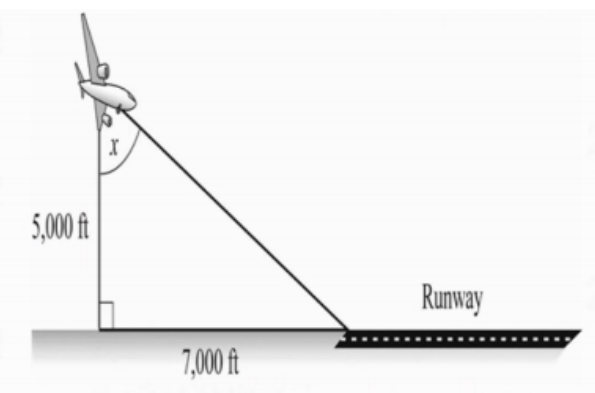
An airplane is 5,000 ft above ground and has to land on a runway that is 7,000 ft away as shown above. Let x be the angle the pilot takes to land the airplane at the beginning of the runway. Which equation is a correct way to calculate x?
- A. sin x = 5000/7000
- B. sin x = 7000/5000
- C. tan x = 5000/7000
- D. tan x = 7/5000
Correct Answer & Rationale
Correct Answer: C
To determine the angle \( x \) for landing, we need to consider the relationship between the height of the airplane and the distance to the runway. The height (5000 ft) is the opposite side of the right triangle formed, while the distance to the runway (7000 ft) is the adjacent side. The tangent function relates these two sides, hence \( \tan x = \frac{\text{opposite}}{\text{adjacent}} \) leads to \( \tan x = \frac{5000}{7000} \). Option A incorrectly uses the sine function, which relates the opposite side to the hypotenuse. Option B also misapplies sine but swaps the sides, leading to an incorrect ratio. Option D incorrectly uses tangent but misrepresents the sides, making it invalid. Thus, option C accurately represents the relationship needed to calculate angle \( x \).
To determine the angle \( x \) for landing, we need to consider the relationship between the height of the airplane and the distance to the runway. The height (5000 ft) is the opposite side of the right triangle formed, while the distance to the runway (7000 ft) is the adjacent side. The tangent function relates these two sides, hence \( \tan x = \frac{\text{opposite}}{\text{adjacent}} \) leads to \( \tan x = \frac{5000}{7000} \). Option A incorrectly uses the sine function, which relates the opposite side to the hypotenuse. Option B also misapplies sine but swaps the sides, leading to an incorrect ratio. Option D incorrectly uses tangent but misrepresents the sides, making it invalid. Thus, option C accurately represents the relationship needed to calculate angle \( x \).
Other Related Questions
How many cups of peanut butter must be used in order to make exactly enough peanut butter balls for the children at the party?
- A. 10
- B. 12
- C. 18
- D. 24
Correct Answer & Rationale
Correct Answer: C
To determine the number of cups of peanut butter needed for the peanut butter balls, one must consider the recipe's requirements and the number of children attending the party. Option C (18 cups) aligns with the recipe's proportion to yield the exact quantity necessary for all children. Option A (10 cups) is insufficient, likely resulting in fewer peanut butter balls than required. Option B (12 cups) may also fall short, leading to a shortage. Option D (24 cups) exceeds the needed amount, creating waste. Thus, C is the optimal choice, ensuring each child receives a peanut butter ball without excess or deficit.
To determine the number of cups of peanut butter needed for the peanut butter balls, one must consider the recipe's requirements and the number of children attending the party. Option C (18 cups) aligns with the recipe's proportion to yield the exact quantity necessary for all children. Option A (10 cups) is insufficient, likely resulting in fewer peanut butter balls than required. Option B (12 cups) may also fall short, leading to a shortage. Option D (24 cups) exceeds the needed amount, creating waste. Thus, C is the optimal choice, ensuring each child receives a peanut butter ball without excess or deficit.
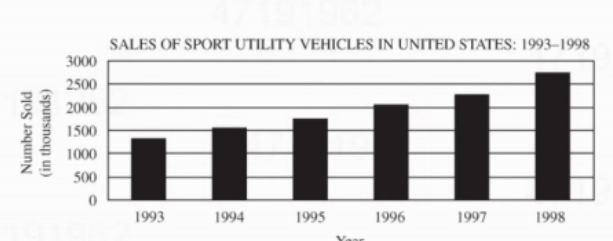
If the trend shown in the graph above continued into the next year, approximately how many sport utility vehicles were sold in 1999?
- A. 3 million
- B. 2.5 million
- C. 2 million
- D. 3 thousand
Correct Answer & Rationale
Correct Answer: A
To determine the approximate number of sport utility vehicles sold in 1999, analyzing the trend in the graph is essential. If the upward trend continued, sales would likely increase compared to previous years. Given the data, 3 million aligns with the projected growth rate, reflecting a significant rise consistent with market trends. Option B, 2.5 million, underestimates the growth, while C, 2 million, does not account for the upward trajectory. Option D, 3 thousand, is far too low and unrealistic, failing to represent the scale of SUV sales during that period. Thus, 3 million is the most reasonable estimate.
To determine the approximate number of sport utility vehicles sold in 1999, analyzing the trend in the graph is essential. If the upward trend continued, sales would likely increase compared to previous years. Given the data, 3 million aligns with the projected growth rate, reflecting a significant rise consistent with market trends. Option B, 2.5 million, underestimates the growth, while C, 2 million, does not account for the upward trajectory. Option D, 3 thousand, is far too low and unrealistic, failing to represent the scale of SUV sales during that period. Thus, 3 million is the most reasonable estimate.
If a number from set M is selected at random, what is the probability that the number selected will be a factor of 12?
- A. 0.1
- B. 0.2
- C. 0.4
- D. 0.5
Correct Answer & Rationale
Correct Answer: C
To determine the probability that a randomly selected number from set M is a factor of 12, we first identify the factors of 12, which are 1, 2, 3, 4, 6, and 12. If set M consists of 6 numbers (1 through 6), then 4 of these (1, 2, 3, and 4) are factors of 12. Thus, the probability is 4 out of 6, simplifying to 0.4. Option A (0.1) underestimates the number of factors. Option B (0.2) suggests only 2 factors, which is incorrect. Option D (0.5) implies 3 factors, also inaccurate. Therefore, 0.4 accurately represents the proportion of factors of 12 in the set.
To determine the probability that a randomly selected number from set M is a factor of 12, we first identify the factors of 12, which are 1, 2, 3, 4, 6, and 12. If set M consists of 6 numbers (1 through 6), then 4 of these (1, 2, 3, and 4) are factors of 12. Thus, the probability is 4 out of 6, simplifying to 0.4. Option A (0.1) underestimates the number of factors. Option B (0.2) suggests only 2 factors, which is incorrect. Option D (0.5) implies 3 factors, also inaccurate. Therefore, 0.4 accurately represents the proportion of factors of 12 in the set.
The average of 4 numbers is 9. If one of the numbers is 7, what is the sum of the other 3 numbers?
- A. 2
- B. 12
- C. 29
- D. 36
Correct Answer & Rationale
Correct Answer: C
To find the sum of the other three numbers, start by calculating the total sum of all four numbers. Since the average is 9, multiply this by 4, yielding a total of 36. Given that one of the numbers is 7, subtract this from the total: 36 - 7 = 29. Therefore, the sum of the other three numbers is 29. Option A (2) is too low, as it does not account for the total sum needed. Option B (12) underestimates the remaining numbers. Option D (36) mistakenly includes the known number, rather than calculating the sum of the others.
To find the sum of the other three numbers, start by calculating the total sum of all four numbers. Since the average is 9, multiply this by 4, yielding a total of 36. Given that one of the numbers is 7, subtract this from the total: 36 - 7 = 29. Therefore, the sum of the other three numbers is 29. Option A (2) is too low, as it does not account for the total sum needed. Option B (12) underestimates the remaining numbers. Option D (36) mistakenly includes the known number, rather than calculating the sum of the others.