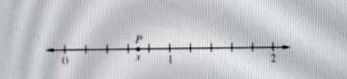
The coordinate of pointP on the number line above is x. The value of 10x is between
- A. 1 and 4
- B. 4 and 6
- C. 6 and 8
- D. 8 and 12
Correct Answer & Rationale
Correct Answer: B
To determine the correct range for \(10x\), we first need to assess the implications of each option based on the value of \(x\). - **Option A: 1 and 4** suggests \(0.1 < x < 0.4\). This would yield \(10x\) values less than 4, which is too low. - **Option B: 4 and 6** indicates \(0.4 < x < 0.6\). This range results in \(10x\) values between 4 and 6, aligning perfectly with the requirement. - **Option C: 6 and 8** implies \(0.6 < x < 0.8\). Here, \(10x\) would exceed 6, which is not valid. - **Option D: 8 and 12** indicates \(0.8 < x < 1.2\), leading to values of \(10x\) that exceed 8, thus also incorrect. Therefore, only Option B accurately reflects the condition for \(10x\) being between 4 and 6.
To determine the correct range for \(10x\), we first need to assess the implications of each option based on the value of \(x\). - **Option A: 1 and 4** suggests \(0.1 < x < 0.4\). This would yield \(10x\) values less than 4, which is too low. - **Option B: 4 and 6** indicates \(0.4 < x < 0.6\). This range results in \(10x\) values between 4 and 6, aligning perfectly with the requirement. - **Option C: 6 and 8** implies \(0.6 < x < 0.8\). Here, \(10x\) would exceed 6, which is not valid. - **Option D: 8 and 12** indicates \(0.8 < x < 1.2\), leading to values of \(10x\) that exceed 8, thus also incorrect. Therefore, only Option B accurately reflects the condition for \(10x\) being between 4 and 6.
Other Related Questions
2 + (2 × 2) + 2 =
- A. 8
- B. 10
- C. 12
- D. 16
Correct Answer & Rationale
Correct Answer: A
To solve the expression 2 + (2 × 2) + 2, it’s essential to follow the order of operations, often remembered by the acronym PEMDAS (Parentheses, Exponents, Multiplication and Division, Addition and Subtraction). First, calculate the value inside the parentheses: 2 × 2 equals 4. Next, substitute this back into the expression: 2 + 4 + 2. Then, perform the addition from left to right: 2 + 4 equals 6, and then 6 + 2 equals 8. Options B (10), C (12), and D (16) are incorrect because they do not adhere to the proper order of operations or miscalculate the addition steps.
To solve the expression 2 + (2 × 2) + 2, it’s essential to follow the order of operations, often remembered by the acronym PEMDAS (Parentheses, Exponents, Multiplication and Division, Addition and Subtraction). First, calculate the value inside the parentheses: 2 × 2 equals 4. Next, substitute this back into the expression: 2 + 4 + 2. Then, perform the addition from left to right: 2 + 4 equals 6, and then 6 + 2 equals 8. Options B (10), C (12), and D (16) are incorrect because they do not adhere to the proper order of operations or miscalculate the addition steps.
If a number rounded to the nearest hundredth is 9.99, which of the following could be the number?
- A. 9.845
- B. 9.983
- C. 9.992
- D. 9.998
Correct Answer & Rationale
Correct Answer: C
Rounding to the nearest hundredth means looking at the third decimal place to determine if the second decimal place should round up or stay the same. For a number rounded to 9.99, the possible range is 9.985 to 9.995. Option A (9.845) rounds to 9.84, which is outside the range. Option B (9.983) rounds to 9.98, also outside the range. Option D (9.998) rounds to 10.00, exceeding the upper limit. Option C (9.992) falls within the range and correctly rounds to 9.99, making it the only viable option.
Rounding to the nearest hundredth means looking at the third decimal place to determine if the second decimal place should round up or stay the same. For a number rounded to 9.99, the possible range is 9.985 to 9.995. Option A (9.845) rounds to 9.84, which is outside the range. Option B (9.983) rounds to 9.98, also outside the range. Option D (9.998) rounds to 10.00, exceeding the upper limit. Option C (9.992) falls within the range and correctly rounds to 9.99, making it the only viable option.
Which of the following is equivalent to 8,1/4?
- A. 0.0825
- B. 0.825
- C. 8.25
- D. 82.5
Correct Answer & Rationale
Correct Answer: c
To convert the mixed number 8 1/4 into an improper fraction, first multiply the whole number (8) by the denominator (4), resulting in 32. Then, add the numerator (1) to get 33, making the improper fraction 33/4. When you divide 33 by 4, you get 8.25. Option A (0.0825) is incorrect as it represents a much smaller value. Option B (0.825) is also incorrect, as it is less than 1. Option D (82.5) is incorrect, being ten times larger than the correct value. Thus, 8.25 accurately reflects the original mixed number.
To convert the mixed number 8 1/4 into an improper fraction, first multiply the whole number (8) by the denominator (4), resulting in 32. Then, add the numerator (1) to get 33, making the improper fraction 33/4. When you divide 33 by 4, you get 8.25. Option A (0.0825) is incorrect as it represents a much smaller value. Option B (0.825) is also incorrect, as it is less than 1. Option D (82.5) is incorrect, being ten times larger than the correct value. Thus, 8.25 accurately reflects the original mixed number.
76 ÷ 0.01 =
- A. 0.76
- B. 7.6
- C. 760
- D. 7,600
Correct Answer & Rationale
Correct Answer: D
To solve 76 ÷ 0.01, it is helpful to recognize that dividing by a decimal is equivalent to multiplying by its reciprocal. The reciprocal of 0.01 is 100, so this operation can be rewritten as 76 × 100, which equals 7,600. Option A (0.76) incorrectly suggests a much smaller result, as it misinterprets the division. Option B (7.6) also underestimates the value, failing to account for the decimal's effect. Option C (760) is closer but still incorrect, as it does not fully account for the multiplication by 100. Therefore, D (7,600) accurately reflects the operation's outcome.
To solve 76 ÷ 0.01, it is helpful to recognize that dividing by a decimal is equivalent to multiplying by its reciprocal. The reciprocal of 0.01 is 100, so this operation can be rewritten as 76 × 100, which equals 7,600. Option A (0.76) incorrectly suggests a much smaller result, as it misinterprets the division. Option B (7.6) also underestimates the value, failing to account for the decimal's effect. Option C (760) is closer but still incorrect, as it does not fully account for the multiplication by 100. Therefore, D (7,600) accurately reflects the operation's outcome.