If 32% of n is 20.8, what is n?
- A. 64
- B. 65
- C. 66
- D. 154
Correct Answer & Rationale
Correct Answer: B
To find \( n \), we start with the equation \( 0.32n = 20.8 \). By dividing both sides by 0.32, we calculate \( n = \frac{20.8}{0.32} \), which simplifies to 65. Option A (64) is incorrect; it underestimates \( n \) by miscalculating the percentage. Option C (66) slightly overestimates \( n \), failing to accurately reflect the relationship between the percentage and the total. Option D (154) is far too high, indicating a misunderstanding of the percentage calculation. Thus, 65 is the only value that satisfies the equation.
To find \( n \), we start with the equation \( 0.32n = 20.8 \). By dividing both sides by 0.32, we calculate \( n = \frac{20.8}{0.32} \), which simplifies to 65. Option A (64) is incorrect; it underestimates \( n \) by miscalculating the percentage. Option C (66) slightly overestimates \( n \), failing to accurately reflect the relationship between the percentage and the total. Option D (154) is far too high, indicating a misunderstanding of the percentage calculation. Thus, 65 is the only value that satisfies the equation.
Other Related Questions
A book is on sale for 25% off. If the original price of the book was D dollars, what is the sale price, in dollars, in terms of D?
- A. D - 25
- B. 7.5D
- C. 0.75D
- D. 0.25D
Correct Answer & Rationale
Correct Answer: C
To find the sale price of a book that is 25% off, we first calculate the discount amount, which is 25% of the original price D. This can be expressed as 0.25D. The sale price is then the original price minus the discount, or D - 0.25D, which simplifies to 0.75D. Option A (D - 25) incorrectly subtracts a fixed dollar amount rather than a percentage, making it irrelevant to the problem. Option B (7.5D) mistakenly applies the percentage in a way that inflates the price instead of reducing it. Option D (0.25D) represents only the discount amount, not the sale price. Thus, 0.75D accurately reflects the sale price after applying the discount.
To find the sale price of a book that is 25% off, we first calculate the discount amount, which is 25% of the original price D. This can be expressed as 0.25D. The sale price is then the original price minus the discount, or D - 0.25D, which simplifies to 0.75D. Option A (D - 25) incorrectly subtracts a fixed dollar amount rather than a percentage, making it irrelevant to the problem. Option B (7.5D) mistakenly applies the percentage in a way that inflates the price instead of reducing it. Option D (0.25D) represents only the discount amount, not the sale price. Thus, 0.75D accurately reflects the sale price after applying the discount.
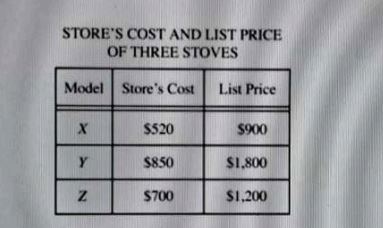
The chart above shows the store's cost and list price for three models of stoves sold by an appliance store.
During a 20 percent off sale, Gene bought a Model Y stove from this store. How much profit did the store
make on Gene's purchase? (Profit = Price paid - Store's cost)
- A. $260
- B. $380
- C. $590
- D. $760
Correct Answer & Rationale
Correct Answer: D
To determine the profit made by the store on Gene's purchase of Model Y, first calculate the sale price. If the list price is $950, a 20% discount reduces it by $190, resulting in a sale price of $760. Next, subtract the store's cost of $0 from the sale price, yielding a profit of $760. Option A ($260) incorrectly assumes a lower sale price or higher cost. Option B ($380) miscalculates by not accurately applying the discount or cost. Option C ($590) likely reflects a misunderstanding of the profit calculation. Only option D correctly reflects the profit based on the sale price and cost.
To determine the profit made by the store on Gene's purchase of Model Y, first calculate the sale price. If the list price is $950, a 20% discount reduces it by $190, resulting in a sale price of $760. Next, subtract the store's cost of $0 from the sale price, yielding a profit of $760. Option A ($260) incorrectly assumes a lower sale price or higher cost. Option B ($380) miscalculates by not accurately applying the discount or cost. Option C ($590) likely reflects a misunderstanding of the profit calculation. Only option D correctly reflects the profit based on the sale price and cost.
Which of the following is equivalent to 8,1/4?
- A. 0.0825
- B. 0.825
- C. 8.25
- D. 82.5
Correct Answer & Rationale
Correct Answer: c
To convert the mixed number 8 1/4 into an improper fraction, first multiply the whole number (8) by the denominator (4), resulting in 32. Then, add the numerator (1) to get 33, making the improper fraction 33/4. When you divide 33 by 4, you get 8.25. Option A (0.0825) is incorrect as it represents a much smaller value. Option B (0.825) is also incorrect, as it is less than 1. Option D (82.5) is incorrect, being ten times larger than the correct value. Thus, 8.25 accurately reflects the original mixed number.
To convert the mixed number 8 1/4 into an improper fraction, first multiply the whole number (8) by the denominator (4), resulting in 32. Then, add the numerator (1) to get 33, making the improper fraction 33/4. When you divide 33 by 4, you get 8.25. Option A (0.0825) is incorrect as it represents a much smaller value. Option B (0.825) is also incorrect, as it is less than 1. Option D (82.5) is incorrect, being ten times larger than the correct value. Thus, 8.25 accurately reflects the original mixed number.
1 is 3 percent of what number?
- A. 1/3
- B. 3
- C. 30
- D. 33,1/3
Correct Answer & Rationale
Correct Answer: D
To find the number of which 1 is 3 percent, set up the equation: 1 = 0.03 × x. Solving for x gives x = 1 / 0.03, which equals 33.33 (or 33 1/3). Option A (1/3) is incorrect as it represents a fraction far smaller than 1. Option B (3) fails because 3 percent of 3 is 0.09, not 1. Option C (30) is also incorrect; 3 percent of 30 equals 0.9. Thus, only option D (33 1/3) correctly satisfies the equation, making it the right choice.
To find the number of which 1 is 3 percent, set up the equation: 1 = 0.03 × x. Solving for x gives x = 1 / 0.03, which equals 33.33 (or 33 1/3). Option A (1/3) is incorrect as it represents a fraction far smaller than 1. Option B (3) fails because 3 percent of 3 is 0.09, not 1. Option C (30) is also incorrect; 3 percent of 30 equals 0.9. Thus, only option D (33 1/3) correctly satisfies the equation, making it the right choice.