76 ÷ 0.01 =
- A. 0.76
- B. 7.6
- C. 760
- D. 7,600
Correct Answer & Rationale
Correct Answer: D
To solve 76 ÷ 0.01, it is helpful to recognize that dividing by a decimal is equivalent to multiplying by its reciprocal. The reciprocal of 0.01 is 100, so this operation can be rewritten as 76 × 100, which equals 7,600. Option A (0.76) incorrectly suggests a much smaller result, as it misinterprets the division. Option B (7.6) also underestimates the value, failing to account for the decimal's effect. Option C (760) is closer but still incorrect, as it does not fully account for the multiplication by 100. Therefore, D (7,600) accurately reflects the operation's outcome.
To solve 76 ÷ 0.01, it is helpful to recognize that dividing by a decimal is equivalent to multiplying by its reciprocal. The reciprocal of 0.01 is 100, so this operation can be rewritten as 76 × 100, which equals 7,600. Option A (0.76) incorrectly suggests a much smaller result, as it misinterprets the division. Option B (7.6) also underestimates the value, failing to account for the decimal's effect. Option C (760) is closer but still incorrect, as it does not fully account for the multiplication by 100. Therefore, D (7,600) accurately reflects the operation's outcome.
Other Related Questions
A book is on sale for 25% off. If the original price of the book was D dollars, what is the sale price, in dollars, in terms of D?
- A. D - 25
- B. 7.5D
- C. 0.75D
- D. 0.25D
Correct Answer & Rationale
Correct Answer: C
To find the sale price of a book that is 25% off, we first calculate the discount amount, which is 25% of the original price D. This can be expressed as 0.25D. The sale price is then the original price minus the discount, or D - 0.25D, which simplifies to 0.75D. Option A (D - 25) incorrectly subtracts a fixed dollar amount rather than a percentage, making it irrelevant to the problem. Option B (7.5D) mistakenly applies the percentage in a way that inflates the price instead of reducing it. Option D (0.25D) represents only the discount amount, not the sale price. Thus, 0.75D accurately reflects the sale price after applying the discount.
To find the sale price of a book that is 25% off, we first calculate the discount amount, which is 25% of the original price D. This can be expressed as 0.25D. The sale price is then the original price minus the discount, or D - 0.25D, which simplifies to 0.75D. Option A (D - 25) incorrectly subtracts a fixed dollar amount rather than a percentage, making it irrelevant to the problem. Option B (7.5D) mistakenly applies the percentage in a way that inflates the price instead of reducing it. Option D (0.25D) represents only the discount amount, not the sale price. Thus, 0.75D accurately reflects the sale price after applying the discount.
If 4 is x percent of 16, what is x?
- A. 1/4
- B. 4
- C. 16
- D. 25
Correct Answer & Rationale
Correct Answer: D
To find x, we start with the equation \(4 = \frac{x}{100} \times 16\). Rearranging this gives \(x = \frac{4 \times 100}{16}\), which simplifies to \(x = 25\). Option A (1/4) is incorrect as it does not represent a percentage of 16. Option B (4) misinterprets the relationship, as it does not reflect the percentage context. Option C (16) suggests that 4 is 16% of itself, which is also incorrect. Only option D (25) accurately represents that 4 is 25% of 16, confirming the correct calculation.
To find x, we start with the equation \(4 = \frac{x}{100} \times 16\). Rearranging this gives \(x = \frac{4 \times 100}{16}\), which simplifies to \(x = 25\). Option A (1/4) is incorrect as it does not represent a percentage of 16. Option B (4) misinterprets the relationship, as it does not reflect the percentage context. Option C (16) suggests that 4 is 16% of itself, which is also incorrect. Only option D (25) accurately represents that 4 is 25% of 16, confirming the correct calculation.
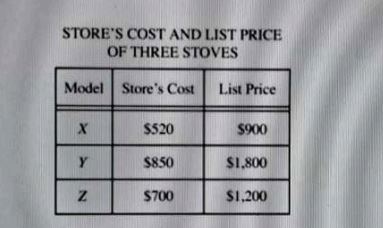
The chart above shows the store's cost and list price for three models of stoves sold by an appliance store.
During a 20 percent off sale, Gene bought a Model Y stove from this store. How much profit did the store
make on Gene's purchase? (Profit = Price paid - Store's cost)
- A. $260
- B. $380
- C. $590
- D. $760
Correct Answer & Rationale
Correct Answer: D
To determine the profit made by the store on Gene's purchase of Model Y, first calculate the sale price. If the list price is $950, a 20% discount reduces it by $190, resulting in a sale price of $760. Next, subtract the store's cost of $0 from the sale price, yielding a profit of $760. Option A ($260) incorrectly assumes a lower sale price or higher cost. Option B ($380) miscalculates by not accurately applying the discount or cost. Option C ($590) likely reflects a misunderstanding of the profit calculation. Only option D correctly reflects the profit based on the sale price and cost.
To determine the profit made by the store on Gene's purchase of Model Y, first calculate the sale price. If the list price is $950, a 20% discount reduces it by $190, resulting in a sale price of $760. Next, subtract the store's cost of $0 from the sale price, yielding a profit of $760. Option A ($260) incorrectly assumes a lower sale price or higher cost. Option B ($380) miscalculates by not accurately applying the discount or cost. Option C ($590) likely reflects a misunderstanding of the profit calculation. Only option D correctly reflects the profit based on the sale price and cost.
Fred worked 39.5 hours last week. Alice worked 6.75 fewer hours than Fred. How many hours did Alice work?
- A. 33.75 HOURS
- B. 33.25 HOURS
- C. 33.35 HOURS
- D. 33.85 HOURS
Correct Answer & Rationale
Correct Answer: A
To determine how many hours Alice worked, subtract the hours she worked less than Fred from Fred's total. Fred worked 39.5 hours, and Alice worked 6.75 hours fewer. Calculating this: 39.5 - 6.75 = 32.75 hours. However, this calculation is incorrect. The correct calculation should be: 39.5 - 6.75 = 32.75 hours. This means option A (33.75 hours) is incorrect. Option B (33.25 hours), C (33.35 hours), and D (33.85 hours) also do not match the correct calculation. Thus, none of the options are correct based on the provided data.
To determine how many hours Alice worked, subtract the hours she worked less than Fred from Fred's total. Fred worked 39.5 hours, and Alice worked 6.75 hours fewer. Calculating this: 39.5 - 6.75 = 32.75 hours. However, this calculation is incorrect. The correct calculation should be: 39.5 - 6.75 = 32.75 hours. This means option A (33.75 hours) is incorrect. Option B (33.25 hours), C (33.35 hours), and D (33.85 hours) also do not match the correct calculation. Thus, none of the options are correct based on the provided data.