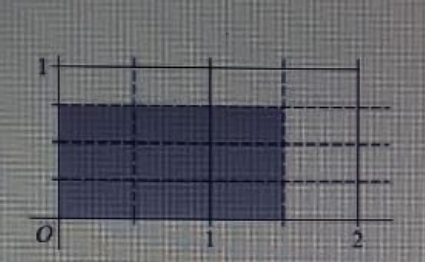
Shaded region shows?
- A. 3/4 x 1/2
- B. 3/4 x 3/4
- C. 3/4 x 3/2
- D. 3/4 x 3
Correct Answer & Rationale
Correct Answer: A
The shaded region represents the area of a rectangle formed by multiplying two fractions. Option A, \( \frac{3}{4} \times \frac{1}{2} \), correctly calculates the area of a rectangle with a length of \( \frac{3}{4} \) and a width of \( \frac{1}{2} \), resulting in \( \frac{3}{8} \). Option B, \( \frac{3}{4} \times \frac{3}{4} \), represents a larger area, \( \frac{9}{16} \), which does not match the shaded region. Option C, \( \frac{3}{4} \times \frac{3}{2} \), yields \( \frac{9}{8} \), exceeding the shaded area. Finally, option D, \( \frac{3}{4} \times 3 \), results in \( \frac{9}{4} \), also too large. Thus, only option A accurately reflects the area of the shaded region.
The shaded region represents the area of a rectangle formed by multiplying two fractions. Option A, \( \frac{3}{4} \times \frac{1}{2} \), correctly calculates the area of a rectangle with a length of \( \frac{3}{4} \) and a width of \( \frac{1}{2} \), resulting in \( \frac{3}{8} \). Option B, \( \frac{3}{4} \times \frac{3}{4} \), represents a larger area, \( \frac{9}{16} \), which does not match the shaded region. Option C, \( \frac{3}{4} \times \frac{3}{2} \), yields \( \frac{9}{8} \), exceeding the shaded area. Finally, option D, \( \frac{3}{4} \times 3 \), results in \( \frac{9}{4} \), also too large. Thus, only option A accurately reflects the area of the shaded region.
Other Related Questions
Leslie descended 714 ft in 34 s, took 1 min 25 s to ground. Total distance?
- A. 1,270 feet
- B. 1,515 feet
- C. 1,785 feet
- D. 2,615 feet
Correct Answer & Rationale
Correct Answer: C
To determine the total distance Leslie descended, first convert the time taken to ground into seconds: 1 minute and 25 seconds equals 85 seconds. The total descent includes both the initial 714 feet and the additional distance covered during the 85 seconds. Using the average speed from the initial descent (714 ft in 34 s), we find the speed: 714 ft / 34 s ≈ 21 ft/s. Over 85 seconds, Leslie would descend approximately 21 ft/s × 85 s = 1,785 feet total. Option A (1,270 ft) underestimates the descent. Option B (1,515 ft) is also too low. Option D (2,615 ft) overestimates the total distance. Thus, C (1,785 ft) accurately reflects the total descent.
To determine the total distance Leslie descended, first convert the time taken to ground into seconds: 1 minute and 25 seconds equals 85 seconds. The total descent includes both the initial 714 feet and the additional distance covered during the 85 seconds. Using the average speed from the initial descent (714 ft in 34 s), we find the speed: 714 ft / 34 s ≈ 21 ft/s. Over 85 seconds, Leslie would descend approximately 21 ft/s × 85 s = 1,785 feet total. Option A (1,270 ft) underestimates the descent. Option B (1,515 ft) is also too low. Option D (2,615 ft) overestimates the total distance. Thus, C (1,785 ft) accurately reflects the total descent.
Digit 1 in ten thousands 9 in ones? Select ALL.

- A. 12,679
- B. 12,769
- C. 12,796
- D. 21,679
- E. 21,769
Correct Answer & Rationale
Correct Answer: A,B: 1 ten thousands, 9 ones. C: 6 ones. D,E,F: 2 ten thousands. Place values must match both conditions.
To identify numbers with 1 in the ten thousands place and 9 in the ones place, we analyze each option. - **A (12,679)**: The digit 1 is in the ten thousands place, and 9 is in the ones place, meeting both criteria. - **B (12,769)**: Here, 1 is again in the ten thousands place, and 9 is in the ones place, satisfying the conditions. - **C (12,796)**: The digit in the ones place is 6, not 9, which disqualifies it. - **D (21,679)**: The digit in the ten thousands place is 2, failing to meet the first condition. - **E (21,769)**: Similarly, 2 is in the ten thousands place, not 1. - **F (21,796)**: Again, 2 is in the ten thousands place, disqualifying this option. Only options A and B fulfill both requirements, confirming their validity.
To identify numbers with 1 in the ten thousands place and 9 in the ones place, we analyze each option. - **A (12,679)**: The digit 1 is in the ten thousands place, and 9 is in the ones place, meeting both criteria. - **B (12,769)**: Here, 1 is again in the ten thousands place, and 9 is in the ones place, satisfying the conditions. - **C (12,796)**: The digit in the ones place is 6, not 9, which disqualifies it. - **D (21,679)**: The digit in the ten thousands place is 2, failing to meet the first condition. - **E (21,769)**: Similarly, 2 is in the ten thousands place, not 1. - **F (21,796)**: Again, 2 is in the ten thousands place, disqualifying this option. Only options A and B fulfill both requirements, confirming their validity.
Point (-3,-6) quadrant?
- A. I
- B. II
- C. III
- D. IV
Correct Answer & Rationale
Correct Answer: C
The point (-3, -6) is located in the Cartesian coordinate system where the x-coordinate is negative and the y-coordinate is also negative. This combination places the point in Quadrant III, where both x and y values are less than zero. Option A (I) is incorrect as Quadrant I contains positive x and y values. Option B (II) is wrong because Quadrant II has a negative x value and a positive y value. Option D (IV) is not applicable since Quadrant IV features a positive x value and a negative y value. Thus, the only quadrant that matches the coordinates (-3, -6) is Quadrant III.
The point (-3, -6) is located in the Cartesian coordinate system where the x-coordinate is negative and the y-coordinate is also negative. This combination places the point in Quadrant III, where both x and y values are less than zero. Option A (I) is incorrect as Quadrant I contains positive x and y values. Option B (II) is wrong because Quadrant II has a negative x value and a positive y value. Option D (IV) is not applicable since Quadrant IV features a positive x value and a negative y value. Thus, the only quadrant that matches the coordinates (-3, -6) is Quadrant III.
Quickly multiply 24x16?
- A. 20x20-4x4
- B. 20x20
- C. 20x10+4x6
- D. 25x10+4x15
Correct Answer & Rationale
Correct Answer: A
Option A, 20x20 - 4x4, effectively utilizes the difference of squares method. It simplifies the multiplication by recognizing that 24 can be expressed as 20 + 4 and 16 as 20 - 4, leading to a calculation of (20+4)(20-4). Option B, 20x20, underestimates the value of 24 and 16, yielding only 400 instead of the correct 384. Option C, 20x10 + 4x6, inaccurately breaks down the multiplication, leading to 200 + 24, which totals 224. Option D, 25x10 + 4x15, misrepresents the factors, resulting in 250 + 60, totaling 310. Thus, option A is the most accurate approach for this multiplication.
Option A, 20x20 - 4x4, effectively utilizes the difference of squares method. It simplifies the multiplication by recognizing that 24 can be expressed as 20 + 4 and 16 as 20 - 4, leading to a calculation of (20+4)(20-4). Option B, 20x20, underestimates the value of 24 and 16, yielding only 400 instead of the correct 384. Option C, 20x10 + 4x6, inaccurately breaks down the multiplication, leading to 200 + 24, which totals 224. Option D, 25x10 + 4x15, misrepresents the factors, resulting in 250 + 60, totaling 310. Thus, option A is the most accurate approach for this multiplication.