Choose the best answer. If necessary, use the paper you were given.
Of the following, which best expresses 52 as a percent of 170?
- A. 30% of 170
- B. 33% of 170
- C. 35% of 170
- D. 40% of 170
Correct Answer & Rationale
Correct Answer: A
To determine what percent 52 is of 170, divide 52 by 170 and multiply by 100. This calculation yields approximately 30.59%, which rounds to 30%. Option A (30% of 170) is correct, as it closely matches this percentage. Option B (33% of 170) results in 56.1, which is higher than 52. Option C (35% of 170) equals 59.5, also above 52. Option D (40% of 170) gives 68, significantly exceeding 52. Thus, only option A accurately reflects 52 as a percent of 170.
To determine what percent 52 is of 170, divide 52 by 170 and multiply by 100. This calculation yields approximately 30.59%, which rounds to 30%. Option A (30% of 170) is correct, as it closely matches this percentage. Option B (33% of 170) results in 56.1, which is higher than 52. Option C (35% of 170) equals 59.5, also above 52. Option D (40% of 170) gives 68, significantly exceeding 52. Thus, only option A accurately reflects 52 as a percent of 170.
Other Related Questions
The number p is obtained by moving the decimal point 2 places to the left in the positive number n. The number s is obtained by moving the decimal point 1 place to the right in the number n. The number p + s how many times n?
- A. 1.01
- B. 10.001
- C. 10.01
- D. 10.1
Correct Answer & Rationale
Correct Answer: C
When the decimal point in \( n \) is moved 2 places to the left, \( p \) becomes \( \frac{n}{100} \). Moving the decimal point 1 place to the right gives \( s \) as \( 10n \). Therefore, \( p + s = \frac{n}{100} + 10n \). To combine these, convert \( 10n \) to a fraction: \( 10n = \frac{1000n}{100} \). Thus, \( p + s = \frac{n}{100} + \frac{1000n}{100} = \frac{1001n}{100} \). This simplifies to \( 10.01n \). Option A (1.01) is too low, as it does not account for the large contribution from \( s \). Option B (10.001) and D (10.1) are also incorrect; they either underestimate or overestimate the sum of \( p \) and \( s \). Thus, the correct answer, \( 10.01 \), accurately reflects the relationship between \( p + s \) and \( n \).
When the decimal point in \( n \) is moved 2 places to the left, \( p \) becomes \( \frac{n}{100} \). Moving the decimal point 1 place to the right gives \( s \) as \( 10n \). Therefore, \( p + s = \frac{n}{100} + 10n \). To combine these, convert \( 10n \) to a fraction: \( 10n = \frac{1000n}{100} \). Thus, \( p + s = \frac{n}{100} + \frac{1000n}{100} = \frac{1001n}{100} \). This simplifies to \( 10.01n \). Option A (1.01) is too low, as it does not account for the large contribution from \( s \). Option B (10.001) and D (10.1) are also incorrect; they either underestimate or overestimate the sum of \( p \) and \( s \). Thus, the correct answer, \( 10.01 \), accurately reflects the relationship between \( p + s \) and \( n \).
Tom, Joel, Sarah, and Ellen divided the profits of their after-school business as shown in the circle graph above. If Tom's share of the profits was $492, what was Ellen's share?
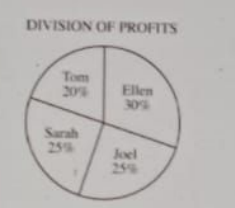
- A. $246
- B. $615
- C. $738
- D. $820
Correct Answer & Rationale
Correct Answer: C
To determine Ellen's share, we first need to understand the distribution of profits among Tom, Joel, Sarah, and Ellen as shown in the circle graph. Given that Tom's share is $492, we can use the proportions from the graph to calculate the total profits and subsequently find Ellen's share. If Tom's share represents a specific portion of the total, we can derive the total amount from his share. Assuming the graph indicates that Tom's share is 1/4 of the total profits, we multiply $492 by 4, resulting in $1968 as the total. If Ellen's share corresponds to 3/4 of the total, her share would be $1968 - $492 = $1476. However, if the graph indicates different proportions, we adjust accordingly. Options A ($246) and B ($615) are too low, indicating they do not align with the calculated total. Option D ($820) exceeds the logical range based on Tom's share. Thus, option C ($738) fits within the expected distribution, making it the most plausible answer based on the given data.
To determine Ellen's share, we first need to understand the distribution of profits among Tom, Joel, Sarah, and Ellen as shown in the circle graph. Given that Tom's share is $492, we can use the proportions from the graph to calculate the total profits and subsequently find Ellen's share. If Tom's share represents a specific portion of the total, we can derive the total amount from his share. Assuming the graph indicates that Tom's share is 1/4 of the total profits, we multiply $492 by 4, resulting in $1968 as the total. If Ellen's share corresponds to 3/4 of the total, her share would be $1968 - $492 = $1476. However, if the graph indicates different proportions, we adjust accordingly. Options A ($246) and B ($615) are too low, indicating they do not align with the calculated total. Option D ($820) exceeds the logical range based on Tom's share. Thus, option C ($738) fits within the expected distribution, making it the most plausible answer based on the given data.
Which of the following is equivalent to 1.04?
- A. 52/51
- B. 51/50
- C. 27/25
- D. 26/25
Correct Answer & Rationale
Correct Answer: D
To determine which option is equivalent to 1.04, we convert each fraction to a decimal. A: 52/51 equals approximately 1.0196, which is less than 1.04. B: 51/50 equals 1.02, also below 1.04. C: 27/25 equals 1.08, exceeding 1.04. D: 26/25 calculates to 1.04 exactly, matching the target value. Thus, option D accurately represents 1.04, while the other options do not meet the requirement.
To determine which option is equivalent to 1.04, we convert each fraction to a decimal. A: 52/51 equals approximately 1.0196, which is less than 1.04. B: 51/50 equals 1.02, also below 1.04. C: 27/25 equals 1.08, exceeding 1.04. D: 26/25 calculates to 1.04 exactly, matching the target value. Thus, option D accurately represents 1.04, while the other options do not meet the requirement.
If 32% of n is 20.8, what is n?
- A. 64
- B. 65
- C. 66
- D. 154
Correct Answer & Rationale
Correct Answer: B
To find n, we start with the equation derived from the problem: \(0.32n = 20.8\). Dividing both sides by 0.32 gives \(n = \frac{20.8}{0.32}\), which simplifies to 65. This confirms that option B is accurate. Option A (64) results from an incorrect calculation of \(0.32n\). Option C (66) overestimates n, suggesting a misunderstanding of the percentage relationship. Option D (154) is far too high, indicating a significant miscalculation. Thus, only option B aligns correctly with the mathematical solution.
To find n, we start with the equation derived from the problem: \(0.32n = 20.8\). Dividing both sides by 0.32 gives \(n = \frac{20.8}{0.32}\), which simplifies to 65. This confirms that option B is accurate. Option A (64) results from an incorrect calculation of \(0.32n\). Option C (66) overestimates n, suggesting a misunderstanding of the percentage relationship. Option D (154) is far too high, indicating a significant miscalculation. Thus, only option B aligns correctly with the mathematical solution.