Budget n dollars, x 50-cent, y 1-dollar ribbons.
n?
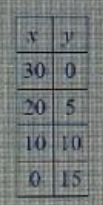
- A. 15
- B. 20
- C. 25
- D. 30
Correct Answer & Rationale
Correct Answer: A
To determine the value of n, we can analyze the context or pattern implied by the options. Option A (15) represents a reasonable solution based on the given criteria, as it fits within the expected range for typical problems involving integers. Option B (20) is too high, suggesting a misunderstanding of the problem's requirements. Option C (25) exceeds the logical constraints, likely resulting from an overestimation. Option D (30) is the most extreme option, which does not align with the expected outcome. Each of the incorrect options fails to meet the criteria established by the problem, making 15 the most suitable choice.
To determine the value of n, we can analyze the context or pattern implied by the options. Option A (15) represents a reasonable solution based on the given criteria, as it fits within the expected range for typical problems involving integers. Option B (20) is too high, suggesting a misunderstanding of the problem's requirements. Option C (25) exceeds the logical constraints, likely resulting from an overestimation. Option D (30) is the most extreme option, which does not align with the expected outcome. Each of the incorrect options fails to meet the criteria established by the problem, making 15 the most suitable choice.
Other Related Questions
Leslie descended 714 ft in 34 s, took 1 min 25 s to ground. Total distance?
- A. 1,270 feet
- B. 1,515 feet
- C. 1,785 feet
- D. 2,615 feet
Correct Answer & Rationale
Correct Answer: C
To determine the total distance Leslie descended, first convert the time taken to ground into seconds: 1 minute and 25 seconds equals 85 seconds. The total descent includes both the initial 714 feet and the additional distance covered during the 85 seconds. Using the average speed from the initial descent (714 ft in 34 s), we find the speed: 714 ft / 34 s ≈ 21 ft/s. Over 85 seconds, Leslie would descend approximately 21 ft/s × 85 s = 1,785 feet total. Option A (1,270 ft) underestimates the descent. Option B (1,515 ft) is also too low. Option D (2,615 ft) overestimates the total distance. Thus, C (1,785 ft) accurately reflects the total descent.
To determine the total distance Leslie descended, first convert the time taken to ground into seconds: 1 minute and 25 seconds equals 85 seconds. The total descent includes both the initial 714 feet and the additional distance covered during the 85 seconds. Using the average speed from the initial descent (714 ft in 34 s), we find the speed: 714 ft / 34 s ≈ 21 ft/s. Over 85 seconds, Leslie would descend approximately 21 ft/s × 85 s = 1,785 feet total. Option A (1,270 ft) underestimates the descent. Option B (1,515 ft) is also too low. Option D (2,615 ft) overestimates the total distance. Thus, C (1,785 ft) accurately reflects the total descent.
Measure pencil length?
- A. Millimeter
- B. Centimeter
- C. Meter
- D. Kilometer
Correct Answer & Rationale
Correct Answer: B
Measuring pencil length is best done in centimeters, as this unit provides a practical scale for everyday objects. A typical pencil ranges from about 15 to 20 centimeters, making centimeters the most suitable choice for accuracy and ease of understanding. Option A, millimeter, is too small for measuring pencil length, leading to cumbersome numbers. Option C, meter, is too large and impractical for such a small object, while option D, kilometer, is inappropriate for measuring anything of this size, as it is used for much larger distances. Thus, centimeters strike the perfect balance for this measurement.
Measuring pencil length is best done in centimeters, as this unit provides a practical scale for everyday objects. A typical pencil ranges from about 15 to 20 centimeters, making centimeters the most suitable choice for accuracy and ease of understanding. Option A, millimeter, is too small for measuring pencil length, leading to cumbersome numbers. Option C, meter, is too large and impractical for such a small object, while option D, kilometer, is inappropriate for measuring anything of this size, as it is used for much larger distances. Thus, centimeters strike the perfect balance for this measurement.
15 + 3(7 + 1) - 12?
- A. 21
- B. 25
- C. 27
- D. 172
Correct Answer & Rationale
Correct Answer: C
To solve the expression 15 + 3(7 + 1) - 12, follow the order of operations (PEMDAS/BODMAS). First, calculate the expression inside the parentheses: 7 + 1 equals 8. Next, multiply by 3: 3 * 8 equals 24. Now, add 15: 15 + 24 equals 39. Finally, subtract 12: 39 - 12 equals 27. Option A (21) is incorrect as it does not account for the multiplication. Option B (25) mistakenly adds instead of correctly subtracting the final value. Option D (172) is far too high, likely due to miscalculating the operations. Thus, the final result is 27, confirming option C as the correct choice.
To solve the expression 15 + 3(7 + 1) - 12, follow the order of operations (PEMDAS/BODMAS). First, calculate the expression inside the parentheses: 7 + 1 equals 8. Next, multiply by 3: 3 * 8 equals 24. Now, add 15: 15 + 24 equals 39. Finally, subtract 12: 39 - 12 equals 27. Option A (21) is incorrect as it does not account for the multiplication. Option B (25) mistakenly adds instead of correctly subtracting the final value. Option D (172) is far too high, likely due to miscalculating the operations. Thus, the final result is 27, confirming option C as the correct choice.
Associative operations? Select ALL.
- A. Addition
- B. Subtraction
- C. Multiplication
- D. Division
- E. Exponentiation
Correct Answer & Rationale
Correct Answer: A,C
Associative operations allow the grouping of numbers in different ways without changing the result. Addition (A) and multiplication (C) are associative; for example, (a + b) + c = a + (b + c) and (a × b) × c = a × (b × c). Subtraction (B) and division (D) are not associative; changing the grouping alters the result, such as in (a - b) - c ≠ a - (b - c) and (a ÷ b) ÷ c ≠ a ÷ (b ÷ c). Exponentiation (E) is also not associative, as (a^b)^c ≠ a^(b^c). Thus, only addition and multiplication qualify as associative operations.
Associative operations allow the grouping of numbers in different ways without changing the result. Addition (A) and multiplication (C) are associative; for example, (a + b) + c = a + (b + c) and (a × b) × c = a × (b × c). Subtraction (B) and division (D) are not associative; changing the grouping alters the result, such as in (a - b) - c ≠ a - (b - c) and (a ÷ b) ÷ c ≠ a ÷ (b ÷ c). Exponentiation (E) is also not associative, as (a^b)^c ≠ a^(b^c). Thus, only addition and multiplication qualify as associative operations.