0.034÷(10)^(-1) =
- A. 0.0034
- B. 0.034
- C. 0.34
- D. 3.4
Correct Answer & Rationale
Correct Answer: C
To solve 0.034 ÷ (10)^(-1), we first recognize that (10)^(-1) is equivalent to 1/10 or 0.1. Dividing by 0.1 is the same as multiplying by 10. Therefore, 0.034 ÷ 0.1 equals 0.034 × 10, which results in 0.34. Option A (0.0034) misinterprets the division, mistakenly moving the decimal too far left. Option B (0.034) fails to account for the division by 0.1, leaving the original number unchanged. Option D (3.4) incorrectly multiplies instead of dividing, moving the decimal point too far right. Thus, the only accurate calculation leads to 0.34.
To solve 0.034 ÷ (10)^(-1), we first recognize that (10)^(-1) is equivalent to 1/10 or 0.1. Dividing by 0.1 is the same as multiplying by 10. Therefore, 0.034 ÷ 0.1 equals 0.034 × 10, which results in 0.34. Option A (0.0034) misinterprets the division, mistakenly moving the decimal too far left. Option B (0.034) fails to account for the division by 0.1, leaving the original number unchanged. Option D (3.4) incorrectly multiplies instead of dividing, moving the decimal point too far right. Thus, the only accurate calculation leads to 0.34.
Other Related Questions
Fred, Norman, and Dave own a total of 128 comic books. If Dave owns 44 of them, what is the average (arithmetic mean) number of comic books owned by Fred and Norman?
- A. 42
- B. 44
- C. 46
- D. 48
Correct Answer & Rationale
Correct Answer: A
To find the average number of comic books owned by Fred and Norman, first determine how many comic books they collectively own. Since Dave has 44 comic books, subtract this from the total: 128 - 44 = 84. Fred and Norman together own 84 comic books. To find the average for the two, divide this number by 2: 84 ÷ 2 = 42. Option B (44) incorrectly assumes Fred and Norman have more than they actually do. Option C (46) miscalculates the average by not considering the correct total for Fred and Norman. Option D (48) similarly overestimates their combined ownership. Thus, the average is accurately calculated as 42.
To find the average number of comic books owned by Fred and Norman, first determine how many comic books they collectively own. Since Dave has 44 comic books, subtract this from the total: 128 - 44 = 84. Fred and Norman together own 84 comic books. To find the average for the two, divide this number by 2: 84 ÷ 2 = 42. Option B (44) incorrectly assumes Fred and Norman have more than they actually do. Option C (46) miscalculates the average by not considering the correct total for Fred and Norman. Option D (48) similarly overestimates their combined ownership. Thus, the average is accurately calculated as 42.
A salesperson's commission is k percent of the selling price of a car. Which of the following represents the commission, in dollars, on 2 cars that sold for $14,000 each?
- A. 280k
- B. 28,000k
- C. 14,000/(100+2k)
- D. (28,000+k)/100
Correct Answer & Rationale
Correct Answer: A
To determine the commission on 2 cars sold for $14,000 each, first calculate the total selling price: 2 × $14,000 = $28,000. The commission, being k percent of this total, is expressed as (k/100) × $28,000, which simplifies to $280k. Option B, 28,000k, incorrectly suggests the commission is k percent of the total without dividing by 100. Option C, 14,000/(100+2k), misrepresents the calculation entirely by altering the formula. Option D, (28,000+k)/100, incorrectly adds k to the total selling price before calculating the percentage, which is not aligned with commission calculation principles.
To determine the commission on 2 cars sold for $14,000 each, first calculate the total selling price: 2 × $14,000 = $28,000. The commission, being k percent of this total, is expressed as (k/100) × $28,000, which simplifies to $280k. Option B, 28,000k, incorrectly suggests the commission is k percent of the total without dividing by 100. Option C, 14,000/(100+2k), misrepresents the calculation entirely by altering the formula. Option D, (28,000+k)/100, incorrectly adds k to the total selling price before calculating the percentage, which is not aligned with commission calculation principles.
3√2- 2/(√2) =
- A. 2√2
- B. √2
- C. 3
- D. 4
Correct Answer & Rationale
Correct Answer: A
To solve the expression \( 3\sqrt{2} - \frac{2}{\sqrt{2}} \), we first simplify \( \frac{2}{\sqrt{2}} \). This can be rewritten as \( \frac{2\sqrt{2}}{2} = \sqrt{2} \). Thus, the expression becomes \( 3\sqrt{2} - \sqrt{2} \), which simplifies to \( 2\sqrt{2} \). Option B (\( \sqrt{2} \)) is incorrect as it does not account for the subtraction from \( 3\sqrt{2} \). Option C (3) is incorrect because it misrepresents the value obtained after simplification. Option D (4) is also incorrect, as it does not relate to the expression at all.
To solve the expression \( 3\sqrt{2} - \frac{2}{\sqrt{2}} \), we first simplify \( \frac{2}{\sqrt{2}} \). This can be rewritten as \( \frac{2\sqrt{2}}{2} = \sqrt{2} \). Thus, the expression becomes \( 3\sqrt{2} - \sqrt{2} \), which simplifies to \( 2\sqrt{2} \). Option B (\( \sqrt{2} \)) is incorrect as it does not account for the subtraction from \( 3\sqrt{2} \). Option C (3) is incorrect because it misrepresents the value obtained after simplification. Option D (4) is also incorrect, as it does not relate to the expression at all.
Valentina attends several meetings each day, as shown in the table below. Which of the following describes this pattern?
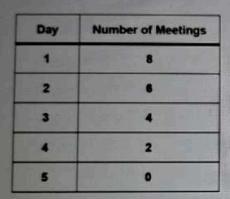
- A. The number of meetings increases by the same amount each day.
- B. The number of meetings decreases by the same amount each day.
- C. Each day, the number of meetings increases by the same percent over the previous day's number of meetings.
- D. Each day, the number of meetings decreases by the same percent over the previous day's number of meetings.
Correct Answer & Rationale
Correct Answer: C
The pattern of Valentina's meetings indicates that the number of meetings increases by a consistent percentage each day, reflecting exponential growth. This is evident when comparing the daily totals, which show a proportional rise rather than a fixed increase. Option A is incorrect because it suggests a linear growth, where the same number of meetings is added daily, which is not observed. Option B implies a consistent decrease, which contradicts the observed increase in meetings. Option D also misrepresents the data by suggesting a percentage decrease, which does not align with the trend of increasing meetings.
The pattern of Valentina's meetings indicates that the number of meetings increases by a consistent percentage each day, reflecting exponential growth. This is evident when comparing the daily totals, which show a proportional rise rather than a fixed increase. Option A is incorrect because it suggests a linear growth, where the same number of meetings is added daily, which is not observed. Option B implies a consistent decrease, which contradicts the observed increase in meetings. Option D also misrepresents the data by suggesting a percentage decrease, which does not align with the trend of increasing meetings.